



Unsolved Ohio reports from public court records, official registries, documented media reports, on-record interviews, and open-source analysis using Artificial Intelligence and Social Network Analysis. A documented association between two people is a starting point for investigation — never proof of a crime — and naming anyone as a subject of investigative interest is not an accusation of guilt; any person not convicted of a specific crime is presumed innocent. This is an educational publication and not legal advice; read our full sourcing standard, presumption-of-innocence framing, and corrections policy in our Disclaimer.

The Case of Amanda Ward-Romine
In the summer of 2013, the atmosphere over Springfield hung thick and motionless. It was a physical weight pressing down upon the limestone facades and endless asphalt, trapping the summer heat and the town’s secrets in equal measure. Within this geography — a rust-belt landscape suspended between natural beauty and quiet decay — the tragedy of Amanda Lyn Ward-Romine began its slow, inevitable unfolding. It was not a sudden burst of inexplicable violence, but rather the grinding culmination of a life lived at the margins.
To comprehend her vanishing, one must look past the singular date of her departure and study the ecosystem that nurtured her, as well as the men who orbited her. It was a world illuminated by the neon flicker of tavern signs, blurred by the chemical haze of opioids, crack cocaine, and heroin. Yet, more destructive than narcotics was the brutal, rhythmic cycle of domestic warfare. Here, a police report is rarely a resolution; it is merely a chapter in a serialized, escalating narrative that everyone witnesses, but no one interrupts until the final, blank page is turned.
Standing just 5 feet 2 inches and weighing no more than 130 pounds, Amanda was a petite figure constantly navigating a terrain governed by larger, more perilous forces. She was born on February 24, 1983, a child of the Ohio flatlands who grew into a woman of striking, if fragile, presence. She had made her living as an exotic dancer, a profession demanding a pantomime of vitality even when the spirit is wholly exhausted — and she wore the map of her existence etched directly into her skin.
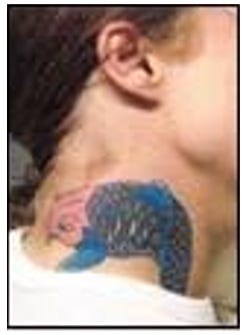
Upon the right side of her neck swam a vividly colored koi fish. In Eastern mythology, the koi is revered for its endurance, swimming against the current to scale waterfalls and transform into a dragon. It is a monument to perseverance. For Amanda, adversity was a constant current. Her feet bore the names of her earthly attachments, anchors that dragged her downward rather than permitting ascent: “Danny,” flanked by stars, marked her right foot; “Romine” claimed her left. They were less decorations than brands of ownership, demarcating both her path and her inescapable destination.
Her legal history, a paper trail of minor infractions and steep descents, sketched the portrait of a woman slipping silently through society’s widening cracks. The unraveling began innocuously in the summer of 2002, with a traffic stop in Huber Heights for driving without a license. But the trajectory steepened drastically. By 2004, amid a failed first marriage, residential instability, and the encroaching shadow of the region’s drug epidemic, she was indicted in Montgomery County for possession of crack cocaine. The court, perhaps registering the youth behind the fifth-degree felony, granted her “Treatment in Lieu of Conviction” in December of that year. It was a momentary mercy, a brief opportunity to rewrite her narrative.
But addiction is a relentless author.
By May of 2005, she had violated the terms of her probation. The court’s leniency evaporated, replaced by the rigid arithmetic of the penal system, and in September she was sentenced to the Marysville Women’s Correctional Facility for trafficking. This incarceration was pivotal. It excised her status as an ordinary citizen, affixing the permanent label of “felon” — a designation that would build a wall of skepticism between her and the authorities sworn to protect her. Later, when she evaporated into the Ohio ether, this history would provide a convenient rationale for inaction, a dismissal of “lifestyle” that squandered precious investigative hours.
Amanda was a woman accustomed to dancing on the precipice. Marysville had introduced her to other Springfield women serving time for narcotics — women who, upon their release, would soon meet premature deaths or simply vanish. In 2009, after completing a hard stretch behind bars, she stepped back out into a landscape densely populated by opportunists and dangerous men.
Chaos appeared to run deep in the Ward bloodline. Between Amanda and her two sisters, a revolving door of dysfunction turned continuously, producing a combined eleven marriages, including one to a registered sex offender. Yet Amanda’s own romantic entanglements constituted a distinct, volatile element.
At the center of her life lay a twisted triangle involving her estranged husband, Daniel “Danny” Michael Romine, and another dancer — an addict whispered to be far more perilous than a mere rival, a woman some in that world quietly suspected of worse.

When Amanda vanished, her paper trail was swiftly swallowed by obfuscation. Her Facebook account had gone dark months prior, or so it seemed. The official missing-person report was a web of glaring inconsistencies: mismatched dates, conflicting hours, and phantom locations that simply defied logic. Adding to the tumult were the public broadcasts of Aliya, one of Amanda's sisters, whose myriad theories and public accusations thickened the atmosphere of suspicion.
At the epicenter of this volatility stood Whitie's Tavern, a family-run establishment owned by Danny's father, where Danny himself tended bar.
It was a magnet for disorder — a place regularly subjected to police attention for illegal gambling machines, plagued by sudden violence, and echoing with the gunfire that precipitated inevitable arrests. The tavern harbored an additional complication: it employed a second woman named Amanda. This other Amanda was a frequent presence at Danny’s residence, weaving herself into the domestic wreckage and casting another shadow over a narrative already defined by blur and contradiction.
Then came the account of a midnight ride. A terrified informant led Springfield Police detectives southward toward Kentucky, unspooling a chilling account of a drug run with Danny and his associates. They had not merely been hauling narcotics, the informant claimed; they carried a body, believed to be Amanda’s. But as swiftly as the revelation surfaced, the informant fractured, completely recanting the statement.
Was it fear, or was a hidden hand ensuring his silence?
The answer might lie in the company Danny kept. According to witness accounts, Amanda’s estranged husband was no mere street-level hustler; he was said to be supplying narcotics directly to figures inside local law enforcement and city government. In a town where the arbiters of the law might themselves be compromised, who could be trusted to search for a missing woman?
Further complicating the record was the matter of Amanda’s brother, who resided next door to Whitie’s Tavern in a property owned by the Romine family. Shortly after Amanda’s disappearance, her brother was abruptly evicted. Soon after, neighbors spoke of late-night digging, frantic repairs, and work in a crawl space — all executed by Danny. Rumors also swirled around the Avondale Avenue home where Amanda and Danny had lived, focusing on a backyard fire pit and the precise clothing Amanda had last worn. Depending upon the storyteller, Amanda was seen wearing three entirely different outfits on the day she vanished.
The count of the lost did not cease with Amanda’s departure. In a quiet, terrifying escalation, several women acquainted with Amanda would eventually turn up dead or missing.
And then the record delivered its most damning line. Two months after Amanda vanished, a tenant renting an apartment connected to Danny’s property reported that he had been ordered to vacate instantly so that “work” could be done in a small crawl space beneath the floor. When the Ohio Bureau of Criminal Investigation later swept the darkness beneath those boards, investigators recovered hair and skin cells that matched Amanda’s DNA.
Whatever secrets Danny harbored regarding his wife’s final days, he carried them into the dark. Two years after Amanda vanished into the thick Springfield air, Danny was found dead in the Avondale home. The heavy door on the truth was pulled permanently shut.
Amanda Ward-Romine’s story is a labyrinth of addiction, compromised institutions, vanished women, and a husband who took his answers to the grave — a tragedy resting quietly in the shadows, waiting for a light that has yet to arrive.
Over the coming weeks, we are going to open that file, page by page. This is Case 3 of Unsolved Ohio.
This prologue is the opening of Case 3. The full case file — Amanda’s life, the timeline of her final days, the institutional record, and the people who moved through her world — publishes soon. Subscribe now to follow the investigation from the beginning.