



This is part of the Amber Whitmer case file — start at the hub: Amber Marie Whitmer.
Unsolved Ohio reports from public court records, official registries, documented media reports, on-record interviews, and open-source analysis using Artificial Intelligence and Social Network Analysis. A documented association between two people is a starting point for investigation — never proof of a crime — and naming anyone is not an accusation of guilt; any person not convicted of a specific crime is presumed innocent. This is an educational publication and not legal advice; read our full sourcing standard, presumption-of-innocence framing, and corrections policy in our Disclaimer.
“A man’s life choice — his virtue or his vice — does not vanish when his pulse stops. It stays in the wood of the house, it alters the soil of the garden, and it shapes the bones of the children who must live in the shadow of what he decided to be.”
— John Steinbeck, East of Eden (1952)
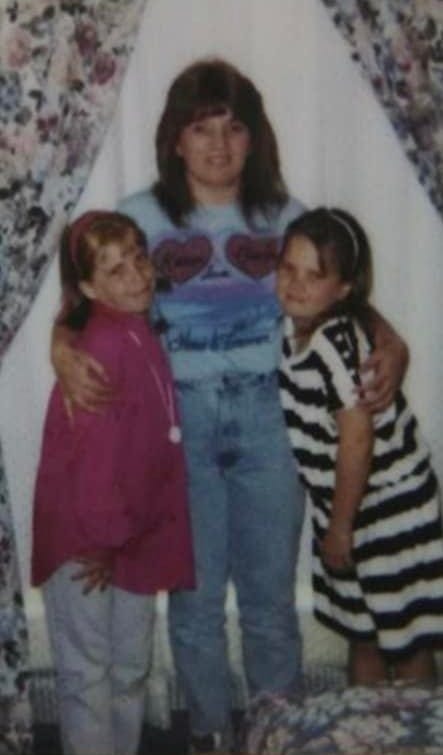
The Making of Karen Diana Whitmer
The reconstruction of a single human life from the dry remains of public registries is an exercise in paleontology. One must take the calcified fragments of births, marriages, and divorces and attempt to flesh out the warm, breathing creature that once moved through the world. The life of Karen Diana Whitmer is a quiet, mid-century tapestry woven across the vast, indifferent landscape of the American continent — a story marked by the search for domestic warmth, the sudden, sharp interruptions of tragedy, and the inevitable, repetitive cycle of human coupling and dissolution.
To observe her life is to observe a series of quiet, intensely personal moments played out against the noisy, historic backdrop of late-twentieth-century America: a world of cold-war standoffs, televised tragedies, and the fleeting, synthetic melodies of popular radio.
To understand the trajectory of Karen Diana Whitmer, one must first examine the soil from which her mother, Delores Elizabeth Whitmer, emerged. Delores was born on May 17, 1949, in Columbus, Ohio, during the robust post–World War II manufacturing boom. Her parents, Charles Edward Whitmer and Gladys May Moore (later known as Gladys Davis), had established a sprawling household in Columbus that eventually grew to include ten children: Lee, Don, Bert, Becky, George, Liz, Joanne, Jeannie, Kathy, and Delores.
The family was anchored in the blue-collar optimism of the era, where factory smoke symbolized prosperity and a steady wage could secure a piece of the American dream. Yet by the mid-1960s, the gravitational pull of the West Coast proved irresistible to the young Delores. Leaving the industrial valleys of Ohio behind, she drifted to Los Angeles County, California, where the promise of sun, sand, and social transformation was at its peak.
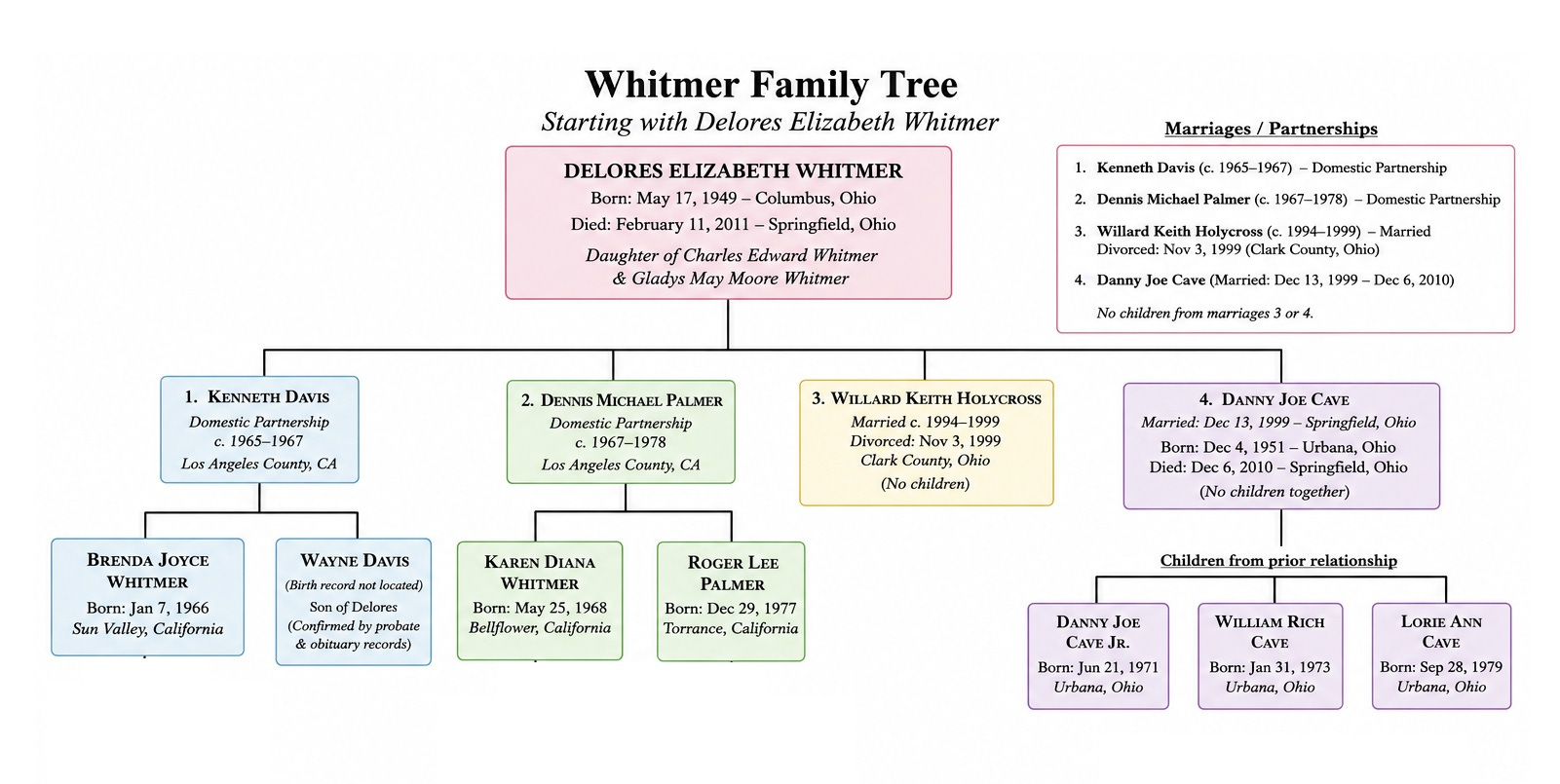
In California, Delores entered two domestic partnerships that would define the next generation of the Whitmer family.
In 1966, Delores landed in Sun Valley, California, a gritty, hardworking, industrial engine of the eastern San Fernando Valley. Unlike the picture-perfect, white-picket-fence suburban imagery often associated with neighboring areas like Burbank or North Hollywood, Sun Valley had a raw, blue-collar identity shaped by its geography, its heavy industries, and the post-war transportation boom.
At the age of 17, Delores entered the first of two partnerships — with Kenneth Davis, which produced two children: Brenda Whitmer and Wayne Davis, born in Sun Valley, California. For reasons unknown, Delores relocated 45 miles south, down the I-5, to Bellflower, California. In 1968, Bellflower was in the middle of a major identity shift, completing its transition from a rural, dairy-farming community into a bustling, post–World War II working-class suburb of Los Angeles.
At the age of 19, Delores entered the second partnership, with Dennis Michael Palmer, which brought Karen Diana Whitmer and her younger brother, Roger Lee Palmer, into the world. Karen Diana Whitmer entered the world on Saturday, May 25, 1968, in the suburban enclave of Bellflower, California.
Karen was born into a domestic landscape already complicated by informal unions and the transient nature of Southern California’s suburban sprawl.
On the day of Karen’s birth, the air in Southern California was warm, smelling of dry grass, coastal exhaust, and the sea breeze filtering through the orange groves. Across the country and the world, the atmosphere was changing. A little over a month earlier, on April 4, 1968, Dr. Martin Luther King Jr. had been assassinated in Memphis, Tennessee; on June 5, 1968, only 30 miles from Bellflower, Robert F. Kennedy would be assassinated in Los Angeles.
Small color, the day Karen was born: on May 12, 1968, a man no one had heard of, Reggie Dwight of Pinner, assumed the stage name “Elton John.” By May 25, The Graduate, with Dustin Hoffman and Anne Bancroft, was the number-one movie in America, and “Tighten Up” by Archie Bell & the Drells was the number-one song. On May 27, a 22-year-old enlisted in the Texas Air National Guard after graduating from Yale University; his name was George W. Bush.
The winter of 1985 was cold, both literally and geopolitically. Ronald Reagan was president, the dominant radio soundtrack was Madonna’s “Like a Virgin,” and Eddie Murphy, as the wisecracking Detroit detective Axel Foley, starred in the number-one movie in America, Beverly Hills Cop.
It was here, in Circleville, Ohio, that Delores and Dennis Palmer had moved the entire family — Brenda, Wayne, Karen, and Roger — from Bellflower, California. This was a small town surrounded by corn fields, yet a prosperous community with good jobs, good incomes, and stable housing.
By 1985, the population of Circleville was approximately 11,700. DuPont operated a massive chemical and plastics manufacturing facility. A General Electric lamp plant maintained a prominent manufacturing footprint. Circleville was home to a massive glass plant dedicated to the television industry, operated by RCA. PPG operated a chemical and resin plant that produced automotive and industrial paints. As the seat of Pickaway County, Circleville’s economy was deeply intertwined with Midwest commodity grain farming; the towering Cargill grain elevator served as a central hub for the area’s agricultural output.
However, only 60 miles south on State Route 23 was Portsmouth, Ohio. That town of 18,000 saw an explosion of “pain clinics” that operated almost exclusively to prescribe narcotics — specifically OxyContin — for cash, often without legitimate physical exams or medical records. At its peak, Portsmouth had among the most pill mills per capita of any city in the country. And in 2005, only 20 miles south of Circleville on that same stretch of Route 23, Chillicothe, Ohio — a city of roughly 22,000 — would become the base for a local public defender turned private attorney who operated a human-trafficking and prostitution ring tied to a major drug-distribution operation, a case associated with more than 17 women dead or missing. That pattern would soon be echoed in Circleville with the Boysel, Crosby, and Whitmer families.
It was 1985 when Delores’s third child, Karen, would meet a man named Curtis Boysel.

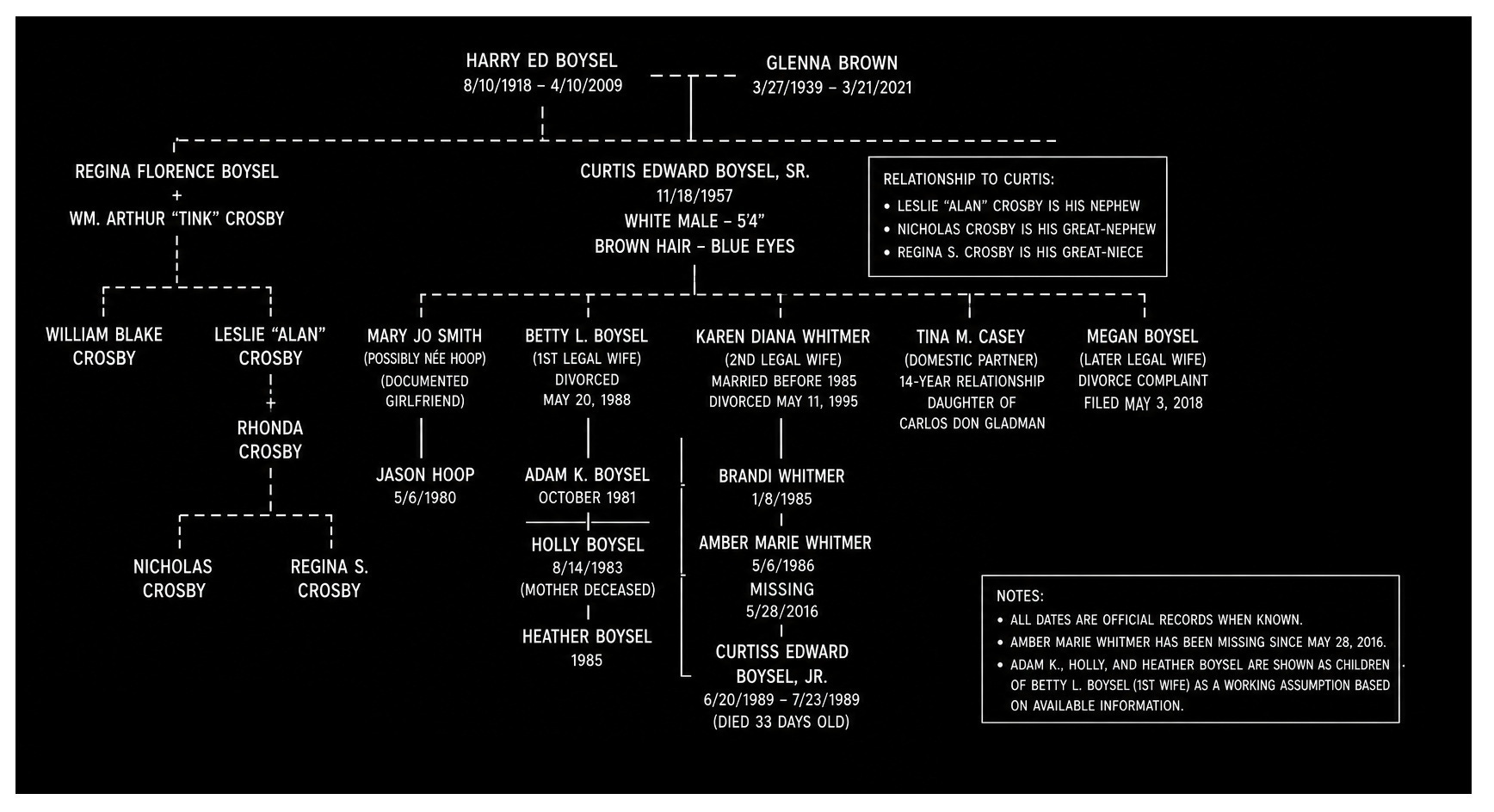
Born on November 18, 1957, Curtis was the son of Harry Ed Boysel and Glenna (Brown) Boysel, a maternal anchor residing in Circleville. He was surrounded by a large, complex web of siblings and half-siblings, including the Crosby family:
Full biological siblings: Sylvia (Boysel) Chadbourne, Danny Boysel, and Regina (Boysel) Crosby.
Step / half-siblings: Penny Towne, Terri Swisher/Brown, Dwayne Whalen, Dwight Heise, Darrin Heise, Tracy Brown, Darlene Manbeavers, and Virginia “Dude” Shaffer.
Curtis was not yet a criminal mastermind of grand ambition; he was a man caught in the chaotic, low-level churn of the local justice system. His primary residence was established at 381 Walnut Street, Circleville. His early paper trail reveals a disorganized life characterized by traffic infractions and public disorder.
Curtis’s first domestic ties were already fracturing by the late 1980s. His marriage to Betty L. Boysel dissolved after a bitter courtroom battle initiated on February 25, 1988 (Case 1988DV0069), with the decree finalized on May 20, 1988.
Here was Curtis Boysel, living in Pickaway County with a wife, Betty, and four children: Jason Hoop (born 1980), Adam K. Boysel (born 1981), Holly Boysel (born 1983), and Heather Boysel (born 1985).
Karen’s introduction to the Boysel and Crosby family
Where does a twenty-seven-year-old married man, shadowed by legal infractions and four children, intersect with a sixteen-year-old girl?
In the growing industrial town of Circleville, the geography of romance is severely limited, and the boundaries protecting the young are notoriously porous. They did not meet in the sanitized halls of a high school or the innocent confines of a local dance. Karen and Curtis crossed paths in the blurred, adult spaces of the Ohio Rust Belt — perhaps under the harsh fluorescent lights of a late-night diner off Route 23, or on the sagging wooden porch of a mutual acquaintance on Walnut Street, where the heavy summer air smelled of stale beer and exhaust. Karen Diana Whitmer, born in May 1968, was merely sixteen, but she possessed the naive, reckless gravity of a girl eager to outrun her own youth. Curtis, more than a decade her senior, offered the illusion of escape and the dangerous allure of adult permanence.
And then there was the matriarch, Delores. Did Delores Whitmer know about the twenty-seven-year-old man lingering in the shadows of her teenage daughter’s life? The records, read alongside her own history, point to yes — and to a passive, fatalistic acceptance of it.
In the Whitmer household, outrage over such a severe age gap was a moral luxury they could not afford. Delores looked at her sixteen-year-old daughter and saw an unbroken mirror reflecting her own past. Decades earlier, in the working-class sprawl of Southern California, Delores herself had become a mother at sixteen when she gave birth to Karen’s older sister, Brenda. She dropped out of school, eventually left the first man — the father of her first two children, Brenda and Wayne — then lived with the father of her next two, Karen and Roger, before they all moved to Circleville. To Delores, sixteen was not the fragile precipice of childhood; it was the abrupt, expected arrival of womanhood. A twenty-seven-year-old man like Curtis was simply a reality of the landscape. The generational pattern was cyclical, spinning like a rusted wheel.
A problem with the math
What follows is a reconstruction built from public birth, marriage, and divorce records. No one named here was ever charged with statutory rape, bigamy, or adultery in connection with any of it, and nothing here is a finding that he committed a crime. We lay out what the documents and their dates suggest; everyone named is presumed innocent.
Simple math indicates a problem with subtraction and addition. Curtis married Betty in 1978; they divorced in 1988. The records are silent on any marriage certificate between Karen and Curtis; however, Clark County, Ohio, probate-court records show a divorce decree between Karen and Curtis in 1995 (with children).
The children of Curtis and Betty were born in 1980, 1981, 1983, and 1985. Karen and Curtis’s children were born in 1985 (Brandi), 1986 (Amber), and a son who died one month after birth in 1989 (Curtis Edward Boysel Jr.).
While Karen gave birth in 1985 and 1986, Curtis was still married to Betty. In 1985, Brandi Whitmer was born only days apart from when Betty gave birth to Heather Boysel — which raises a further arithmetic problem, the subtraction of nine months to the point of conception. On these dates, it is possible that Heather and Brandi were conceived within days of each other.

Thus the foundation of the Whitmer family was laid in silence. Out of this heavy union, the children arrived in rapid succession. Brandi Whitmer was born in the deep winter, on January 8, 1985, forcing the teenage Karen into sudden motherhood, while Curtis remained absent from the birth registry. The following spring, on May 6, 1986, Amber Marie Whitmer was born into the same volatile core. Again, Curtis was absent from the official record.
In the bureaucratic reality of vital records, the mathematics of their union told a more complicated story. When Brandi and Amber were born, Karen was sixteen and seventeen. Curtis, born in 1957, was a grown man — and to declare paternity on those early registries would have raised the prospect of statutory prosecution, as well as the questions of bigamy and adultery that follow below.
Under Ohio Revised Code § 2919.01, bigamy is a first-degree misdemeanor: it occurs when a person marries or continues to cohabit with someone in Ohio while knowing they are still legally married to another. The statute provides a defense if the original spouse was continuously absent for the five years immediately preceding the second marriage and was not known to be alive — but Betty was alive and bearing children during this period. A first-degree misdemeanor in Ohio is punishable by up to six months in jail and a fine, and a bigamous marriage is void ab initio — legally invalid from the moment it occurs. Criminal intent is required; a genuine belief that a prior dissolution was finalized can serve as a defense to the criminal charge, though the later marriage remains void.
Adultery, by contrast, is not a crime in Ohio; it is strictly a civil matter. Under ORC § 3105.01 it is one of several fault-based grounds for divorce, alongside bigamy, extreme cruelty, and habitual drunkenness. To claim it, the filing spouse must provide clear and convincing evidence. Because Ohio is an equitable-distribution state, adultery itself does not automatically skew the division of assets or custody; a court can adjust asset division only where marital funds were dissipated to facilitate an affair, and custody is typically affected only where the affair directly exposed children to harm.
Again, the marriage math is uneven. The marriage of Curtis and Karen took place sometime after Betty’s 1988 divorce and before the 1995 divorce between Curtis and Karen — most likely between 1989 and 1994. What we do know is that on June 20, 1989, in Circleville, Karen gave birth to a son fathered by Curtis: Curtis Edward Boysel Jr. The promise was tragically short-lived. Only thirty-three days later, on July 23, 1989, in Springfield, Ohio, Curtis Jr. died — a quiet, devastating loss that left an empty crib in a humid Ohio summer and cracked the foundation of the marriage.
The fractures could not be repaired, and on May 11, 1995, the union officially dissolved in a formal divorce — a court document in the probate courts of Clark County, Ohio.
In 1995, at age nine, Amber Whitmer was now separated from her father, yet still a member of a huge, interconnected family: the Boysels, the Crosbys, and the rest of the Whitmer clan.
Karen would go on to marry and establish many domestic partnerships, bringing different men into the household. Between the ages of nine and thirty-one, Amber would encounter a revolving door of stepfathers, stepbrothers, and stepsisters. During this same time, Karen’s brothers and sisters — Amber’s aunts and uncles — would play a pivotal role in shaping Amber’s earliest exposure to drugs and to the street.
The next stage of Amber’s life would revolve around the people and forces gathering on the South Side of Springfield.
If you have information about Amber Whitmer, submit it at unsolvedohio.com — your name is never published without your written permission. We correct factual errors promptly. Full terms: Disclaimer.