



This is Part of the Amber Whitmer case file — start at the hub: Amber Marie Whitmer.
This installment documents the institutional response to Amber Whitmer’s disappearance from public records and on-record statements. Officials are named in connection with documented statements and decisions, not accused of crimes. See our full Disclaimer.
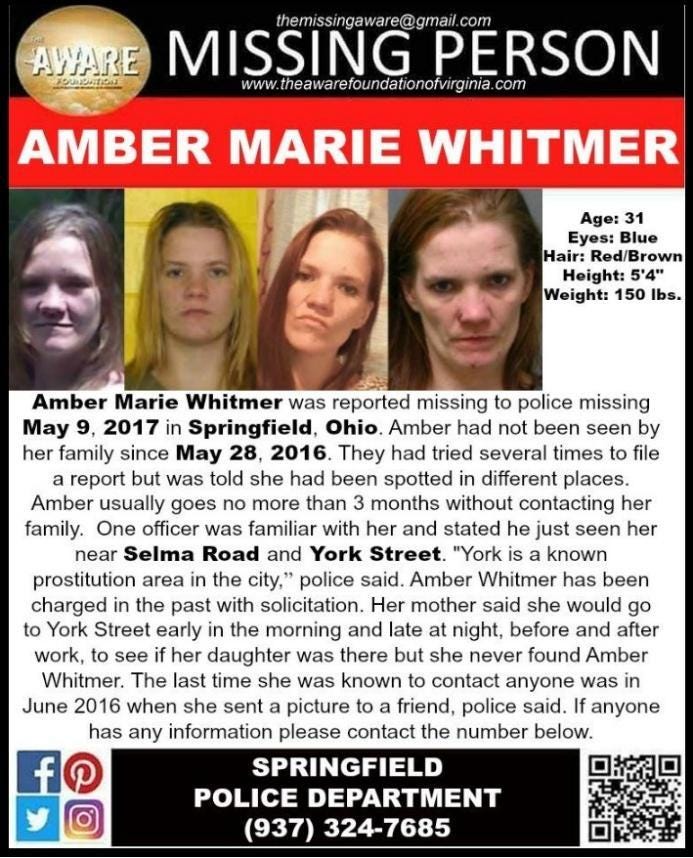
In the weeks and months that followed May 28, 2016, Karen Whitmer’s growing dread was met with systemic indifference. She made repeated attempts to file a missing-person report with the Springfield Police Division, acting on a mother’s intuition and the cold, hard fact of her daughter’s silence. Each time, her concerns were dismissed. The official reason for this inaction encapsulates the institutional bias that would cripple the investigation from its inception. An officer, reportedly familiar with Amber from her presence on the streets, claimed to have recently seen her in her “usual area near Selma Road and York Street.”
This informal, uncorroborated sighting was deemed sufficient to conclude she was not a missing person. The location itself was immediately qualified by law enforcement as a “known prostitution area” — a label that reveals how Amber’s identity was perceived: not as a missing daughter, but as a known prostitute whose transience was to be expected. This was a profound act of confirmation bias. The officer’s cognitive framework, shaped by his professional interactions with Amber, predisposed him to read her absence as behavior consistent with her high-risk lifestyle rather than as evidence of foul play. The label “prostitute” effectively negated the label “missing person.” The officer’s familiarity with her, which should have made the break in her pattern more alarming, instead became the justification for inaction. This value judgment — prioritizing an informal sighting over a mother’s report of a broken communication pattern — became the root cause of the “lost year.”
The Springfield Police Division’s refusal to take a missing-person report was not merely a procedural oversight; it was a value judgment rooted in deep-seated institutional bias. It created a hierarchy of victimhood, in which a woman’s lifestyle could disqualify her from the full protection of the law. Amber Whitmer, in the eyes of the system, was not a citizen who had vanished; she was a “known prostitute” whose absence was treated as an occupational hazard, a predictable consequence of her choices.
This perception, articulated by Lt. Jeffrey Meyer of the Springfield Police Division, reveals the core of the problem: “York is a known prostitution area in the city.” The location of the alleged sighting was immediately used to validate the decision not to investigate. The logic was circular and self-reinforcing: Amber was a prostitute; prostitutes frequented York Street; an officer saw her on York Street; therefore she was not missing — she was simply being a prostitute.
This is a classic example of confirmation bias, the cognitive shortcut in which people favor information that confirms what they already believe. The officer’s belief system, informed by his professional experience, saw Amber not as a daughter with consistent family ties, but as a “career criminal” whose life was inherently unstable. Her mother’s testimony about a broken pattern of communication — a primary red flag in any standard missing-person case — was weighed against the officer’s informal, unlogged, undated sighting. The system chose to believe its own agent over the frantic mother, effectively silencing the one person who knew Amber’s patterns best.
The underlying assumption was that Amber was merely transient, or actively avoiding contact. That conclusion deprioritized her case and treated her disappearance as a matter of choice rather than a potential crime. This de-prioritization is a common experience for marginalized people. Those who engage in sex work, who struggle with addiction, or who carry extensive criminal records are often viewed by law enforcement as unreliable narrators of their own lives. Their vulnerability is misread as a lack of credibility. When they go missing, their absence is often not investigated with the same urgency as that of someone from a more stable, socially accepted background. They are seen as having “assumed the risk,” and their disappearance is treated as a predictable outcome rather than a potential homicide. This systemic disregard creates a hunting ground for predators, who know they can target these individuals with a lower risk of serious law-enforcement scrutiny — and serial offenders rely on exactly that disregard to operate freely.
In this context, the Springfield Police Division’s initial inaction was not just a mistake; it was the fulfillment of a dangerous and discriminatory pattern.
What 365 Days Destroyed
The consequences of this year-long delay were catastrophic and irreversible. In modern forensics, the first 48 hours of a missing-person investigation are considered the most critical — the window in which the most valuable, time-sensitive evidence can be collected. In Amber Whitmer’s case, that window was not just missed; it was willfully ignored for 365 days. The “lost year” was a systematic destruction of the evidentiary trail — a decay caused not by a perpetrator’s cunning, but by institutional neglect.
The primary loss was the digital footprint. In 2016, a person’s life was woven into the digital fabric of their phone and social-media accounts. Collected promptly, that data could have built a precise, undeniable timeline of Amber’s final movements.
Cell-phone location data. Carriers retain cell-tower pings — and sometimes GPS — for a limited time. This could have mapped Amber’s movements on and after May 28, 2016, pinpointed her last known location, shown whether she traveled to Cincinnati as a friend later claimed, and revealed whether her phone moved with anyone else’s after she stopped using it. By May 2017, it was long gone, overwritten by a year of new records.
Social-media activity logs. Platforms like Facebook log the IP address of every login — which could have revealed the physical location from which Amber’s accounts (or someone else’s hands on them) were last accessed, and whether they were used after her last known contact. Deleted direct messages would also be unrecoverable after a year.
Call and text records. A complete log of her calls and texts in the days around her disappearance could have identified the last people she spoke with — the most crucial witnesses to her state of mind, her plans, and her companions. A year later, their memories would be faded and unreliable, if they could be located at all.
Surveillance footage. The modern streetscape is watched by cameras on businesses, ATMs, traffic lights, and homes — any of which could have captured Amber, the vehicle she was in, or the people she was with. But that footage is almost universally stored on a short loop, overwritten every 7 to 30 days. The entire visual record of her last days was erased a dozen times over during the lost year.
Beyond the digital decay, the human element was just as compromised. Witness memories are notoriously fallible and degrade fast. Someone who saw something noteworthy on a Saturday in May 2016 would be highly unlikely to recall it with any accuracy in May 2017. The trail grew cold not just on servers and hard drives, but in the minds of every potential witness. The initial police response thus became the single greatest impediment to solving the case — a vacuum of evidence that may never be filled.
The Door Reopens, a Year Too Late
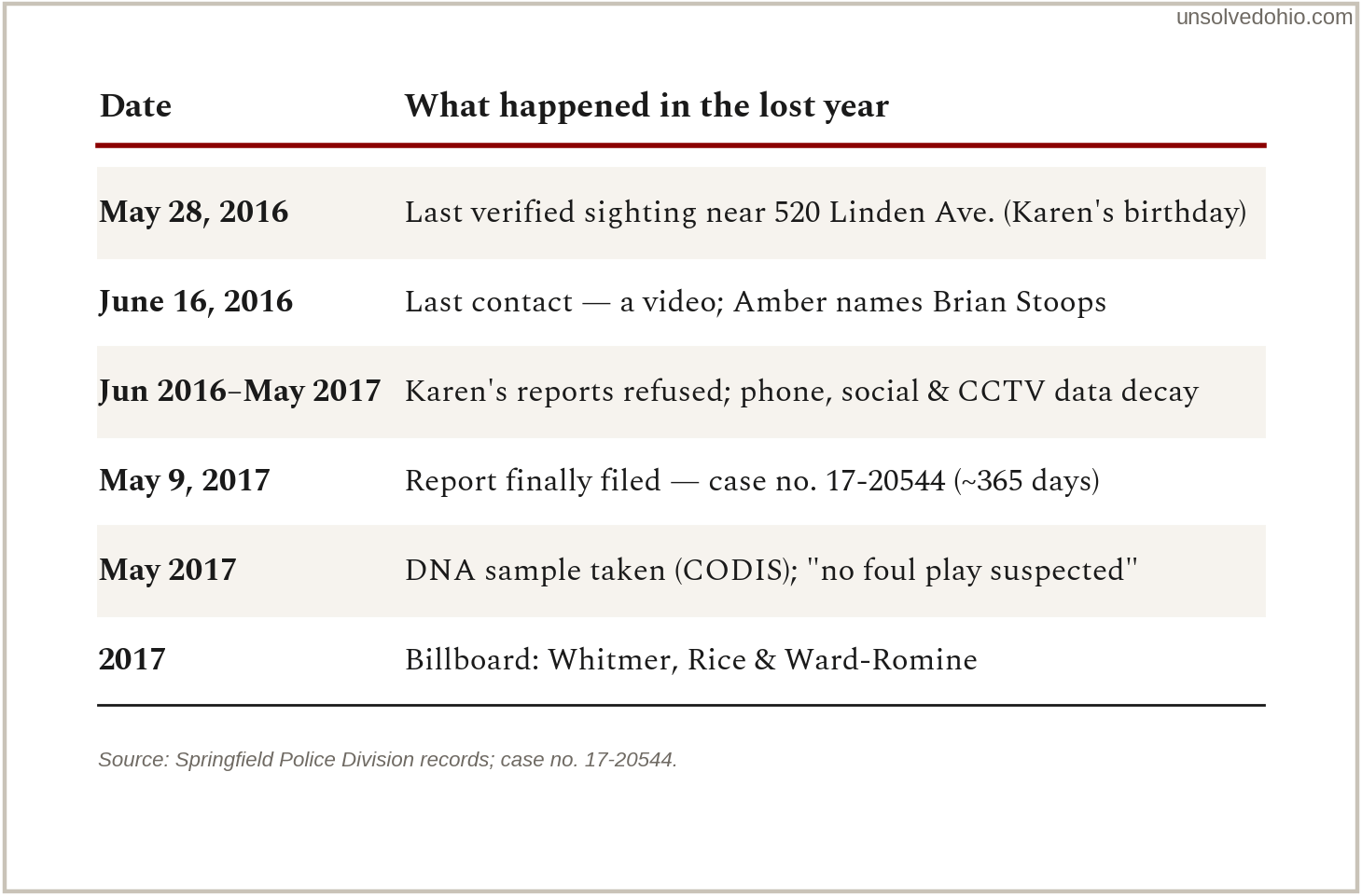
Finally, on May 9, 2017 — nearly 12 months after Amber was last seen — the Springfield Police Division accepted and filed a formal missing-person report, assigning it case number 17-20544. This date marks the official start of the investigation, but it was, in reality, the beginning of a cold case.
The first steps felt tragically belated. In the week that followed, Karen Whitmer was asked to submit a DNA sample — to create a profile for entry into national databases like the Combined DNA Index System (CODIS), which lets investigators cross-reference missing persons against unidentified remains found across the country. It was a standard, necessary step, but one that implicitly acknowledged the high probability that Amber was already deceased.
Police then issued a public statement announcing they were in the “beginning stages” of the investigation. It included a line that, given the circumstances, was particularly hollow: “No foul play was suspected at this time.” That was not a conclusion based on evidence, but a declaration made in a vacuum of evidence — a vacuum the department’s own year-long inaction had created. Without a body, a crime scene, or any of the forensic data that had been allowed to decay, there was no basis on which to suspect or rule out foul play.
To generate leads from a public that was largely unaware a woman had been missing for a year, the police division, with the Clark County Prosecutor’s Office, launched a public-awareness campaign. Billboards went up — including one on Spring Street that featured Amber’s face alongside two other women lost to the streets of Springfield: Michelle L. Rice, missing since 2009, and Amanda Ward-Romine, missing since 2013. The billboard was a stark, public admission of a pattern of failure — a visual testament to how many vulnerable women had vanished from the area over the years.
It was a desperate attempt to find a needle in a haystack, long after the haystack itself had been scattered to the winds.
The next Case File turns to what the record does — and does not — show about the system that was supposed to find her.