



The city of Springfield, Ohio, lies in the flat, gray palm of the Midwest like a discarded tool once gleaming with the grease and sweat of industrial pride, now rusted at the edges, silent where the foundries used to roar. It is a place where seasons do not so much change as settle into the marrow, and where the past does not stay buried in the earth; it seeps up through the limestone, mingling with the mist off Mad River and the stagnant water of the C.J. Brown Reservoir.
In biblical times, a king might tear his robes and cry out to the indifferent heavens when the arch of his house collapsed, lamenting a succession of sorrows so absolute that death felt like a mercy and survival a punishment.
"O my son, my son… if only I had died in your place."
— 2 Samuel 18:33, where King David mourns the death of his rebellious son, Absalom
But King David sat in a palace with cedar and stone. In Springfield, the royalty of misfortune inhabits modest frame houses on Lincoln Park Circle or fading addresses along Main Street, where the crown is made of tin and the only inheritance passed down from parent to child is an astonishing, unrelenting gravity.
This is the story of Angela “Angel” Hall and the Hall family — a lineage scripted not in ink, but in fire, steel, court dockets, and sudden, unaccountable vanishings.
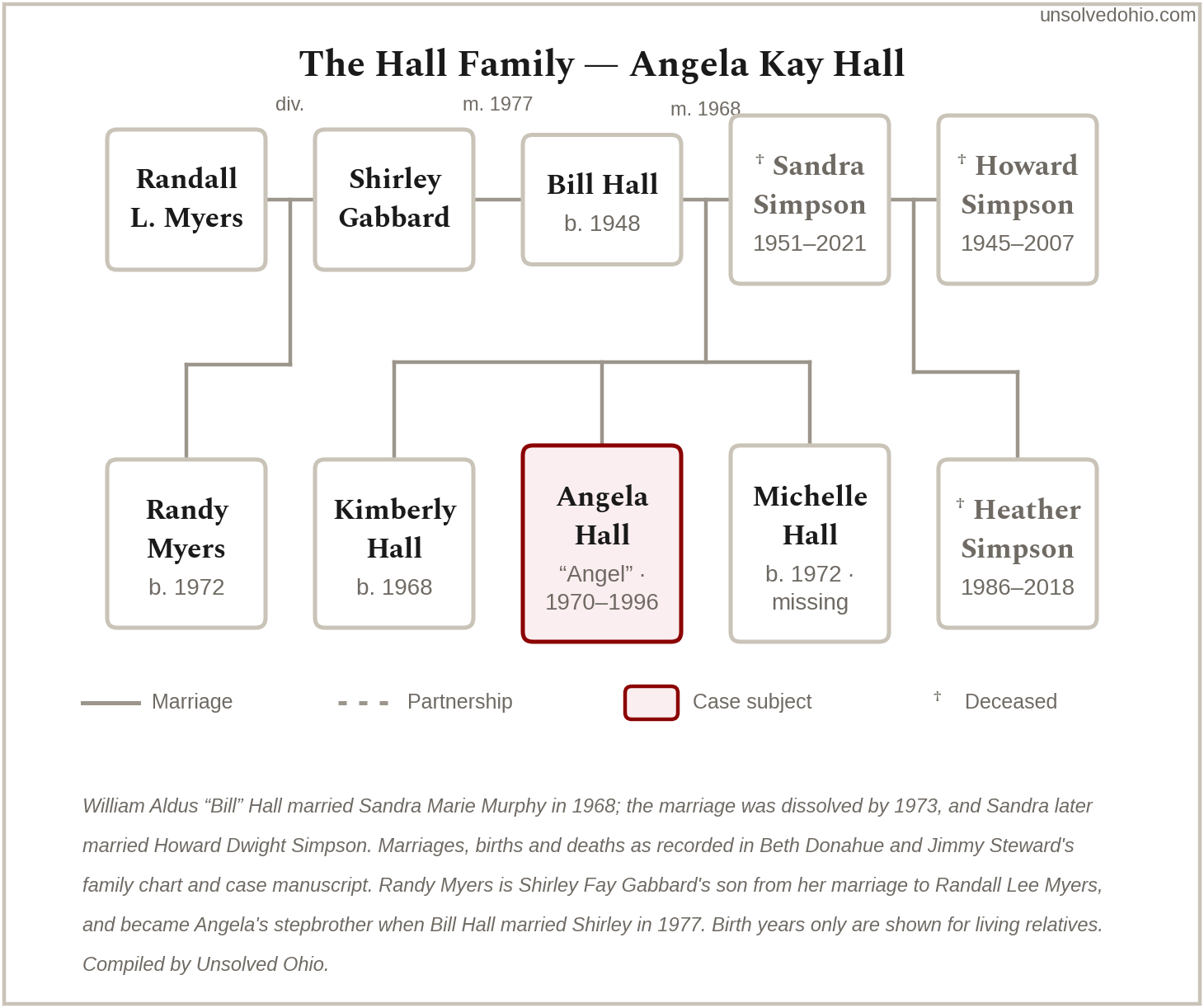
To trace the family tree is to map a disaster zone. It began in the tangled, fractured architecture of a blended household, anchored by a father of three marriages and a mother of three marriages, Sandra, who watched her children summoned one by one by the dark mathematics of fate. There were five children born to this hard soil: Kimberly, whose birth on September 14, 1968, opened a quiet prelude; Angela, arriving on March 20, 1970; Michelle, born February 8, 1972; Randy, following on December 2; and finally, Heather, the youngest, born June 6, 1986, into a world already tilting violently off its axis.
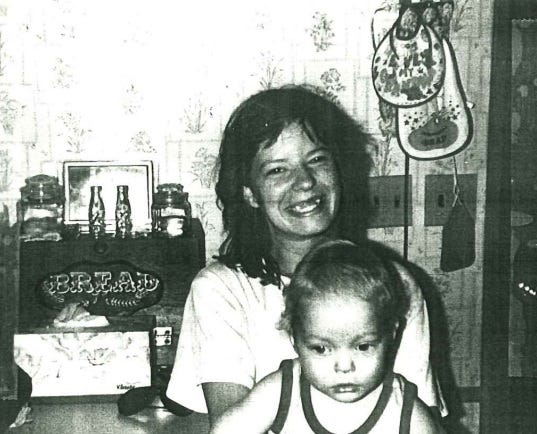
Of them all, Angela Hall was perhaps the most exquisitely fragile. Standing barely 4 feet 10 inches tall, weighing 90 pounds, and moving through the world with a permanent, halting limp, Angela was a creature of intense vulnerability. In the summer of 1988, a motorcycle ride with a boyfriend ended in a catastrophic accident that broke her body further, fusing her fate to physical pain. Yet life pressed on. On December 19, 1992, she gave birth out of wedlock to a son, Bradley, a boy marked by mental disabilities that would require a lifetime of stewardship. Seeking refuge from her isolation, Angela married in 1993, only to discover that the home was another kind of trap; seven months later, she fled a husband whose weapon was domestic violence.
She could not outrun the calendar. In April 1996, Angela vanished into the Springfield air. For nearly a month, her name drifted through the police blotters and the bars along East Main Street. Then, on May 17, 1996, a canoeist gliding across the northern end of the C.J. Brown Reservoir looked down into the shallow water and found what remained of her. The coroner’s ledger recorded the incident as freshwater drowning and cocaine intoxication. The official coroner’s ruling: “Undetermined.”
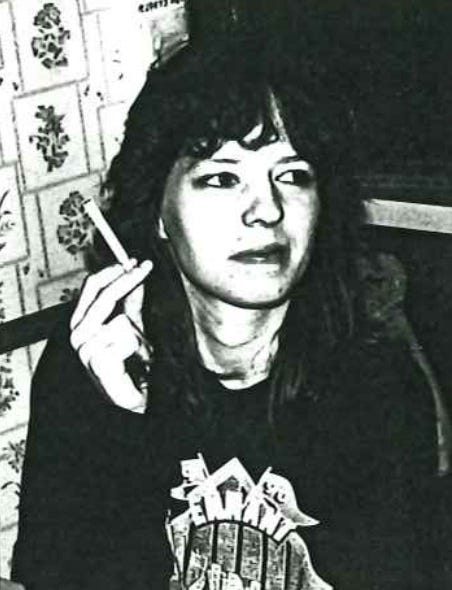
For Angela, it was an ambiguous, murky exit for a 26-year-old mother, leaving little Bradley behind for the mercy of the state and grandparents. An unsolved and undetermined death, filed away in the cabinet of forgotten things.
But the house of Hall was only halfway through its trial.
Michelle, born with the fierce, defensive instinct of the middle child, stepped into the void left by her sister, only to walk headlong into her own labyrinth of horror. In 1998, fire, that most ancient and pitiless element, claimed the life of Michelle’s young daughter, Kassandra. The smoke had barely cleared before Michelle was tasked with raising twin autistic boys, a monumental endurance test compounded by years of severe domestic violence that bruised her spirit long before her body was targeted. The pressures of life, sorrow, and mental instability took over Michelle’s life, and so did the drug abuse. Michelle fell prey to violently intentional men promising safety and security. It was a pressure-cooker existence.
On September 7, 2009, Michelle Hall, who had carried the alias of Rice through a tumultuous marriage dissolved years prior, stepped out of her life in Springfield and simply evaporated. Her body was never recovered. No grave was ever dug. Michelle’s case number became a ghost haunting the files of Clark County detectives.
The generation of sisters was thinning. Only Kimberly and Heather remained to witness the slow erasure. But the ledger was not yet balanced. In 2018, the youngest, Heather, born in the mid-1980s and spared the immediate violence of the 1990s, steeped in its generational sorrow, was struck down by cancer, dying quietly in a hospital room as the Ohio wind rattled the leaves outside.
Today, if you walk down the streets of Springfield, past the brick facades and the fading storefronts, you will find no monument to the Halls. There is no plaque by the reservoir where Angela slipped beneath the surface, nor any marker for Michelle in the empty air where she was last seen. There is only the silence of a Rust Belt town that has seen too much history to care about individual grief, and the enduring, haunting question that echoes through every page of this record:
How much tragedy can a family bear before the bloodline itself becomes a tragedy?
No Bridge Over Troubled Water
The story begins not with a crime, but with a song. On March 20, 1970, the airwaves of a fractured America — a nation bruised by the Vietnam War, governed by Richard Nixon, and still mourning the violent exits of Martin Luther King Jr. and Bobby Kennedy — were blanketed by the soaring, melancholic harmonies of Simon & Garfunkel. Their hit, “Bridge Over Troubled Water,” sat unequivocally at the number one spot on the U.S. Billboard Hot 100, acting as a metaphor for a country desperately seeking salvation. It is precisely on this day, in the industrial cradle of Springfield, Ohio, that our story takes its first breath, only to exhale its last 26 years later. As detailed in the files that are Angel Hall, the anatomy of this tragedy begins with the quiet beauty of ordinary life before the sheer weight of adulthood bends the bough to the breaking point.
The architecture of this sorrow was laid on January 19, 1968, when 20-year-old William Aldus “Bill” Hall and 17-year-old Sandra Marie Murphy were married. They wasted no time constructing a family. On September 14 of that same year, Sandra delivered a baby girl named Kimberly. Almost exactly two years later, on that musically historic day of March 20, 1970, a second daughter, Angela, arrived into the world. The clockwork rhythm of their domestic life continued when, on February 8, 1972, a third daughter, Michelle, completed a trio of beautiful girls born in straight, two-year successions.
Yet, the foundation of this young family was startlingly fragile, and the fracture occurred around Thanksgiving Day — Thursday, November 23, 1972. While families across the nation gathered around roasted birds and television sets watching the Detroit Lions decimate the New York Jets 37–20, and the San Francisco 49ers pull off a 31–10 upset against the Dallas Cowboys, a quieter upheaval was brewing in the Hall household. Perhaps it was on the consumer frenzy of Black Friday that Sandra finalized her silent calculations, for by Tuesday, November 28, 1972, Bill was served with a divorce filing. By 1973, the marriage was entirely dissolved, leaving Sandra alone to provide a roof, food, and love for three little girls aged 1, 3, and 5.
The family tree soon grew complicated, branching out into a tangled, blended canopy. Around that same Thanksgiving of 1972, another couple, Shirley Fay Gabbard and Randall Lee Myers, welcomed a son named Randall on December 2, just two months before Michelle was born. Their marriage, too, would eventually collapse into divorce, paving the way for Bill Hall to marry Shirley Fay Gabbard on October 15, 1977. Sandra, conversely, found a second husband in Howard Dwight Simpson. At the age of 41, with three young women already crowding the house (Kimberly now 18, Angela 16, and Michelle 14), Sandra gave birth to Heather on June 6, 1986. Heather would be Howard’s only child. Howard would stand as a witness to the unimaginable troubled times looming on the horizon, though he would pass away in 2007 at the relatively young age of 62, just two years before Michelle would mysteriously disappear.
But before the darkness fell, there was an “Angel.”
Angela was known sweetly by everyone in the Springfield school system as “Angel.” She walked through the halls of Shawnee High School from 1986 to 1988 with a quiet, unblemished promise. In 1986, she and 14 peers from the Springfield Consolidated School District captured first place at the Ohio State Fair in a Junior Achievement (JA) competition. The organization’s curriculum was ambitious, designed to forge future business leaders by instilling three core pillars. The first was financial literacy, equipping students to manage money, understand credit, and budget. The second was work readiness, helping teens develop the technical literacy and critical thinking needed for modern workplaces. The third was entrepreneurship, teaching market-based economics and calculated risk-taking. Angel was being groomed to be a future business leader in Springfield, and perhaps the world, standing before an open door.
That door, however, would violently slam shut.
The pivot point arrived just months before her expected high school graduation in June. Angela turned 18 on March 20, 1988, crossing the threshold into legal adulthood. Less than three months later, on June 6, 1988, the bright Junior Achievement star was arrested and charged with “Drug Abuse.” Under the grim statutory language of the 1988 Ohio Revised Code Section 2925.11, possessing highly regulated narcotics like cocaine, heroin, or LSD constituted a fourth-degree felony, while lesser-scheduled substances amounted to a third-degree misdemeanor. Angela was charged with a felony. At the time, Angel was living at 152 Brent Drive, Apartment E — a fateful address that would echo through the family’s history, as it was the exact location (listed as 152 Brent Drive West) where 17-year-old Michelle Lynn Hall would marry 18-year-old Lawrence Allen Meredith Jr. the following year, on May 2, 1989.
The true mystery of Angela’s precipitous fall begins in the judicial archives, or rather, the stark lack of them. Despite the severe felony charge, a thorough search of the Ohio court records system yields absolute silence regarding the details of the case. The record vanishes. Did the prosecutor dismiss the charges with a judge’s quiet concurrence? Was Angel diverted into a first-offenders drug court, or transferred to an entirely different county? The paperwork offers no answers, only a void — a chilling prelude to a life that would end much the same way, slipping beneath the dark waters of a reservoir, leaving behind nothing but the echoes of what could have been.
In the next installment: a midnight motorcycle crash on Detrick-Jordan Pike, a weekly-rate motel on Route 40, and a baby born six days before Christmas. Subscribe to follow the Angela K. Hall case file as it publishes and become a paid subscriber for the police reports, coroner’s file, and court records embedded throughout the series.
This installment is a biographical account of Angela K. Hall’s early life and family, drawn from public court records, official registries, documented media reports, and family records compiled by the investigators. It makes no allegation of wrongdoing against anyone named. Angela’s 1988 drug-abuse charge is reported as a charge; no record of its outcome has been found, and a charge is not a conviction. A documented association is never proof of a crime, and anyone not convicted of a specific crime is presumed innocent. Unsolved Ohio is an educational publication and not legal advice. If you knew Angela or her family, submit what you remember at unsolvedohio.com — your name is never published without your written permission, and we correct factual errors promptly. Full terms: Disclaimer.
The way you trace the family history through marriage records, court filings and the missing charge record gives this piece real substance.
That gap in the 1988 case is especially interesting, because you’ve shown exactly where the paper trail stops. Great Read.