



The city of Springfield, Ohio, is a rusted Midwestern town where the past did not stay buried but seeped up through the limestone, mingling with the mist and the stagnant waters of a forgotten town, and Lincoln Park Circle was its most open, festering wound. The city lies in the flat, gray palm of the Midwest like a discarded tool once gleaming with the grease and sweat of industrial pride, now rusted at the edges, silent where the foundries used to roar.
It was here, in this theater of quiet desperation, that the prelude to Angela Kay Hall’s ultimate demise was quietly filed on a Saturday morning, according to the Springfield police records. At precisely 7:25 AM on April 1, 1995, a missing person report, “Case 95-5945-470100,” was logged by the Springfield Police Department. The reporting party was Mark Noble, a 34-year-old male identified as Angela’s live-in boyfriend at their 727 Kenton Street residence. Noble explained to the indifferent officers that the 25-year-old woman had stepped out the previous day, March 31, ostensibly to purchase a pack of cigarettes, and had simply vanished.
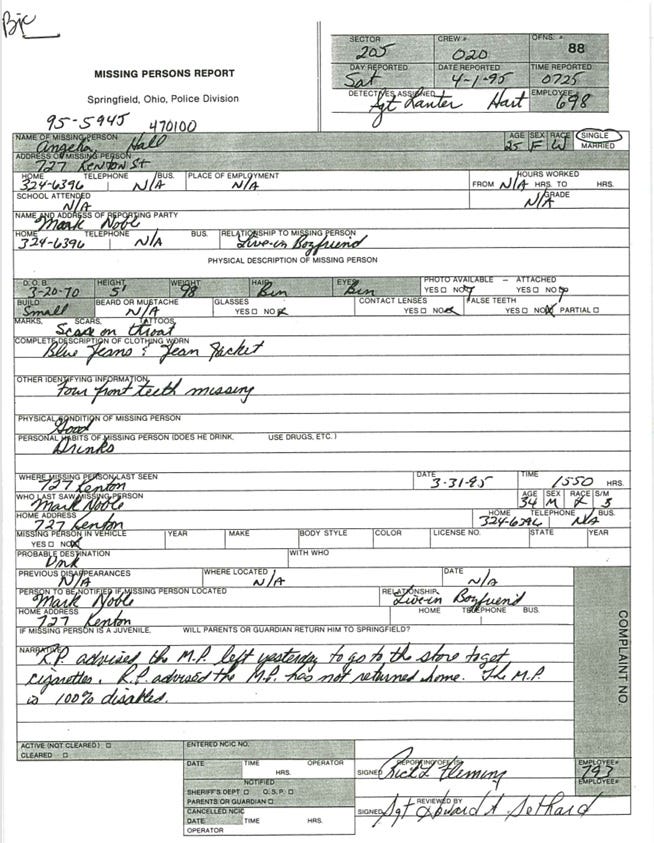
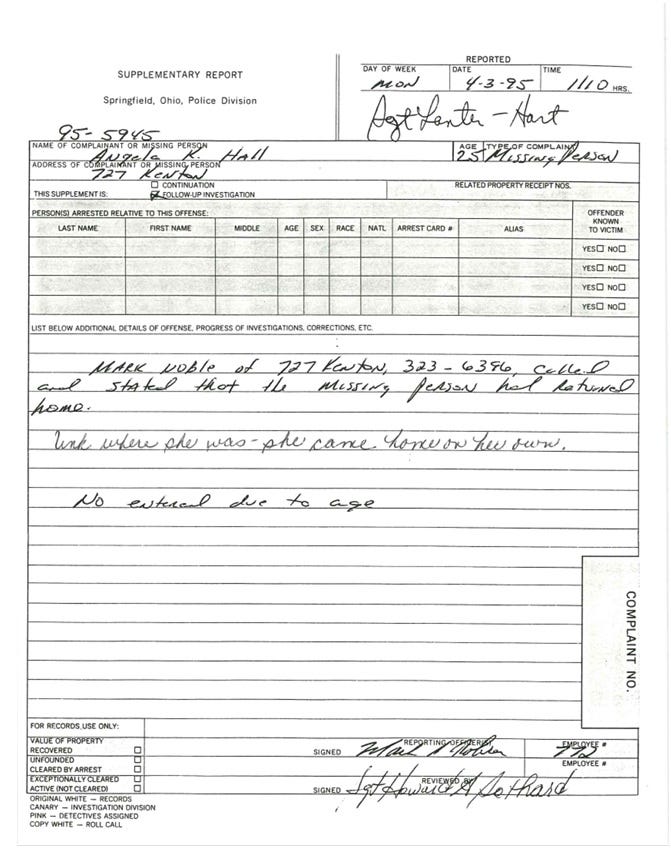
The police notes sketched a portrait of exquisite, almost unbearable fragility: Angela was recorded as completely disabled, bearing a jagged scar on her throat, missing four front teeth, and last seen wearing a denim jacket over blue jeans. Yet, this particular disappearance concluded not in the freezing depths of a reservoir, but with a bewildered anticlimax. Three days later, on April 3 at 11:10 AM, Noble telephoned the authorities to report that Angela had simply returned home. He told the police he had no idea where she had gone.
It was not the first time an angel went missing in Springfield. To the uninitiated, these multi-day vanishings — colloquially dismissed on the streets as a “bender” or a “run” — appear as calculated acts of abandonment, but the truth is far more tragic and strictly biological. When individuals chained to severe substance use disorders slip off the grid, it is an agonizing manifestation of emotional avoidance and executive dysfunction.
Did Angela disappear out of malice, or was she caught in a shame-avoidance fugue?
Confronted with the overwhelming, crushing weight of a life lived in constant pain and poverty, the drug offered an immediate, absolute distance from her stressors. Prolonged abuse hijacks the brain’s prefrontal cortex, entirely eroding a person’s temporal awareness and their capacity to evaluate consequences. When clarity briefly pierces the chemical fog, it brings with it an unbearable shame, which only triggers the compulsion to consume more, a desperate attempt to numb the fresh guilt of having run away. The eventual return home is rarely heralded by a sudden moral epiphany; rather, it is dictated by the brutal realities of biology. They return when the money runs out, when the body can no longer sustain severe sleep deprivation and malnutrition, and when the sheer, primal necessity of survival overrides the psychological desire to hide.
Lincoln Park Square
To understand the gravity that eventually pulled Angela permanently beneath the surface a year later, one must wander into the grim architecture of the Lincoln Park Square area, specifically the concrete purgatory of Lincoln Park Circle, where she eventually took up residence at apartment 285. Between 1993 and 1997, the story of Lincoln Park Circle was a dark narrative steeped in rampant narcotics, unrelenting violence, and unresolved tragedy. It functioned less as a neighborhood than as a festering, active narcotics distribution hub, crawling with opportunistic predators. Serving as a geographic magnet for illicit enterprise, the neighborhood housed virtually every drug dealer from Springfield, Dayton, and New York City.
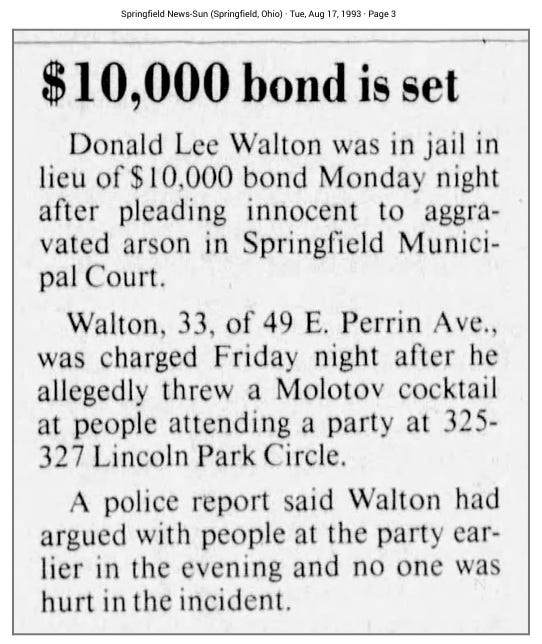
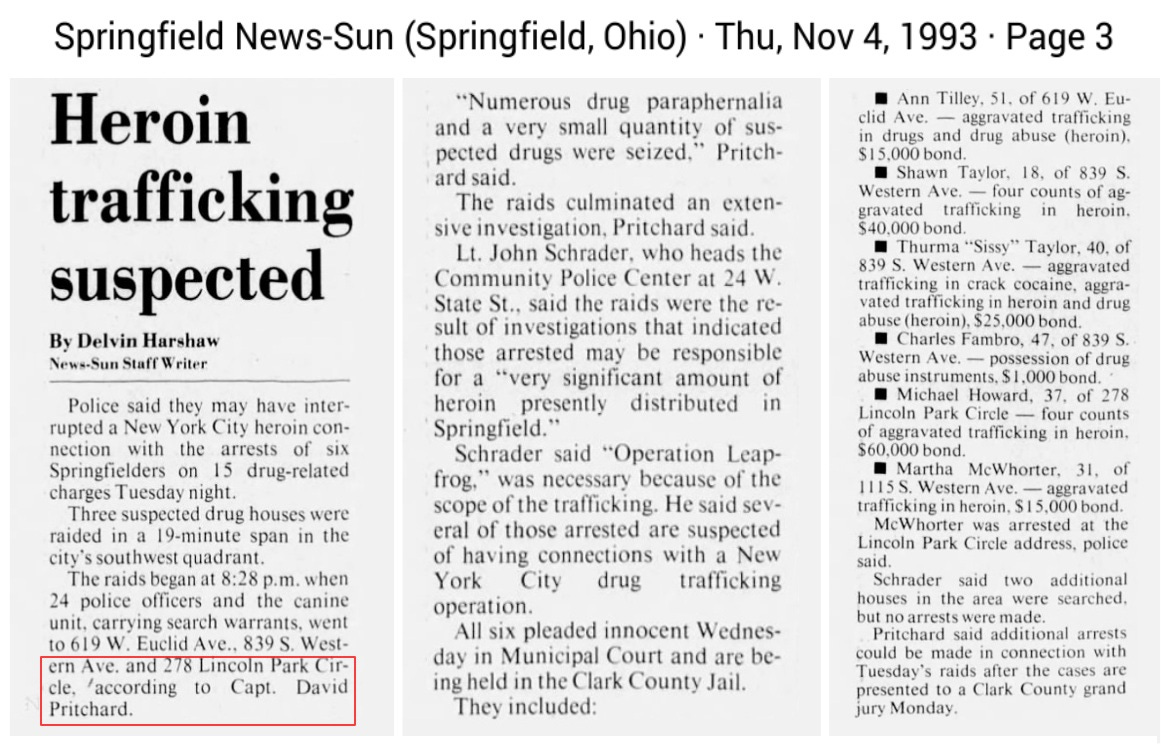
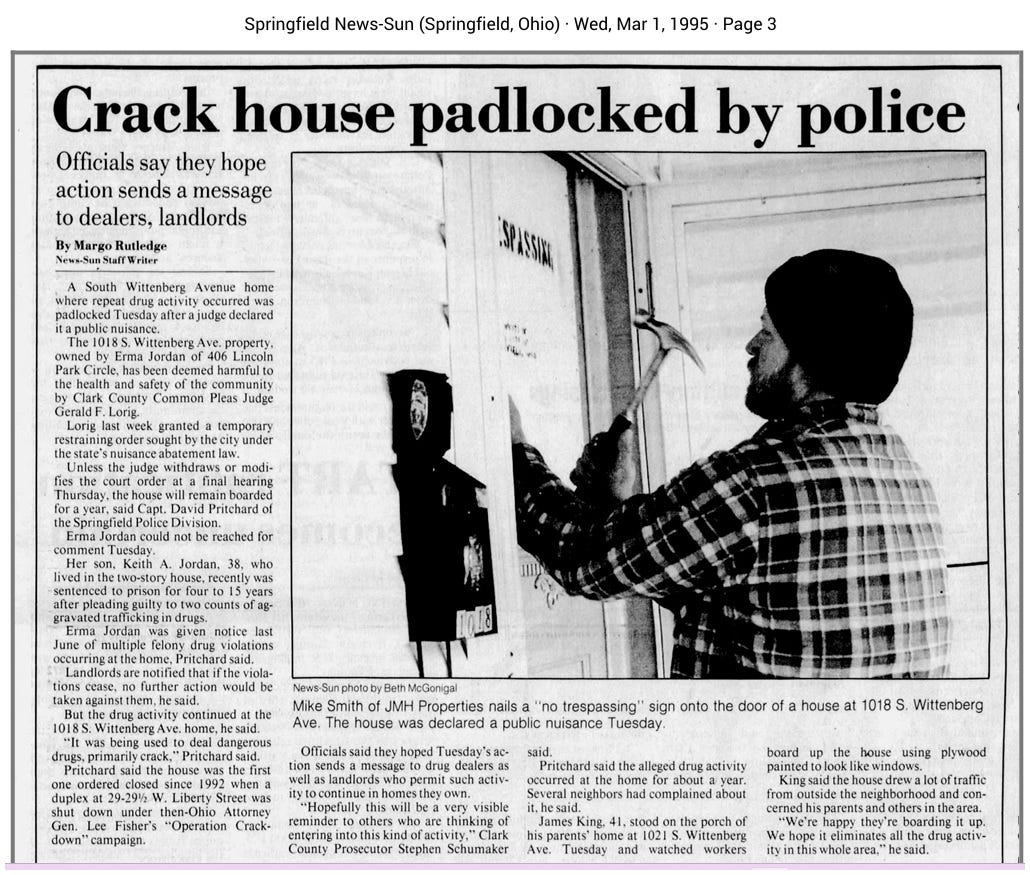
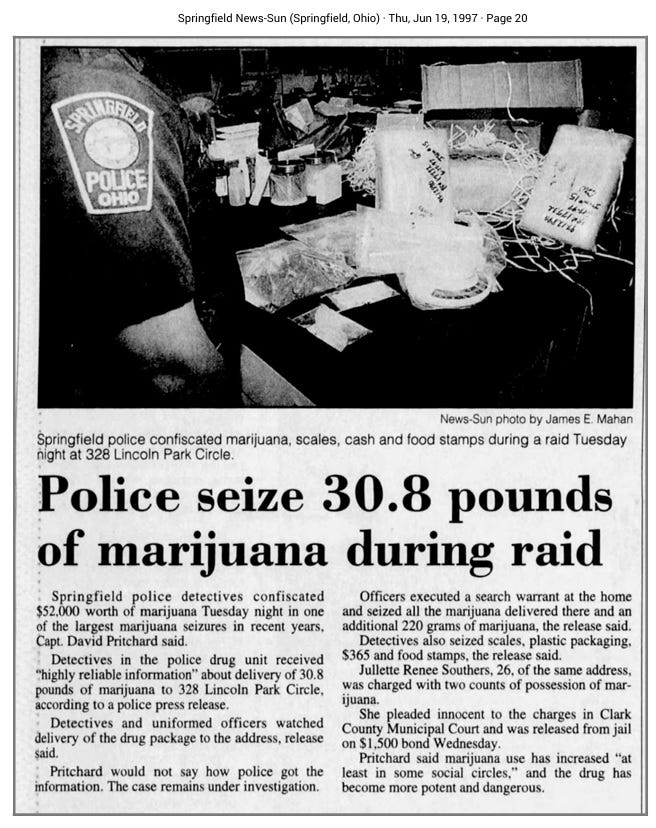
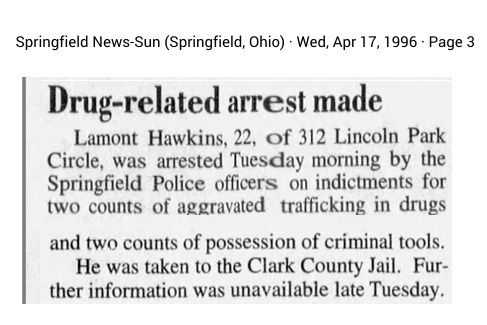
Rampant drug use, particularly the scourge of crack cocaine, dictated the brutal, desperate rhythm of the days and nights. The air in the square was thick with the desperation of addicts and the casual, simmering violence of the men who supplied them. The block was a volatile battleground where disputes quickly turned violent; in August 1993, an argument at a party at 325–327 Lincoln Park Circle culminated in a man named Donald Lee Walton allegedly launching a Molotov cocktail into the gathering. Massive heroin pipelines were allegedly operated behind thin drywall by men like Michael Lee Howard, while crack cocaine heavily influenced the area, leading authorities to padlock properties like the nearby South Wittenberg Avenue home of Keith Jordan, whose mother, Erma, resided at 406 Lincoln Park Circle. Law enforcement constantly battled the influx of dangerous drugs, launching "Operation Leapfrog" in November 1993 to dismantle a suspected New York City heroin connection operating out of addresses like 278 Lincoln Park Circle. Arrests for aggravated trafficking were commonplace, pulling in residents like Michael Howard, Kenneth Campbell, and Lamont Hawkins. Raids consistently yielded illicit spoils, such as a 1997 bust at 328 Lincoln Park Circle where police seized $52,000 worth of marijuana, food stamps, cash, and scales.
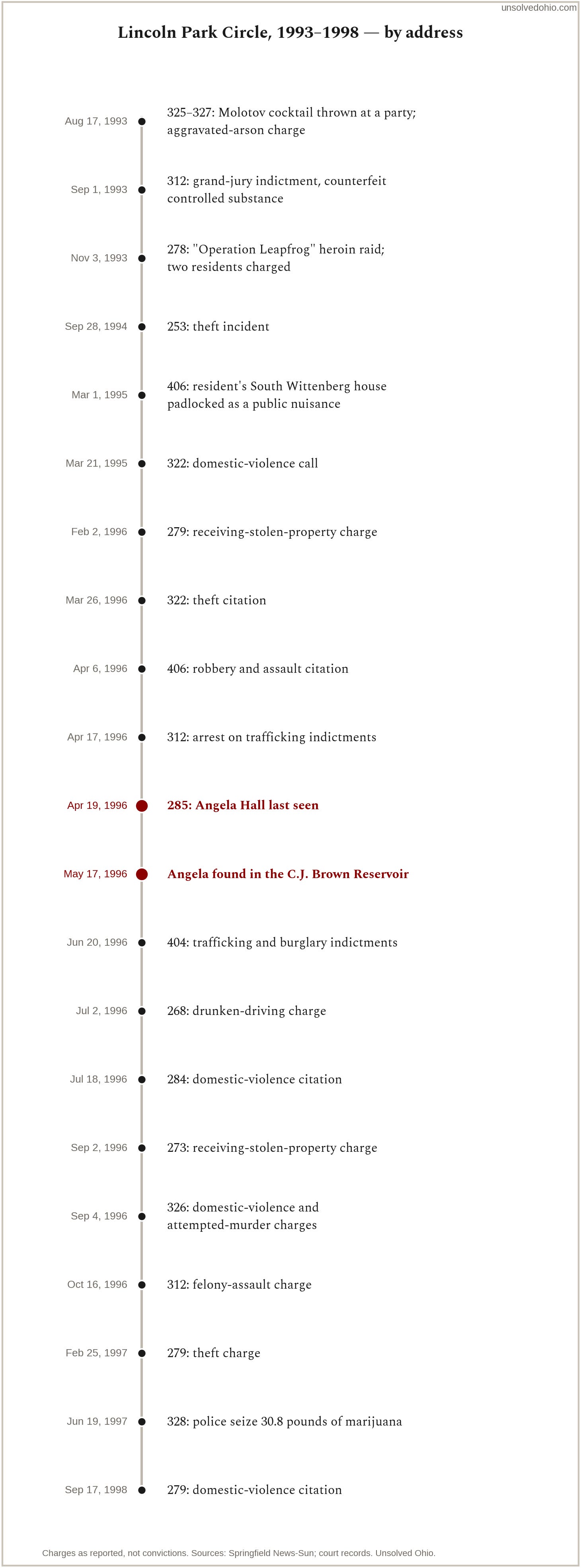
The day-to-day brutality of the neighborhood is starkly preserved in the Lincoln Park Circle Law Enforcement and Criminal Incident Chronology (1993–1998):
August 17, 1993 — 325–327 Lincoln Park Circle: Donald Lee Walton was held on a $10,000 bond after pleading innocent to aggravated arson for allegedly throwing a Molotov cocktail at attendees during a party following an earlier dispute.
September 1, 1993 — 312 Lincoln Park Circle: Kevin L. Bray was indicted by the Clark County grand jury on charges of trafficking in a controlled counterfeit substance.
November 3–4, 1993 — 278 Lincoln Park Circle: As part of Springfield Police Division’s multi-target “Operation Leapfrog” targeting a suspected New York City heroin pipeline, officers raided 278 Lincoln Park Circle. Michael Lee Howard was arrested and indicted on four counts of aggravated trafficking in heroin. Martha McWhorter was also arrested at the address and charged with aggravated trafficking in heroin.
September 28, 1994 — 253 Lincoln Park Circle: Law enforcement processed an incident involving Hiawatha L. Huffman for theft.
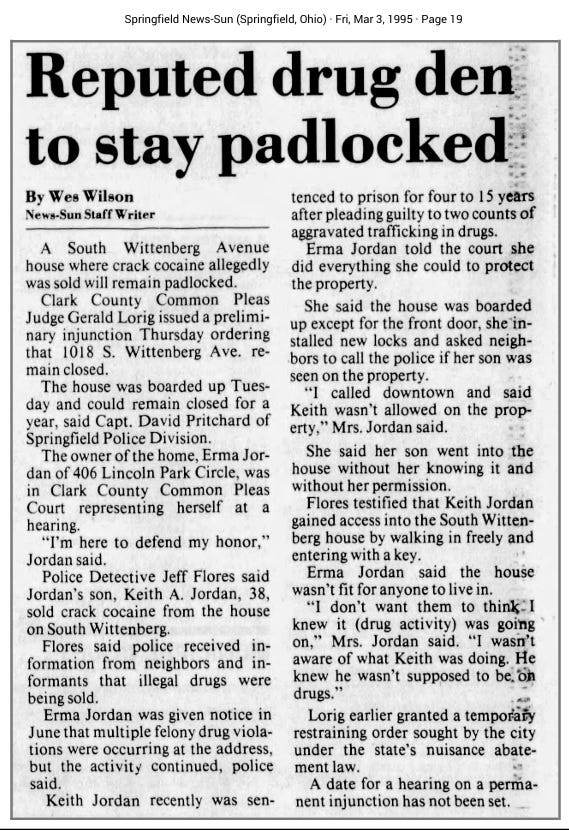
March 1–3, 1995 — 406 Lincoln Park Circle (Connected Operation): Common Pleas Court declared a property tied to Erma Jordan of 406 Lincoln Park Circle a public nuisance and ordered it padlocked following repeated crack cocaine sales. Her son, Keith A. Jordan, was sentenced to prison for 4 to 15 years on two counts of aggravated trafficking in drugs.
March 21, 1995 — 322 Lincoln Park Circle: Police responded to a domestic violence incident involving Sherri Y. Stevens.
February 2, 1996 — 279 Lincoln Park Circle: Charges were filed against Candy D. Applin for receiving stolen property.
March 26, 1996 — 322 Lincoln Park Circle: Sherri Y. Stevens was cited in connection with a theft incident.
April 6, 1996 — 406 Lincoln Park Circle: Clarence C. Jordan was cited for robbery and assault.
April 17, 1996 — 312 Lincoln Park Circle: Lamont Hawkins was arrested by Springfield police officers on grand jury indictments charging two counts of aggravated trafficking in drugs and two counts of possession of criminal tools.
June 20, 1996 — 404 Lincoln Park Circle: Kenneth Campbell was indicted by a Clark County grand jury for aggravated trafficking in drugs, and associated subject Robert Seagraves was indicted for burglary.
July 2, 1996 — 268 Lincoln Park Circle: John R. Fleetwood was charged with driving while intoxicated (DWI).
July 18, 1996 — 284 Lincoln Park Circle: Law enforcement cited Raymond McWhorter for domestic violence.
September 2, 1996 — 273 Lincoln Park Circle: Brent D. Applin was charged with receiving stolen property.
September 4, 1996 — 326 Lincoln Park Circle: Police responded to an incident resulting in domestic violence and attempted murder charges against Miguel H. Martinez Sr.
October 16, 1996 — 312 Lincoln Park Circle: Kevin Bray was charged with felony assault.
February 25, 1997 — 279 Lincoln Park Circle: Robert Williams was charged with theft.
June 19, 1997 — 328 Lincoln Park Circle: Springfield police detectives executed a search warrant following a monitored delivery, seizing 30.8 pounds of marijuana (valued at $52,000), an additional 220 grams of marijuana, drug scales, packaging materials, food stamps, and cash. Juliette Renee Southers was arrested and charged with two counts of possession of marijuana.
September 17, 1998 — 279 Lincoln Park Circle: Law enforcement cited Melissa A. Padgett for domestic violence.
Living directly inside this chaotic ecosystem was 26-year-old Angela Kay Hall, who resided at 285 Lincoln Park Circle. To look at Angela was to behold a creature of exquisite and terrifying fragility. She stood a mere 4 feet 10 inches tall, carrying a frail 90 pounds on a frame fundamentally broken by a catastrophic midnight motorcycle crash on August 4, 1989. Thrown into the unforgiving night as a passenger on a dark country curve, the accident left her with partial left-sided paralysis, slurred speech, and a severe, dragging limp. The town knew her simply as “Angel,” a sweet, stubborn girl with a jagged scar across her forehead and missing front teeth, navigating a world that had become entirely too hard for her. She possessed absolutely no physical capacity for defense or rapid evasion.
She was also a mother. On December 19, 1992, while destitute and living in a rundown motel, she had given birth to a boy named Bradley. He was a child born with Fetal Alcohol Syndrome and severe ADHD, whom she loved but could scarcely protect from the chaos tightening around her.
In this shadow world, a woman of Angela's stature was nothing more than prey. The people that surrounded her were incredibly sketchy, drawing her deep into a web of career criminals and violent offenders. Capitalizing on her profound vulnerability, local drug dealers descended upon her apartment like vultures. By mid-April 1996, according to what neighbors later told police, her own apartment had been hijacked by narcotics dealers Henry "LA" Alexander and Edward "Hollywood" Alexander, who lived just doors away at 276 Lincoln Park Circle. They practically commandeered Angela's modest living space to operate a crack-cocaine distribution ring directly out of her living space. "Hollywood" exerted intense control over Angela, and, neighbors claimed, the brothers routinely intercepted and confiscated her monthly state disability SSI checks to settle her escalating drug debts.
The misery of the Lincoln Park area was a communal, suffocating affair. The drug seeped through the complex, claiming neighbors like Lisa Walden at 413 Lincoln Park Circle, who was described in a police sergeant's May 1996 memo as a frequent purchaser of the crack cocaine flowing directly from Henry Alexander. Angela was both a captive and a consumer in this ecosystem, heavily self-medicating with a lethal mixture of cocaine and alcohol to numb the physical and psychological torment of a life that had narrowed into a daily calculus of survival.
Parasites and Bloodsuckers
In this shadow world, a woman of Angela's stature was nothing more than prey, and her apartment became an open wound of vulnerability. Capitalizing on her condition, local drug dealers descended upon her like vultures. By mid-April 1996, according to what neighbors later told police, her modest living space had been completely hijacked by brothers Henry "LA" Alexander and Edward L. "Hollywood" Alexander, who resided just doors down and utilized her living room to facilitate their crack-cocaine distribution ring. "Hollywood" exerted intense control over Angela, routinely intercepting and confiscating her monthly state disability SSI checks, neighbors claimed, to settle her escalating drug debts. She was both a captive and a consumer in this ecosystem, heavily self-medicating with a lethal mixture of cocaine and alcohol to numb the physical and psychological torment of a life that had narrowed into a daily calculus of survival.
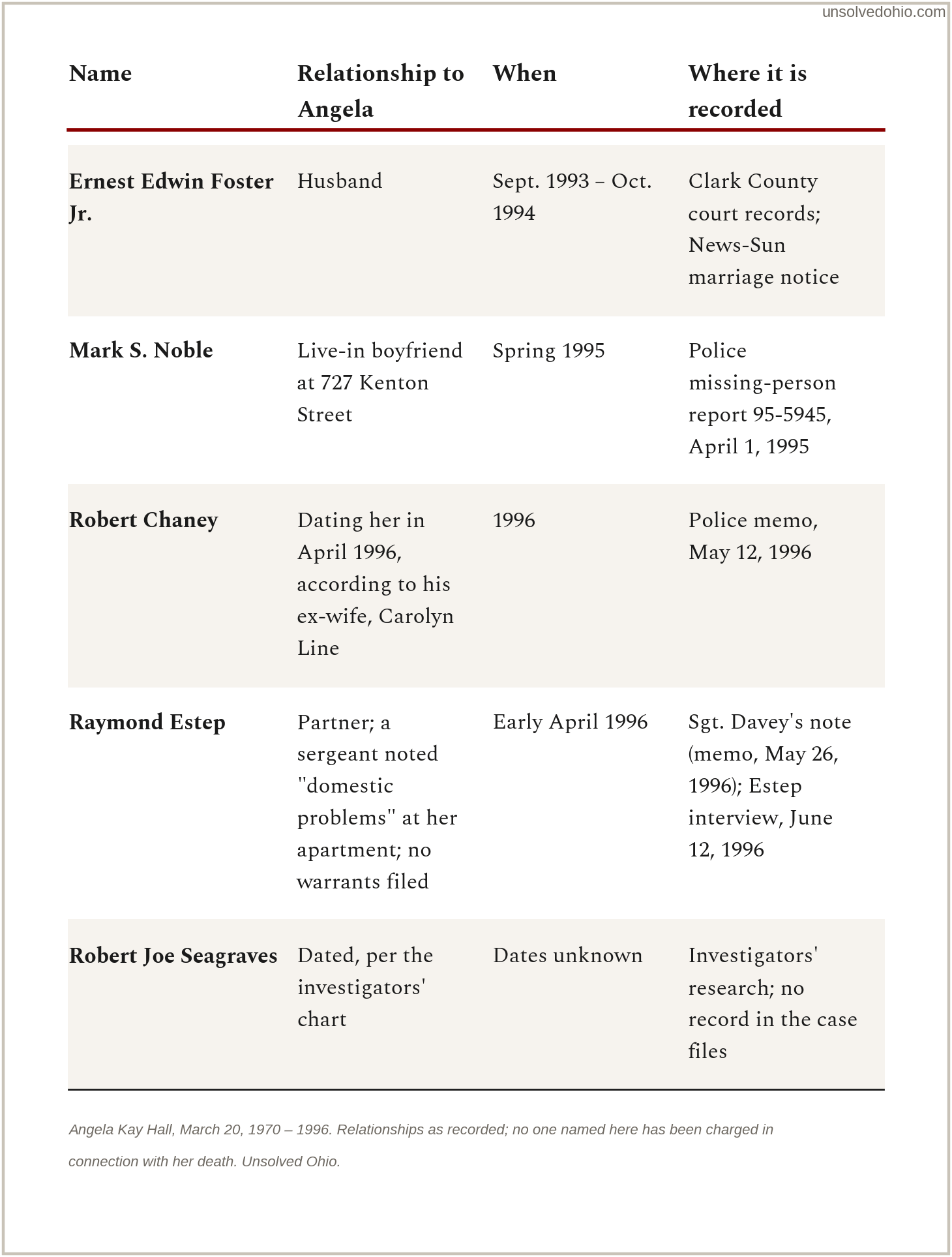
The people that surrounded her drew her deep into a web of career criminals and violent offenders. There was Raymond "Ray-Ray" Estep, a domestic partner with whom she shared a volatile dynamic punctuated by documented domestic disturbances. There was Robert Seagraves, a career criminal whose sprawling record of burglary, theft, and assault frequently collided with her orbit. She also experienced explosive confrontations with associates like Mike Frost, requiring police intervention when, by one account, Frost forcibly repossessed a "Yellowish Dodge Duster" he had sold her, while Key Lounge acquaintances reportedly made overt verbal threats to kill her.
To the uninitiated, these multi-day vanishings appear as calculated acts of abandonment, but the truth is strictly biological. When individuals chained to severe substance use disorders slip off the grid, it is an agonizing manifestation of emotional avoidance and executive dysfunction. Confronted with crushing pain, the drug offers an immediate distance from stressors; Angela did not disappear out of malice, but was caught in a shame-avoidance fugue. They return when the money runs out, when the body can no longer sustain the severe sleep deprivation and malnutrition, and when the sheer, primal necessity of survival overrides the psychological desire to hide.
The Final Disappearance
Angela's personal life was similarly fraught with danger and toxic relationships. Her domestic partner, Raymond "Ray-Ray" Estep, engaged in domestic disturbances with her at the apartment in early April 1996, according to a police sergeant's note. She also experienced explosive confrontations with associates like Mike Frost, requiring police intervention when, by one account, Frost forcibly repossessed a beige yellowish "Dodge Duster" he had previously sold her for $160. Furthermore, Key Lounge acquaintances like Justin Reed reportedly made overt verbal threats to kill her, an anonymous caller told police, while other recreational associates with extensive rap sheets for burglary, domestic violence, and assault, such as Charles "Chuck" Blake Jr. and Ricky L. Brown Sr., drifted in and out of her orbit.
For Paid Subscribers: The Police Memos on Angela Hall, April–June 1996
Thirty-one pages of Springfield Police and Clark County Sheriff's memos — every sighting, every tip, and the jailhouse interview — transcribed by the investigators. Paid subscribers can read them in full here.
For Paid Subscribers: The Original Case File Pages
The 46 original pages behind the transcription — typed memos, handwritten notes, the missing-person forms, the family's flyers, and the dental records that identified her. Paid subscribers can open the scans here.
In the next installment: April 19 to May 17, 1996 — the last sighting, the flood of tips, and the anonymous call that knew where she was.
This installment names people who appear in police memos, news reports and court records from 1993 to 1996, many of whom are living. No one named here has been charged in connection with the death of Angela K. Hall, and every person is presumed innocent. Accounts from neighbors, tipsters and anonymous callers are reported as what they told police — allegations, not findings. Charges are reported as charges; where no outcome is stated, none has been obtained, and a charge is not a conviction. The official manner of Angela’s death is Undetermined; where this account suggests otherwise, that is the investigators’ conclusion, which later installments set out. Unsolved Ohio reports from public court records, official registries, documented media reports, on-record interviews, and open-source analysis using Artificial Intelligence and Social Network Analysis; a documented association is never proof of a crime. This is an educational publication and not legal advice. If you have information about Angela K. Hall’s death, submit it at unsolvedohio.com — your name is never published without your written permission, and we correct factual errors promptly. Full terms: Disclaimer.
Great read. You can see the whole tragedy coming from a mile away in those court dockets, yet the system still treated her like she was invisible.