



In the spring of 1996, Michelle Hall was 24 years old. The divorce had been final since July. The name Meredith was gone, and the man who came with it was gone too, and she had moved what was left of the household to 537 Linden Avenue — herself and four children, the youngest a pair of twins who had just turned one.
She had come through that year on her own. What arrived next did not come through her front door.
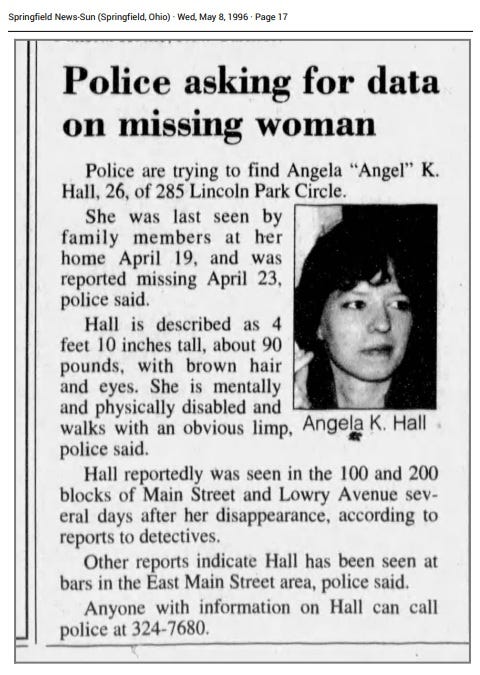
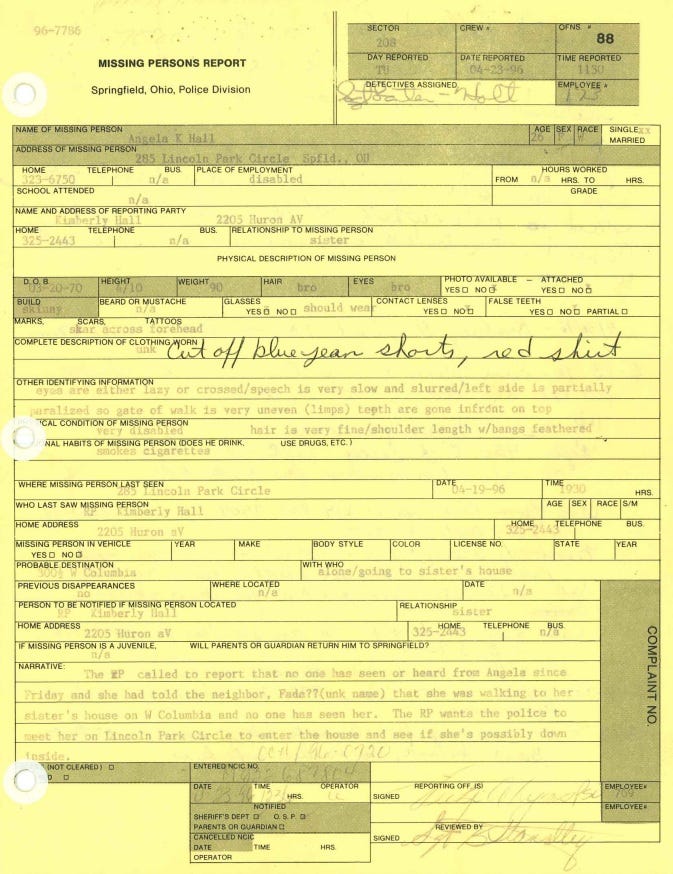
Her sister Angela was 26. She stood 4 feet 10 and weighed 90 pounds. An old motorcycle accident had left her with a dragging limp and a slur in her speech, and she had never owned a car. On Friday, April 19, 1996, Angela K. Hall vanished into the Midwestern air.
April 19 was already a date that carried weight in this country. After 1996 it would carry weight in one family, too.
The Echoes of Violence — April 19
To grasp the atmospheric weight of that date of April 19 is to understand a dark thread running through the American psyche. April 19, 1775 (The Battles of Lexington and Concord): The “shot heard ‘round the world” ignited the American Revolutionary War, initiating a conflict that would claim tens of thousands of lives.
On April 19, 1993, the siege at the Branch Davidian compound in Waco, Texas, ended in an inferno that claimed 76 lives, including 25 children under the age of 15. April 19 had become a solemn mark on the national calendar.
Exactly two years later, on April 19, 1995, Timothy McVeigh detonated a truck bomb that decimated the Alfred P. Murrah Federal Building in Oklahoma City, killing 168 men, women, and children.
To understand the tragedy of April 19, 1996, one must first look at who Angela Hall was. On September 18, 1993, at 23 years old, Angela had married 43-year-old Ernest Edwin Foster Jr.
To understand the shadow that fell over Angela’s final days, one must examine the tangled, peripatetic life of the man she had briefly called her husband: Ernest Edwin Foster Jr. Born in 1950, Ernest’s life was a revolving door of addresses, court dockets, and fleeting marriages. His documented marital history began in the twilight of the 1970s; on June 30, 1979, at the recorded age of 29, he married a woman named Mary Elizabeth Taylor. The union eventually withered, ending in divorce in 1984. By November of that same year, Ernest’s address was recorded at 911 North Street in Springfield, Ohio. He did not remain a bachelor for long; on Christmas Eve, December 24, 1984, he married his second wife, Kathy Sue Snyder.
The geography of Ernest Foster’s life was rooted in the transient spaces of Springfield. On August 1, 1991, he established a residence at 2126 South Tecumseh Road, Lot 4. That same year, 1991, his marriage to Kathy Sue Snyder ended in divorce. Two years later, on September 18, 1993, the 43-year-old Ernest married 23-year-old Angela Kay Hall. It was a union destined for a rapid and total collapse. Violence, or at least the accusation of it, began to orbit his public record. On April 16, 1994, a domestic violence charge against Ernest was dismissed. The victim in this particular incident remains stubbornly unknown, but the location associated with the fractured event was 1419½ Mound Street. Less than a month later, on May 11, 1994, divorce papers from Angela Kay Hall were filed in the local courts. The severance of their brief marriage was finalized on October 1, 1994.
It is here, buried within the dry language of public court records, that another intriguing thread emerges — one that raises questions but stops short of providing definitive answers.
On February 27, 1996, just weeks before Angela Hall was reported missing, a Clark County URESA child support case identified the defendant as Ernest E. Foster and listed an address of 223 Grant Street, St. Paul, Nebraska. Subsequent filings on March 4, 1996, directed child support enforcement documents to the Nebraska Department of Social Services, suggesting that the defendant in the case was believed to be residing in Nebraska at that time.
Whether this individual was, in fact, Ernest Edwin Foster Jr. cannot be stated with certainty. The available record provides no date of birth, Social Security number, or other unique identifying information. While the names “Ernest E. Foster” and plaintiff “Mary E. Wilcox” closely resemble known individuals connected to Ernest’s history — Mary Elizabeth being the mother of one of his children — the plaintiff’s surname differs, the defendant is not identified as “Jr.,” and no additional records have been located that conclusively verify the match.
If the defendant is the same Ernest Foster, the timeline becomes noteworthy. It would suggest that, by early 1996, he was associated with a Nebraska address rather than one in Ohio. If not, then the record belongs to an entirely different individual sharing a remarkably similar name. At present, the available evidence does not allow that question to be answered conclusively.
Nebraska, conversely, guards its secrets. Public access to Nebraska court records is among the most restrictive in the nation. A one-time search of basic public records demands a fee of $17 per individual search, per record. For an investigator, the math is daunting; to track a person with 20 criminal records and 20 traffic violations, the 40 retrieved documents would cost a staggering $680. Whether intentionally or not, such barriers can create a sanctuary of obscurity — one where tracing a person’s past becomes far more difficult than it would in states with more transparent public records.
Until additional records are uncovered, the Nebraska address remains an unresolved lead rather than a verified fact. It is a piece of the timeline that warrants further investigation — not because it proves anything on its own, but because unanswered questions often point investigators toward the next document waiting to be found.
Yet, the gravitational pull of Springfield eventually brought Ernest Foster back to familiar territory, and with his return came the familiar rhythm of court filings. By March 2000, his address was recorded at 1920 West High Street in Springfield, coinciding with a charge for passing bad checks that was filed on March 7 and subsequently dismissed. A second, identical charge for passing bad checks was filed months later, on November 8, 2000, and met the same fate of dismissal while he was still residing at the West High Street address. By March 2003, the geographic shuffle continued, placing him at 1856 Lincoln Park South. That same year, 2003, he divorced a woman named Kimberly Nadine Foster, though the date the two were actually married remains an unknown fragment in his timeline.
The shadows of his past behavior eventually resurfaced in the public ledger at the end of the decade. By November 2009, Ernest was living at 518 East Euclid Avenue. On November 6 of that year, a domestic violence charge was filed against him, which was later reduced to disorderly conduct. The victim was Pamela M. Foster, described as his live-in girlfriend of four years. In a strange, almost absurd clerical footnote, the police affidavit explicitly noted that their shared last name was merely a coincidence, clarifying that the two were not, in fact, married. It was simply another entry in the long, troubled chronology of a man whose life was measured in broken leases, dismissed charges, and the lingering, unanswered questions floating in the cold waters of the C.J. Brown Reservoir.
285 Lincoln Park Circle
To look at Angela was to behold someone profoundly, visibly fragile. Standing a mere 4 feet, 10 inches tall and weighing only 90 pounds, her small frame bore the permanent damage of a prior motorcycle accident. The crash had left her with a distinct, dragging limp and a soft, slurred cadence to her speech. Living with both physical and mental disabilities, Angela was a vulnerable soul who relied heavily on a tight-knit family network. She was the daughter of Sandra Simpson, and the sister to Michelle, Kimberly, and Heather. On the day she disappeared, Angela was residing at 285 Lincoln Park Circle.
On that damp Friday in mid-April, the timeline of Angela’s final known movements began to splinter into a conflicting network of memories and rumors.
One account comes from her sister Kimberly, who believed she was the last family member to see Angela alive at her Lincoln Park Circle home. A second, contrasting memory belongs to their mother, Sandra Simpson, who recalled speaking to Angela over the telephone that same day. In that conversation, Angela mentioned she was preparing to walk over to visit her sister in the 100 block of Lowery Avenue.
Yet the physical reality of Angela’s life made long journeys on foot nearly impossible. She did not own a car, nor was she capable of driving long distances. Her driving record reflected only a single, minor traffic infraction years earlier, in October 1992, involving a two-door maroon Pontiac. Because of her severe limp and physical limitations, she simply could not wander far on her own.
“Angela was handicapped and did not own a vehicle,” her mother would later reflect, state-plain and heartbroken. “Someone had to drive her.”
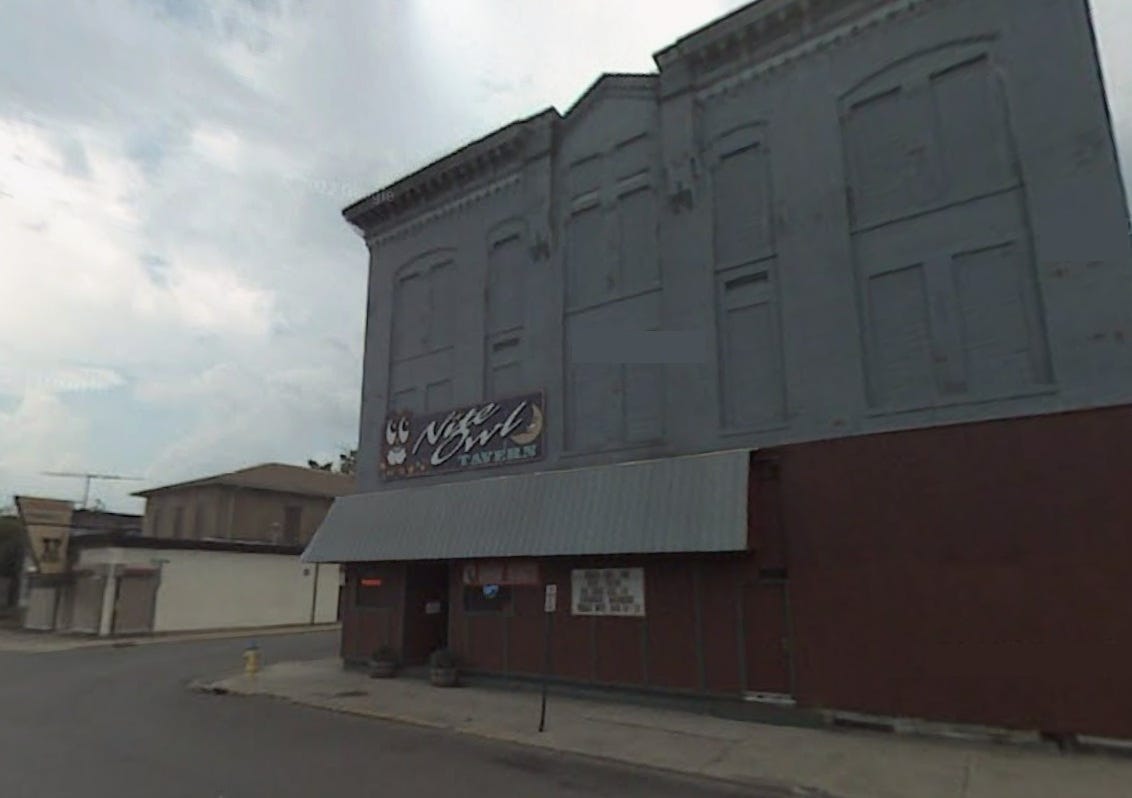
Other voices in town placed Angela elsewhere as night fell — glimpsed near the dim neon glow of the Nite Owl Bar on West Main Street. It was a desolate strip of town already shadowed by the unsettling, unexplained disappearances of nearly 20 local women over the years. Whether she was walking along East Main Street, stepping into the passenger side of a stranger’s vehicle on Lowery Avenue, or sitting in the shadowy corner of a tavern, the precise instant Angela Hall vanished was swallowed by the twilight. On Tuesday, April 23, 1996, her sister Kimberly walked into the police station and filed an official missing person report for 26-year-old Angela.
The Murky Waters of C.J. Brown
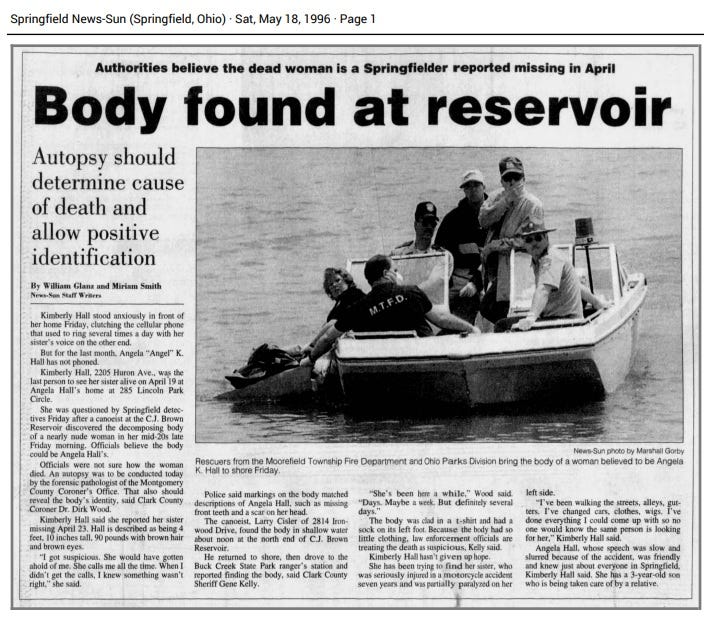
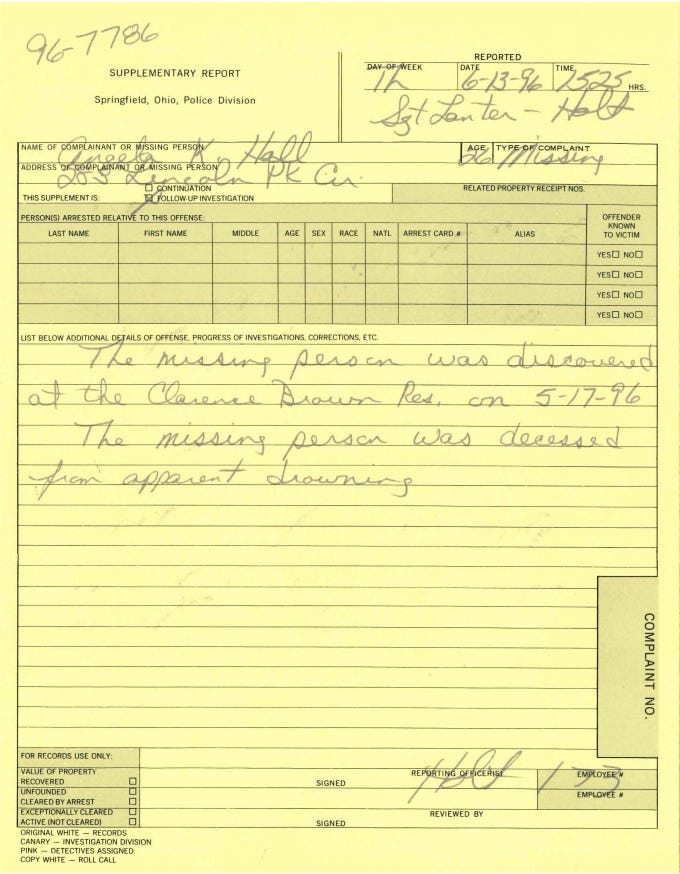
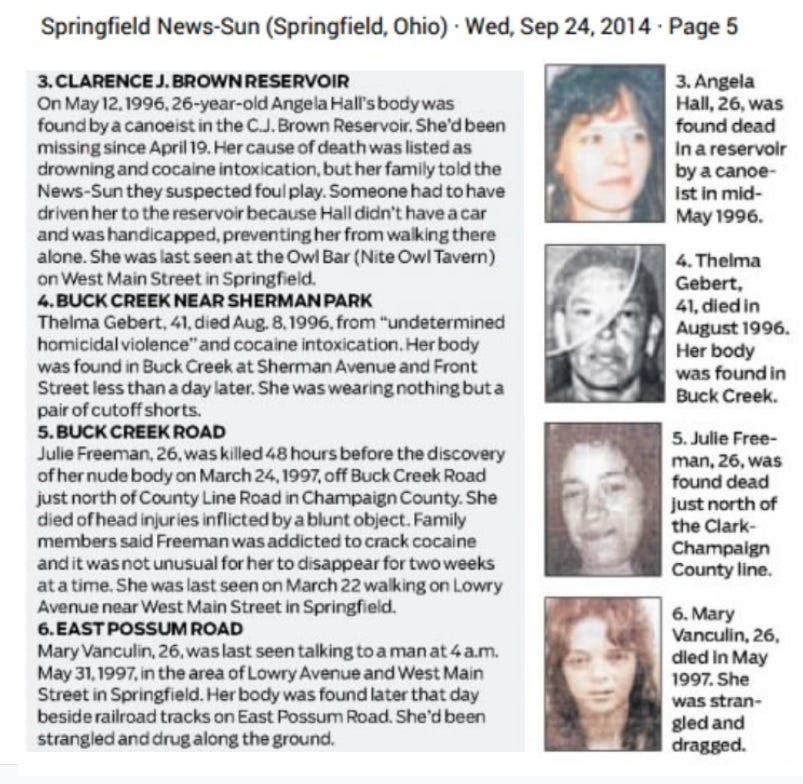
For nearly a month, the family endured the agonizing, static silence that accompanies a missing person case. The agonizing uncertainty came to a sudden, horrifying end on Friday, May 17, 1996, when a lone canoeist paddling through the murky waters of the C.J. Brown Reservoir spotted a body drifting near the shoreline.
It was Angela. An autopsy subsequently listed her cause of death as a lethal combination of drowning and acute cocaine intoxication. On Monday, May 20, 1996, a forensic dental expert officially confirmed the identity of the remains recovered from the reservoir, and law enforcement opened a suspicious cold-case homicide investigation.
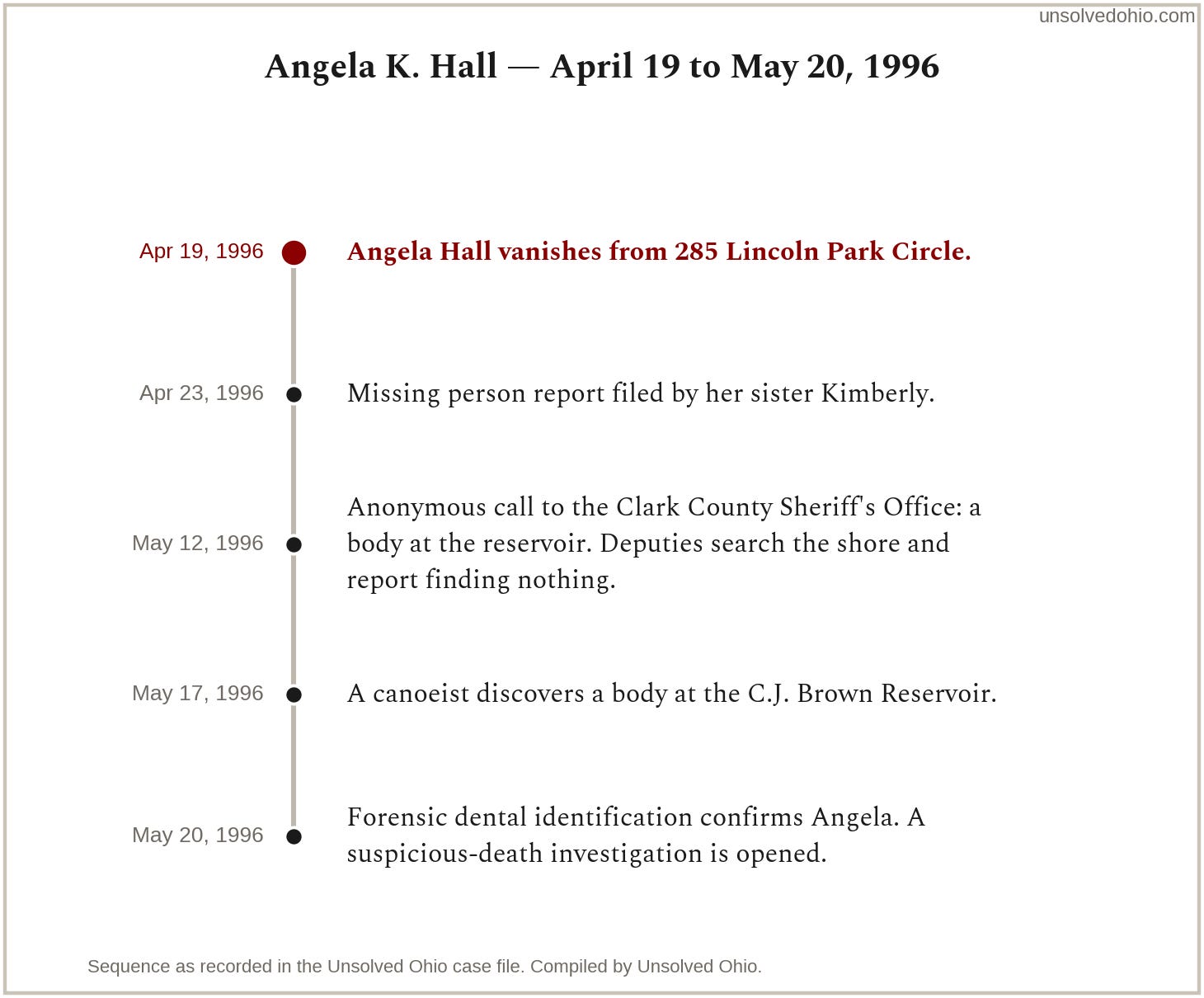
Yet, tucked away inside the official case notes was an ominous, unexplained detail that continues to haunt the record. Five days before the canoeist found Angela’s body, an anonymous phone call had come into the Clark County Sheriff’s Office dispatch. The caller explicitly instructed dispatchers to search a specific location at the C.J. Brown Reservoir, claiming they would find the missing Angela Hall there. Deputies were dispatched to search the shores but reported finding nothing.
Detectives managed to trace the mysterious phone call back to the mother of a “friend” of the Hall family. When questioned, the mother claimed that “her daughter” was the one who had actually spotted Angela’s body in the reservoir. Officially, this tipster was never publicly named, and her identity was buried. The strange exchange made a brief appearance in the local newspaper before vanishing from public discussion entirely.
To those who knew and loved Angela, the official finding of accidental drowning brought no closure. Her family remained steadfast that foul play was the only logical explanation. A frail, 90-pound woman with a severe limp and no automobile could not have navigated the miles of highway to the distant reservoir on her own. Someone had taken her there.
The Dark Atmosphere Over Clark County
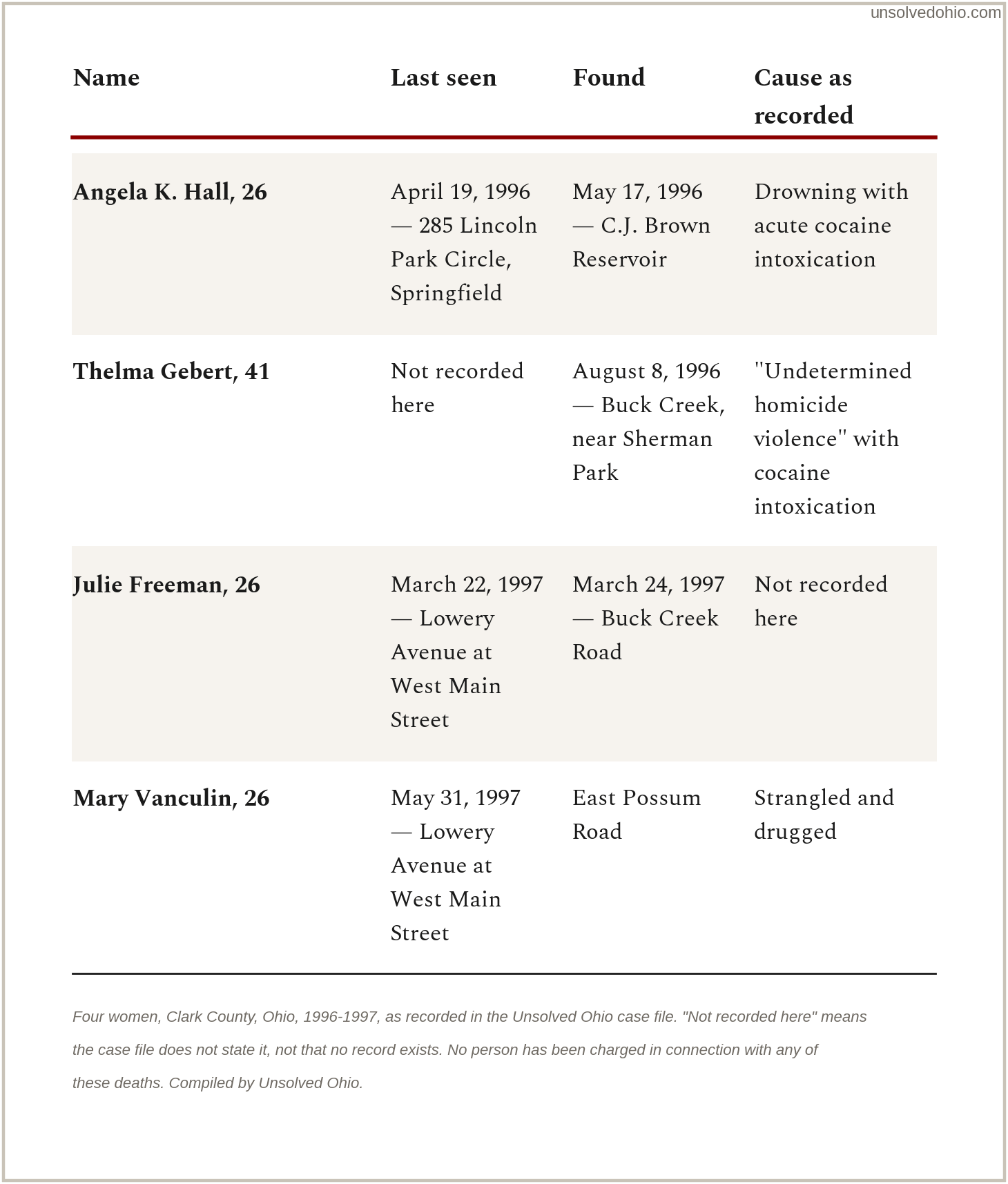
On August 8, 1996, another local woman, 41-year-old Thelma Gebert, was discovered dead in Buck Creek near Sherman Park, wearing only a pair of cutoff denim shorts. Her official cause of death was ruled “Undetermined Homicide Violence” paired with cocaine intoxication — a grim echo of Angela’s final hours.
Then, it happened again.
On March 24, 1997, Julie Freeman, 26, was killed 48 hours before the discovery of her nude body on Buck Creek Road. Julie was seen March 22 walking near Lowery Avenue near West Main Street by the Nite Owl Bar.
Then, it happened again.
On May 31, 1997, Mary Vanculin, 26, was last seen talking to a man in the area of Lowery Avenue and West Main Street. Her body was found on East Possum Road strangled and drugged.
For the family of Angela Hall, the quiet, murky waters of C.J. Brown Reservoir retained their secret. The identity of the driver who led Angela away from Lincoln Park Circle on that April evening remains frozen in time — just one more unsolved chapter in the long litany of women who stepped into the shadows of the Killing Fields of Springfield, Ohio, never to return.
The next installment returns to Michelle. Subscribe to follow the case file as it publishes — and become a paid subscriber for the court records and case documents embedded throughout the series.
This installment names individuals whose public records and documented proximity place them within the investigative scope of this case. No one named here has been charged in connection with the death of Angela Hall or the disappearance of Michelle Rice, and every person is presumed innocent unless and until proven guilty. Court charges that were dismissed or reduced are identified as such, and a dismissed charge is not evidence of anything. We name people to generate investigative leads, not verdicts. Unsolved Ohio reports from public court records, official registries, documented media reports, on-record interviews, and open-source analysis using Artificial Intelligence and Social Network Analysis; a documented association between two people is a starting point for investigation — never proof of a crime. This is an educational publication and not legal advice. If you have information about Angela Hall or Michelle Rice, submit it at unsolvedohio.com — your name is never published without your written permission, and we correct factual errors promptly. Full terms: Disclaimer.