



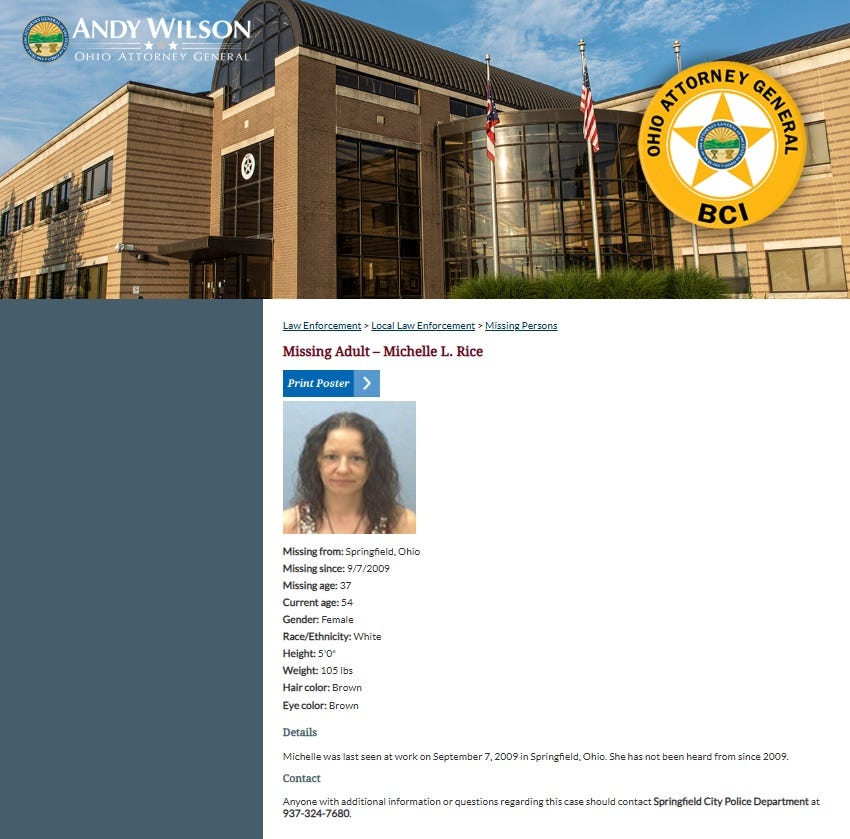
We begin every case story with the cold sterile facts of actuary science and statistics. The story of Michelle Hall-Rice and her possible fate begin here.
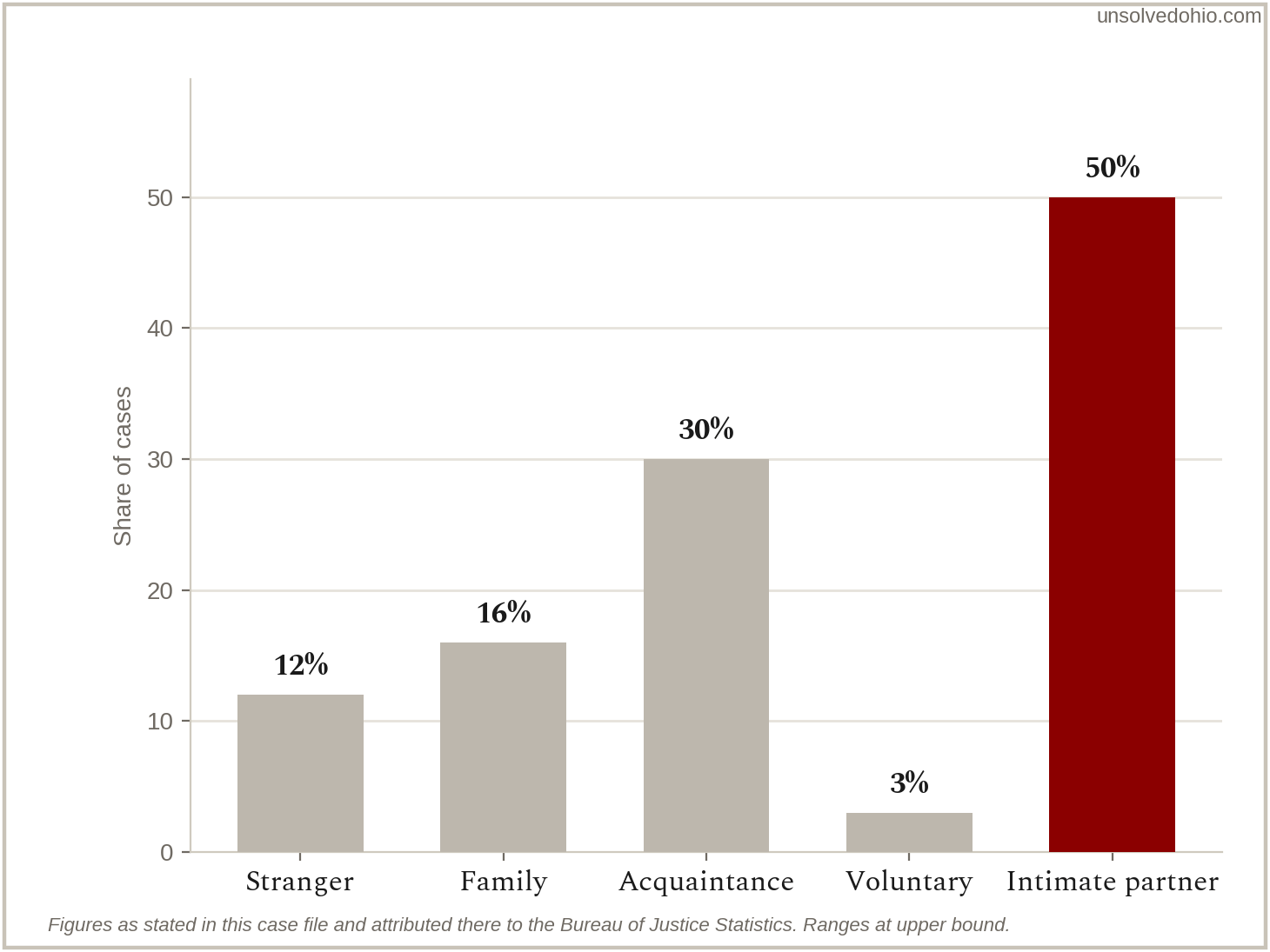
“Suspect Relationship Probabilities” according to crime data from the Bureau of Justice Statistics and public health tracking regarding violence against women”
We begin, as one always must, when the heart’s compass fails, with the cold and sterile facts. To ground a narrative in the unyielding reality of actuarial science is to build upon a chilling, authoritative foundation. It strips the flesh from wild speculation, leaving behind only the heavy, empirical bone of probability.
According to the quiet, damning ledgers kept by the Bureau of Justice Statistics, the threat matrix for a vanishing like Michelle’s constructs a clear and terrifying hierarchy of risk. The mathematics of disappearance are brutally straightforward. In the dark theater of violence against women, the stranger lurking in the alleyway—that classic phantom of our collective nightmares—accounts for a mere 12 percent of the shadows. The non-intimate family member, perhaps a sibling or an in-law, claims roughly 16 percent. The casual acquaintance, the friend, or the familiar face from the workplace makes up 25 to 30 percent. And the comforting, wistful fantasy that a woman simply packed a solitary suitcase and voluntarily drifted away into a new life? A fragile, almost illusory 3 percent.
No, the truest danger, the most suffocating peril, lies much closer to home. Between 34 and 50 percent of the time, the architect of a woman’s demise is an intimate partner, a husband, a boyfriend, an ex-lover whose devotion curdled into control.
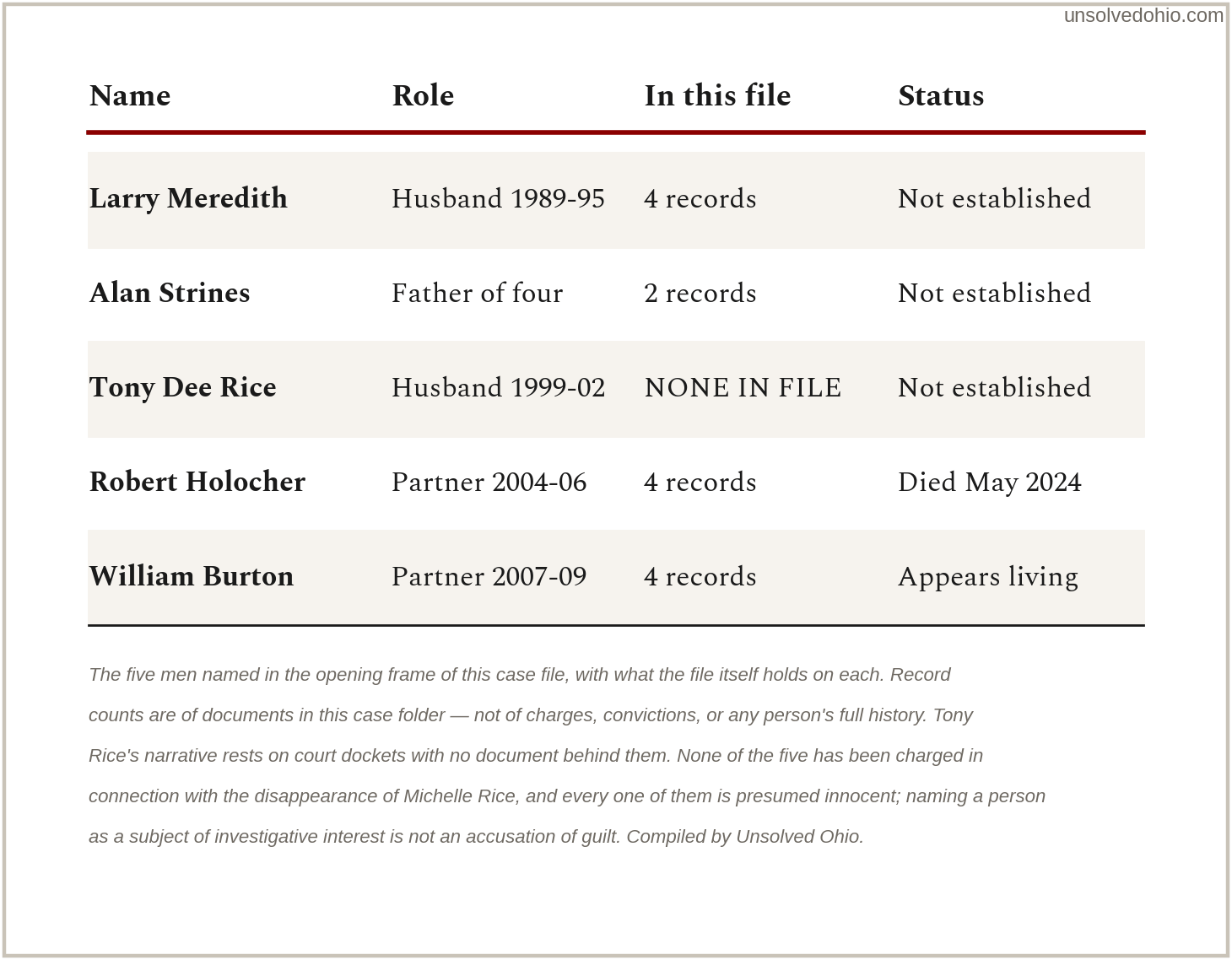
It is against this unforgiving calculus that the architecture of Michelle’s life must be examined. Her world was inextricably tethered to five specific men: Larry Meredith. Allan Strines. Tony Rice. Robert Holocher. William Burton.
To juxtapose these names against the data is to feel the sudden, plunging chill of recognition. These are not gentle men. Each carries a history scarred by the ugly, repetitive rhythms of domestic violence; each bears a criminal record that whispers of a profound capacity for transgression. They fall, every one of them, squarely into that highest, most perilous category of risk.
The actuarial truth is stark and unavoidable: there is up to a 50 percent mathematical probability that the violent answer to Michelle’s fate breathes, or breathed, within this tight circle of men. The investigative lens narrows abruptly—harsh, bright, and blinding—transforming these five figures from mere passing shadows in her past into the glaring, undeniable focal point of our tragedy.
The Last Man to See Michelle Alive
The flat, unyielding expanses of western Ohio in the late winter of 1989 offered little in the way of romance or redemption. The rural manufacturing outskirts of the Dayton metropolitan area, bleeding into the gray borders of Darke and Miami Counties, were places of slow decay. It was a geography defined by the relentless thrum of factories that were already beginning to rust, surrounded by agricultural fields that lay dormant and frozen.
Into this bleak diorama stepped William Burton, a man whose life would become a dark testament to the intersection of poverty, restlessness, and violence.
Born in the frigid mid-January of 1963, William “Bill” Burton was a man of unsettling physical asymmetry. He stood an imposing six feet tall, yet his frame carried a mere 145 pounds. He was gaunt, almost skeletal, with brown hair and brown eyes that betrayed an intrinsic, drifting emptiness. This physical profile—the height of a laborer but the weight of a starved bird—was not merely a descriptive detail; it was a recognized risk factor. In the forensic calculus of domestic violence, such a disparity in leverage and weight often functions as a latent weapon, particularly when hands are eventually brought to the throat of a smaller victim.
For Paid Subscribers: The Arrest Report, February 4, 2008
The night Michelle Rice was strangled, in the arresting officer's own words — including what William Burton told police he had done. Paid subscribers can open the original.
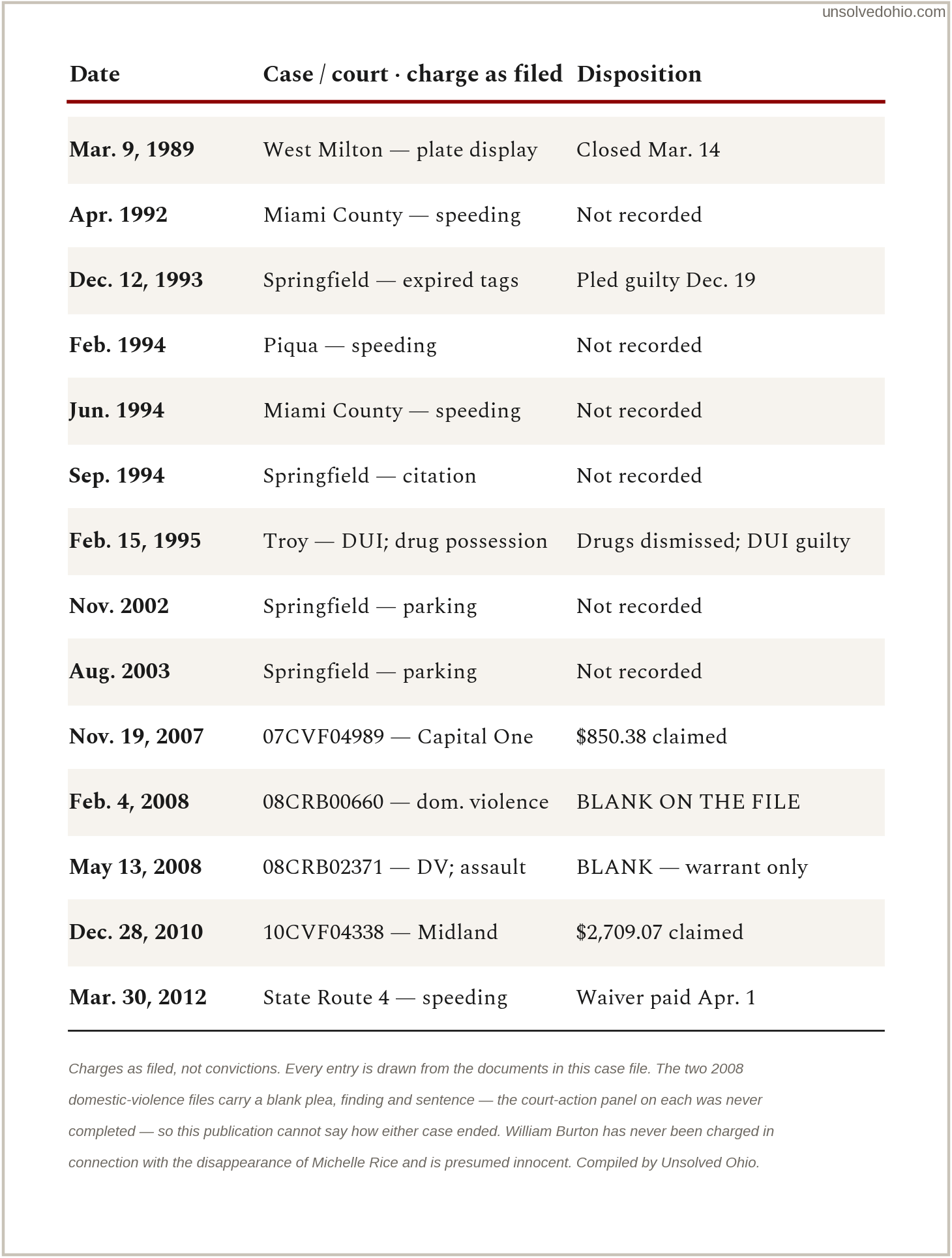
By 1992, the restless energy that would define Burton’s adult years began to manifest as a high-frequency geographic displacement. He was a creature of the Rust Belt, moving like a ghost through the fading municipal boundaries. He shifted his residence within Greenville, retreating toward the slightly denser urban core of the municipality, settling at 604 South Grey Street. The administrative friction persisted. On a Thursday in late April of that year, the flashing lights of a patrol car found him once again. He was cited for a speeding violation and, characteristically, another failure to display his plates properly. The recurrence of these vehicular violations painted a picture of a man perpetually in transit, yet never truly arriving anywhere. He was constantly navigating the margins of the law, accumulating a paper trail of municipal infractions that served as a breadcrumb trail of his downward trajectory.
The following year marked a pivotal shift in Burton’s geography. In 1993, he abandoned the rural outskirts and drifted toward the urban center of Springfield in Clark County. He relocated to 4780 Quwood, bringing with him the defining hallmark of his existence: the clunker. Burton engaged in a practice investigators term “vehicle churning”—the frequent acquisition and operation of older, high-maintenance automobiles that are perpetually on the verge of failure. On a cold Sunday, December 12, 1993, at the intersection of West Pleasant and South Lowery, Springfield police cited him for driving with an expired registration. He was at the wheel of a decaying yellow 1978 Chevy Coupe, a brightly colored relic of a bygone era, sporting license plate F354710. The bright yellow of the rusted chassis must have stood out vividly against the bleak Springfield winter. He pled guilty a week later, waiving the case away, but the transition was complete.
He had entered the Springfield node, the very jurisdiction where, fifteen years later, his path would lethally intersect with Michelle Rice. If 1993 was the year of arrival, 1994 was the year of manic oscillation. Burton could not remain still. He bounced erratically between Piqua, Troy, and Springfield. His vehicle of choice had changed; the yellow Chevy was gone, replaced by a maroon 1986 Dodge Coupe, bearing the plate NUE784. The Dodge became his vessel for a year of escalating traffic hazards.
In February, while listing a residence at 310 South Cherry Street in Troy, he was cited for speeding in Piqua. By June, still claiming the Troy address, he was caught speeding again, coupled with an assured clear distance violation in Miami County. Come September, he was back in Springfield, cited in the 500 block of Weinland, though his registered address had shifted to 320 East North Street in Piqua. He was a man vibrating with an anxious, directionless energy, burning through cheap gasoline and cheap cars, leaving a trail of unpaid municipal debts in his wake.
Then came 1995, and with it, a darkening of his behavioral profile. The administrative nuisances—the speeding tickets, the expired tags—curdled into something more sinister. The rot had reached the core.
On February 15, 1995, the law finally caught up to the deeper reality of William Burton’s lifestyle. He was arrested in Troy for Driving Under the Influence. But this time, the search of his person and his vehicle yielded more than just the smell of alcohol. He was charged with Possession of Drug Paraphernalia and Possession of Controlled Substances. His primary residence was still listed as the Cherry Street address in Troy, though a secondary haunt on Wood Drive in Springfield appeared in the periphery of the records. The drug charges were eventually dismissed by July, but he was found guilty of the DUI. The veneer of the harmless, drifting mechanic was gone; Burton was now officially tethered to substance abuse, a destabilizing factor that would serve as the accelerant for the horrors to come.
Years passed, bleeding into a new millennium, and Burton’s gravitational pull remained fixed on Springfield. By 2002, he had embedded himself in the downtown core, taking up residence at 4 West Main Street, Apartment 819. It was a bleak, utilitarian structure, a place that housed the transient and the financially ruined. Here, he continued his vehicular churning.
In November of 2002, he was operating a Geo Metro Hatchback—a tiny, fragile car that must have looked absurdly small wrapped around his gaunt, six-foot frame. He was cited for a parking violation. By August of 2003, the Geo Metro had been swapped for a Ford pickup truck, which garnered him yet another parking citation at the same address. These mundane infractions were the heartbeat of a life going nowhere, a steady rhythm of minor failures anchoring him to 4 West Main Street. The building itself would soon become a mausoleum for his humanity.
The timeline lurched forward to 2007. The year the storm finally broke. William Burton had moved a few doors down the hall to Suite 900. His financial ruin was no longer a matter of mere unpaid parking tickets; it was systemic. In late November, Capital One Bank filed a formal debt complaint against him for a sum of $850.38. He was a man suffocating under the weight of his own insolvency.
The December Convergence at Hull Plaza
Simultaneously, another fractured soul was navigating the treacherous currents of Springfield. Michelle L. Rice was living on Linden Avenue. In August of 2007, the darkness in her own life spilled over onto the pavement of Lagonda Avenue. At 2:28 in the morning, behind the wheel of a red Honda Prelude, she was involved in an accident. She was arrested for Operating a Vehicle Impaired, her breath test confirming the intoxication. Though her case was dismissed by Halloween, the event marked her as vulnerable, caught in the same downward spiral of substance and circumstance as Burton.
For Paid Subscribers: Suite 900, Before She Moved In
A debt complaint filed a month before the December convergence, naming the address the two of them would share. Paid subscribers can open the filing.
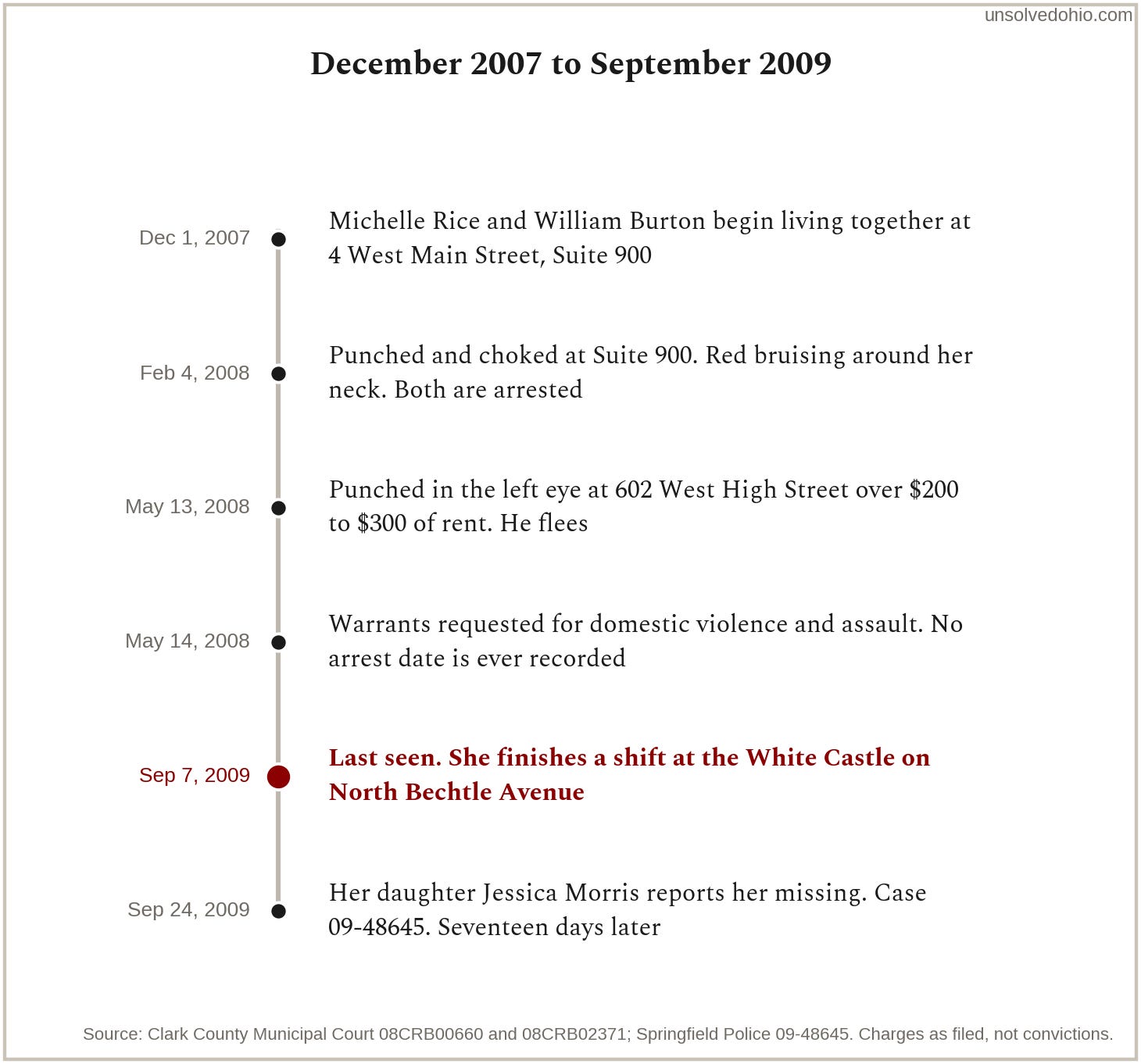
By December of 2007, as the brutal Ohio winter set in, Burton and Rice sought refuge in each other. They began living together as boyfriend and girlfriend in the cramped, suffocating confines of 4 West Main Street, Suite 900. This was the same address that Michelle and Robert Holocher had lived in for a short period of time, it was the Hall Plaza building. It was an alliance forged in desperation. The overlap of Burton's mounting, unpayable debts and Rice's recent, substance-fueled accident meant that from its very inception, the household was a powder keg. They were two drowning people, and rather than saving each other, they would only ensure they sank faster.
The new year brought with it a rapid, terrifying escalation. The year 2008 would be defined by a vicious intersection of economic distress and profound, intimate violence. The minor traffic infractions of Burton’s past were entirely eclipsed by the brutality he now enacted behind closed doors.
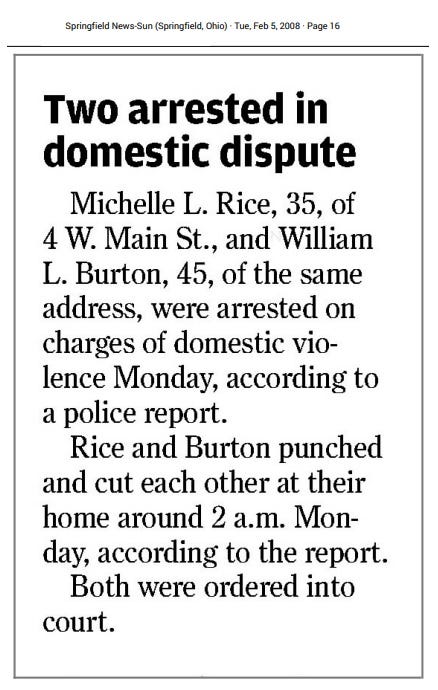
It happened on February 3, 2008. The clock read 2:40 AM, a desolate hour when the bitter cold seeps through the poorly insulated walls of downtown apartments. Springfield Police Officers Matthews and Kranz were dispatched to Suite 900. When they arrived, they were met with a scene of harrowing domestic terror. Michelle (Hall) Rice had returned to the apartment with the fragile hope of reconciling a previous argument. Instead, she was met with a devastating physical assault.
Burton had unleashed his rage upon her, utilizing his physical advantage—that six-foot, angular frame—to terrifying effect. He punched her squarely in the face. But the violence did not stop at blunt force. He wrapped his hands around her throat and squeezed, choking her until the oxygen was cut off, leaving vivid red bruising encircling her neck. The officers dutifully recorded the physical evidence of the nightmare: the angry redness and swelling above her right eye, the slow drip of a bloody nose, the jagged tear of a busted lip.
Burton was arrested for domestic violence, a charge that the indifferent machinery of the courts would later reduce to mere menacing. Rice, in the tragic, tangled reality of victims who self-medicate, was also arrested when officers found two grams of marijuana and glass pipes stuffed in her jacket pocket. The state treated them both as criminals, blind to the fact that one was a predator and the other was prey.
For Paid Subscribers: Her Side of the Same Night
Michelle Rice was arrested too, hours after she was strangled. This is her file. Paid subscribers can open it.
In criminological circles, non-fatal strangulation is not viewed as a mere assault; it is a dark prophecy. It is recognized as one of the most accurate, chilling predictors of future homicide. A victim who has been strangled by an intimate partner is statistically 750 percent more likely to eventually be murdered by that same partner. The red marks on Michelle Rice’s neck were not just bruises; they were a countdown.
By May of that same year, the toxic pair had relocated to 602 West High Street. The change in scenery did nothing to alter the fundamental mathematics of their doom. The financial pressure was crushing them. On May 13, Officer Jeffrey Kerns responded to reports of yet another assault at the new address. The cause of the violence was tragically mundane: the household was $200 to $300 short on their rent money.
Unable to cope with the profound anxiety of his financial failure, Burton manifested his stress through his fists. He punched Michelle Rice directly in the left eye before fleeing the scene like a coward into the spring night. The following morning, the reality of his economic ruin was cemented when Capital One Bank officially filed a Certificate of Judgment against him. The cycle of violence was inexorably linked to the cycle of poverty. Minor disagreements, fueled by the panic of impending eviction, were met with overwhelming, disproportionate physical force.
In criminological circles, non-fatal strangulation is not viewed as a mere assault; it is a dark prophecy. It is recognized as one of the most accurate, chilling predictors of future homicide. A victim who has been strangled by an intimate partner is statistically 750 percent more likely to eventually be murdered by that same partner. The red marks on Michelle Rice’s neck were not just bruises; they were a countdown.
By May of that same year, the toxic pair had relocated to 602 West High Street. The change in scenery did nothing to alter the fundamental mathematics of their doom. The financial pressure was crushing them. On May 13, Officer Jeffrey Kerns responded to reports of yet another assault at the new address. The cause of the violence was tragically mundane: the household was $200 to $300 short on their rent money.
Unable to cope with the profound anxiety of his financial failure, Burton manifested his stress through his fists. He punched Michelle Rice directly in the left eye before fleeing the scene like a coward into the spring night. The following morning, the reality of his economic ruin was cemented when Capital One Bank officially filed a Certificate of Judgment against him. The cycle of violence was inexorably linked to the cycle of poverty. Minor disagreements, fueled by the panic of impending eviction, were met with overwhelming, disproportionate physical force.
For Paid Subscribers: The Line That Dates Everything
One sentence in this affidavit establishes when Michelle Rice and William Burton began living together — and it is the only place in the entire case file that does. Paid subscribers can open it.
Tragically, by August, the domestic violence charges stemming from the May assault were dismissed. Michelle Rice, trapped in the terrifying orbit of her abuser, declined to complete a statement of probable cause. The state washed its hands of the matter, leaving the door unlocked for the final act.
On that same day, September 24th, Missing Person Case number 09-48645 was officially filed By Jessica Morris, Michelle’s first born, her daughter she had with Larry. Had it really been 19 years since she was born? The Springfield Police investigation commenced, but the apartment at 602 West High Street was suddenly terribly quiet.
The official timeframe for her disappearance, as recognized by NamUs and the Ohio Attorney General, is permanently marked as Monday, September 7, 2009, in Springfield, Ohio. On that late-summer Monday, Michelle finished her shift and walked out of her workplace—a White Castle situated at 1901 North Bechtle Avenue. She was supposed to return to the residence she shared at 602 West High Street.
She never arrived.
As the grand jury indictment loomed over the disappearance, William Burton executed his final documented geographic maneuver. He waited three years, weathering the closure of another debt case with Midland Funding, before making a strategic exit from the jurisdiction that was hunting him.
On March 30, 2012, the flashing lights found him one last time. He was cited for speeding on State Route 4. His residence had shifted to 341 East Melford Avenue in Dayton, Ohio. He was behind the wheel of a white 2006 Chevy Van, plate EKT4490, yet another disposable vehicle in a lifelong procession of churned steel. He paid the waiver two days later. In November, Capital One filed yet another judgment against him. He had moved on to Dayton, fleeing the ghosts of Springfield, leaving behind a legacy of unpaid debts, shattered glass, and a missing woman whose fate remained locked somewhere within the silent, violent machinery of his mind.
For Paid Subscribers: Still at West High, December 2010
A debt filing from fifteen months after Michelle disappeared, showing where William Burton was still living. Paid subscribers can open the complaint.
Michelle L. Hall was a woman who had survived abusive lovers, a barrage of evictions, multiple arrests, the crushing loss of her children to the state, the murder of her sister, and the unfathomable agony of watching a fire take her three-year-old daughter. Her life was battered and exhausted; eventually, it simply stopped registering on the grid altogether.
Conclusion
Michelle disappeared entirely into the humid midwestern air. She left behind no clues, only the echoing silence of an unfinished tragedy. 17 days passed in a quiet, agonizing limbo. Finally, on Thursday, September 24, 2009, her daughter, Jessica (Meredith) Morris, walked through the doors of a Springfield police station and officially reported Michelle L. Hall as a missing person.
The desperate search for a woman who had spent her entire, turbulent life trying to find a safe place to rest had officially begun.
The autumn of 2009 arrived in Springfield with a deceptive, almost mocking gentleness. The meteorological records speak of passing white clouds and temperatures lingering comfortably in the mid-forties. It was, by all accounts, sweater weather—the kind of crisp, blue-skied, innocent season that usually heralds the distant roar of Friday night football and the nostalgic, woodsmoke scent of burning leaves drifting across the Ohio plains. Yet, for those paying attention, the cooling air brought no comfort. It brought only the slow, imperceptible tightening of a noose.
The changing of the leaves offered a picturesque veneer over a town that was actively swallowing its most vulnerable. Michelle Hall had vanished into this crisp, midwestern air, leaving behind an apartment on West High Street, an empty uniform at a White Castle, and a lifetime of fractured, charred memories. But to view her disappearance as an isolated tragedy is to misunderstand the very nature of the environment that consumed her.
To understand the architecture of Michelle’s disappearance, one must willingly descend into the dust of Clark County court dockets and the exhaustive, grim records of the Springfield Police Department. When you lay these files out—treating each citation, each dismissed domestic violence charge, and each transient address as a node in a broader, darker web—a terrifying geometry emerges from the data.
This is not merely a collection of bureaucratic paperwork; it is a meticulously mapped network of human misery. Through the empirical lens of link analysis, the chilling coincidences cease to be coincidences at all. By fusing the historical arrest records with the timelines of the missing, the pattern becomes undeniable.
There were other women who disappeared into this exact same chill. There were other unsolved homicides blooming in the margins of the very same neighborhoods during the very same timeframe.
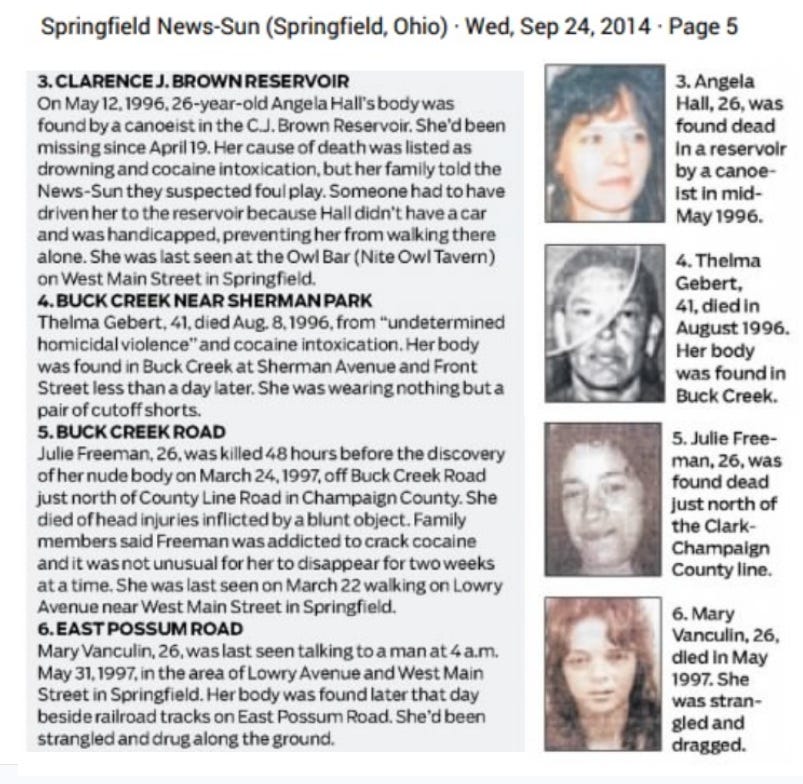
The system that repeatedly failed Michelle—the one that allowed violent men to punch, choke, and control her with near-total impunity—was not just failing her. It was failing an entire demographic of women living on the periphery of Springfield’s consciousness.
At its heart, this investigation was intended to be the story of one woman trying to outrun the ghosts of a Kenton Street fire. Yet, as the shadows in the valley lengthen and the investigative threads are pulled taut, it becomes undeniably clear that this chronicle cannot belong to Michelle alone. It belongs just as much to her sister, Angela. It belongs to the other women whose names are quietly etched into the cold case files, women who found themselves trapped in the exact same cyclical nightmare of poverty, addiction, and systemic neglect.
They were bound together by invisible, frayed threads of circumstance. They shared the same transient apartments, walked the same dimly lit avenues, and sought fleeting refuge in the same anesthetics. And, one by one, they vanished. Their disappearances were met not with sirens and search parties, but with the deafening, apathetic silence of a community that had already looked the other way.
Ultimately, this is the story of the murky, desperate waters these women were forced to inhabit. It is an exploration of a specific depth of society where more than a score of criminals, rapists, and murderers moved with terrifying freedom.
These were not cinematic villains or criminal masterminds. They were men of ordinary, unspectacular evil. They were the boyfriends who withheld rent money, the men driving with suspended licenses, the abusers whose charges were quietly dismissed on a Friday afternoon. They swam silently through the shallows of Springfield like sharks, possessing a predatory instinct honed by a system that rarely held them accountable. They did not need to hunt aggressively; they simply waited for the scent of blood to drift their way.
Michelle Hall spent 37 years treading water in this treacherous ecosystem, carrying the unimaginable weight of lost children and a murdered sister. When she finally slipped beneath the surface in September 2009, she didn’t just disappear. She was consumed by the very waters she had spent a lifetime trying to survive.
The autumn leaves continued to fall, the Friday night lights continued to burn, and the sharks continued to swim, undisturbed in the Ohio chill. And maybe, the opening verse of a song could be heard.
“A long, long time ago, I can still remember, how that music used to make me smile, and I knew if I had my chance, that I could make those people dance, and maybe they’d be happy for a while”.
This is the final installment of Case File 4. The case is not closed — it is unsolved, and the tip line is live. If you knew Michelle, worked a shift with her, lived in the buildings on West Main or West High, or remember September of 2009 in Springfield, we want to hear from you. Start at the case hub — and become a paid subscriber for the court records embedded throughout the series.
If you have information about the disappearance of Michelle Rice, submit it at unsolvedohio.com — your name is never published without your written permission, and we correct factual errors promptly. Full terms: Disclaimer.
deeply sad story. your writing is touching