



We begin every case story with the cold sterile facts of actuarial science and statistics. The story of Michelle Hall-Rice and her possible fate begins here.
“Suspect Relationship Probabilities,” according to crime data from the Bureau of Justice Statistics and public-health tracking regarding violence against women
We begin, as one always must, when the heart’s compass fails, with the cold and sterile facts. To ground a narrative in the unyielding reality of actuarial science is to build upon a chilling, authoritative foundation. It strips the flesh from wild speculation, leaving behind only the heavy, empirical bone of probability.
According to the quiet, damning ledgers kept by the Bureau of Justice Statistics, the threat matrix for a vanishing like Michelle’s constructs a clear and terrifying hierarchy of risk. The mathematics of disappearance are brutally straightforward. In the dark theater of violence against women, the stranger lurking in the alleyway — that classic phantom of our collective nightmares — accounts for a mere 12% of the shadows. The non-intimate family member, perhaps a sibling or an in-law, claims roughly 16%. The casual acquaintance, the friend, or the familiar face from the workplace makes up 25% to 30%. And the comforting, wistful fantasy that a woman simply packed a solitary suitcase and voluntarily drifted away into a new life? A fragile, almost illusory 3%.
No, the truest danger, the most suffocating peril, lies much closer to home. Between 34% and 50% of the time, the architect of a woman’s demise is an intimate partner, a husband, a boyfriend, an ex-lover whose devotion curdled into control.
It is against this unforgiving calculus that the architecture of Michelle’s life must be examined. Her world was inextricably tethered to five specific men: Larry Meredith. Allan Strines. Tony Rice. Robert Holocher. William Burton.
To juxtapose these names against the data is to feel the sudden, plunging chill of recognition. These are not gentle men. Each carries a history scarred by the ugly, repetitive rhythms of domestic violence; each bears a criminal record that whispers of a profound capacity for transgression. They fall, every one of them, squarely into that highest, most perilous category of risk.
The actuarial truth is stark and unavoidable: there is up to a 50% mathematical probability that the violent answer to Michelle’s fate breathes, or breathed, within this tight circle of men. The investigative lens narrows abruptly — harsh, bright, and blinding — transforming these five figures from mere passing shadows in her past into the glaring, undeniable focal point of our tragedy.
Pain, Heartbreak and Death — The Doomed Lives of the Hall and Rice Women
Springfield is a town in the Midwest where the industrial hum of the past has slowly faded into a quiet, relentless rust. To the unobservant eye passing through on a late-night highway, it might seem like just another dot on the map of middle America, a place where the American Dream was once manufactured in brick-and-mortar factories before being quietly packed away into memory. Here, the streets form a grid that attempts to impose order on a populace quietly wrestling with the suffocating weight of broken promises.

The geography of a doomed life is rarely charted across grand estates; instead, it is plotted in a succession of cramped apartments, sterile hospital emergency rooms, and the unforgiving concrete of city intersections. In such towns, destiny is not whispered; it is handed down, generation by generation, like a tarnished heirloom. It was into this specific gravity that Michelle L. Hall was born on a Tuesday, February 8, 1972. She arrived in a world already mourning its own lost glory, her beginning underscored by the haunting refrain drifting from car radios and corner jukeboxes:
So, bye, bye, Miss American Pie, drove my Chevy to the levee but the levee was dry, and them good ole boys were drinking whiskey ‘n rye, singing’ this’ll be the day that I die.
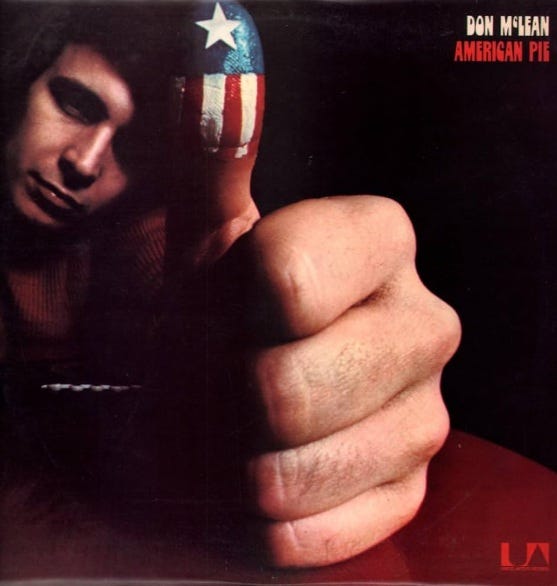
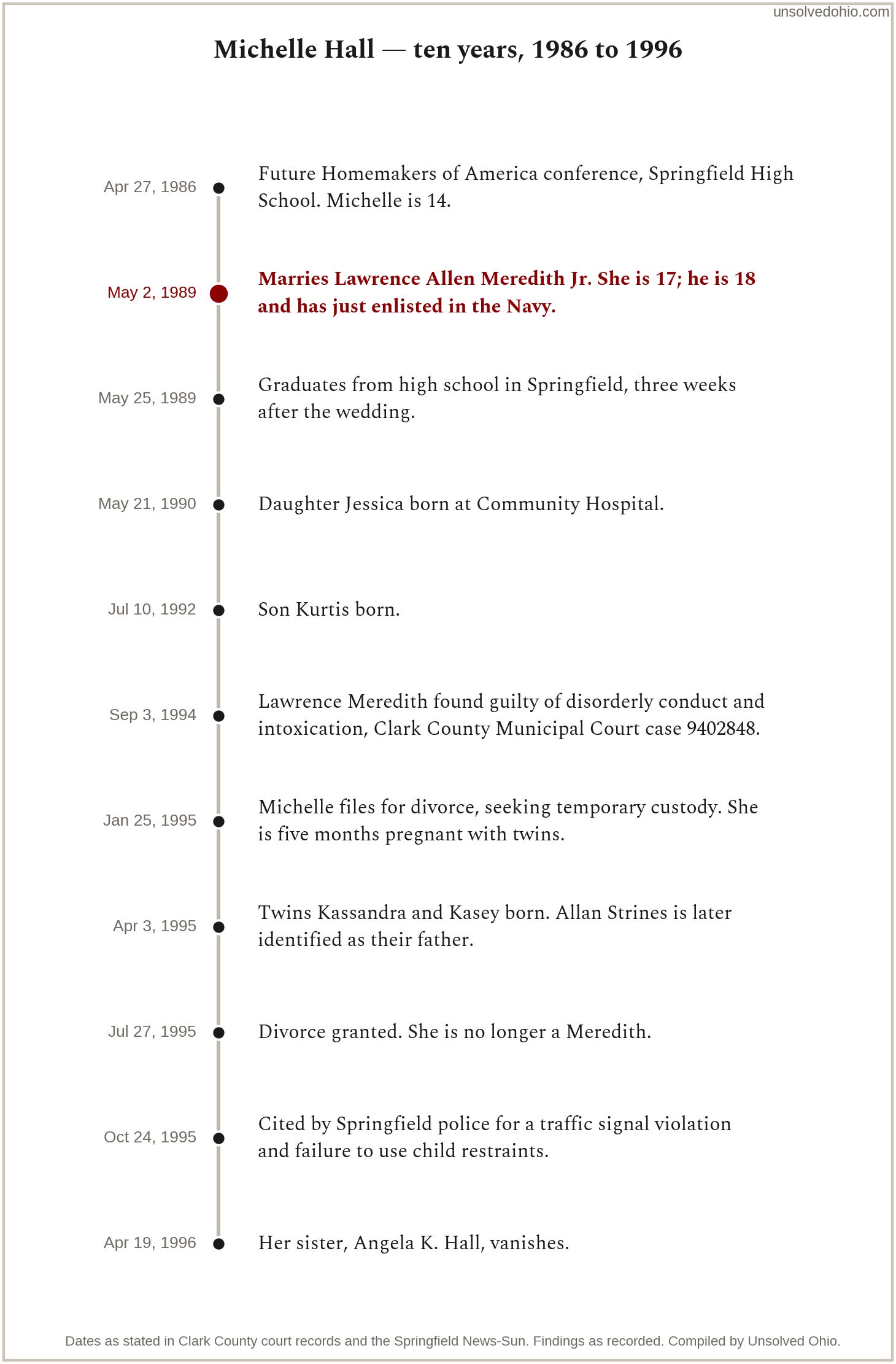
Looking back at those early years is to observe a mirage of ordinary, suburban aspiration. There was a time when the world seemed to hold a gentle, yielding shape for Michelle, a period where the grim realities of the town had not yet crept past the front porch. For a brief, shining moment, the trajectory of Michelle's youth seemed aimed toward conventional respectability. One need only look at Sunday, April 27, 1986, when a 14-year-old Michelle stood among her peers at the Future Homemakers of America (FHA) conference at Springfield High School.
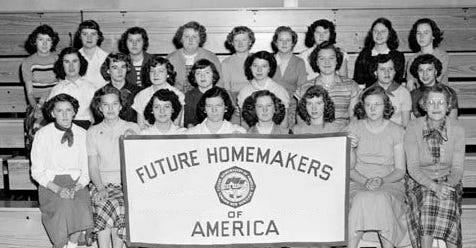
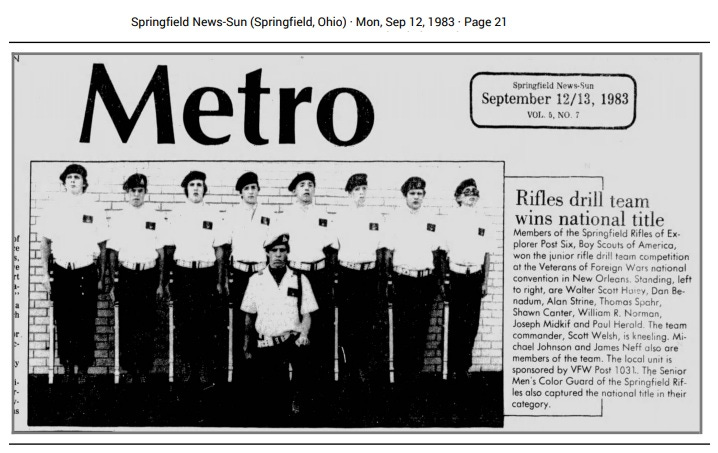
It is an interesting historical footnote that in 1945, the Future Homemakers of America (FHA) was founded by 29 home economics leaders in Chicago, Illinois to prepare students to be leaders in the home and workplace. The Springfield High School event was steeped in the midwestern virtues of domesticity and stability, a poignant contrast to the chaos that was quietly gathering on the horizon. It was an era and a place that still clung desperately to its wholesome laurels. Just three years earlier, a young man named Allan Strines and his Boy Scout troop, which was sponsored by VFW Post 1031, won the national “Rifle Drill Team” title. Strines would also be a graduate of Springfield High School. The town knew how to groom its youth for a picturesque version of adulthood, but it was ill-equipped to catch them when they fell.
Adulthood for Michelle arrived not as a gradual awakening, but as a sudden, breathless collision. By her seventeenth year, the innocent aspirations of the FHA conference had evaporated. At 17, Michelle found herself standing at the precipice of a new, incredibly heavy reality.
The Navy Docks in Springfield
Tuesday, May 2, 1989, was a relatively standard spring day, damp, dreary, and wet, with the temperature hovering around 68 degrees. The sky hung low and bruised, weeping a steady drizzle over the Midwestern grid. In fact, early May in Springfield was laying the groundwork for a record-breaking season. According to the National Weather Service, the frequent heavy rains in March, April, and May of 1989 made it the wettest spring on record for the region dating back to 1900. It was as if the atmosphere itself was gorged with a suffocating melancholy.
On that Tuesday, May 2, 1989, the number one song in America on the Billboard Hot 100 chart was “Like a Prayer” by Madonna. Pumping from every radio, MTV and lingering in the aisles of local grocery stores, the irony of the first verse in the song lays the groundwork for the entire story about Michelle Hall’s life.
On that very day, Lawrence Allen Meredith Jr., age 18, residing at 3022 Derr Road in Springfield, and 17-year-old Michelle Lynn Hall, residing at 152 Brent Drive West, were married. The then 18-year-old Lawrence “Larry” Allen Meredith Jr. had just enlisted in the Navy. There were no grand estates, no lengthy courtships dripping with old-world romance; it was a union born of youth and urgency, one that would eventually sink like a torpedoed battleship.
In a testament to her resilience, the young bride managed to complete her high school education just weeks later. Underneath the ceremonial gown and the fleeting applause of an auditorium, she was already carrying the crushing weight of a life moving too fast. On Thursday, May 25, 1989, Michelle graduated from high school in Springfield.
Yet, the physical toll of her rapid transition into womanhood and motherhood lingered like an unpaid debt. The following spring, the frantic wail of sirens cut through the quiet neighborhood. On Monday, May 21, 1990, a rescue squad responded to Michelle at her residence, transporting her to Community Hospital. The sterile, fluorescent glow of the hospital emergency room welcomed her, and while there, Michelle gave birth to a baby girl named Jessica. The responsibilities multiplied with a ruthless speed. Approximately a year and a half later, on Friday, July 10, 1992, a son named Kurtis was born. Two children, a teenage mother, and a young husband ostensibly tethered to the armed forces. But the foundation of the Meredith household was built on shifting sand.
Financial instability — the silent predator of young marriages — soon bared its teeth. The reality of providing for two infants with pockets full of lint and a marriage built on youthful desperation began to suffocate them. By Monday, July 1, 1991, Lawrence and Michelle faced the indignity of being evicted from their apartment at the Ronez Manor Apartments, located at 1948 Wilkes Drive, Springfield.
The intricacies of Larry’s military career remain shrouded in a haze of bureaucratic ambiguity. We don’t know if Larry was active duty or if he was in the Naval Reserves or if he just lied on the marriage license. What we do know is a stark mathematical reality: an enlisted active-duty sailor with an E-1 paygrade in 1991 earned roughly $753.90 per month, and the sailor would receive basic allowance for quarters (BAQ), with dependents, which would be an additional $289.80 per month. Thus, Larry’s total income for the month would be $1,043.70. It was a sum that demanded miracles of budgeting, leaving no room for the unexpected miseries that life in Springfield reliably provided. We also know that Navy members serve a standard target of three years at sea and three years on shore, though exact lengths range from three to five years at sea and typically three years on shore unless you are assigned to a submarine.
The eviction from Wilkes Drive was not an isolated misfortune; it was the beginning of a relentless, nomadic shuffling from one fragile sanctuary to another. The family became ghosts moving through the city’s underbelly, packing their meager lives into boxes and garbage bags under the cover of night. A documented residence history placed Michelle at 1267 Villa Road in Springfield on April 1, 1993. The walls changed, but the desperation remained the same. By Thursday, September 1, 1994, Lawrence and Michelle faced yet another eviction, this time from a Springfield property managed by a man named John W. Swick.
The strain was not merely financial; it was fracturing Larry’s composure, spilling over into the purview of local law enforcement. Compounding matters, on April 24, 1994, Larry was caught speeding and was found guilty with two BMV points assessed. To the affluent, a traffic ticket is a minor annoyance; to the impoverished, it is a catastrophic blow. When you can’t pay rent, a ticket like this puts hardship on the family.
The unraveling accelerated rapidly as the damp rot of poverty took hold of the young father’s spirit. Then on September 3, 1994, the Clark County Sheriff’s Office arrested Larry for disorderly conduct and intoxication and he was found guilty.
Paid Subscribers: The September 1994 Arrest Record
The Clark County Municipal Court record for the night Larry Meredith was arrested — the charge, the finding, and the address it happened at. Paid subscribers can open the original docket here.
The echoes of this arrest surely reverberated far beyond the walls of the county jail. Again, we assume Larry was no longer in the Navy because any military member who is delinquent in his financial responsibilities and with an arrest recorded is looked upon as a disgrace to the U.S. Navy and a sailor would be discharged under less than honorable circumstances.
The legal apparatus of the town, cold and indifferent, continued to process the wreckage of the Merediths’ lives. In less than a year Larry faced another court case, this time a civil judgment against Larry for $401.31, most likely for back rent. It was a paltry sum in the grand scheme of the American economy, but an insurmountable mountain for a family already drowning in the undertow of Springfield’s fading promise.
The marriage, strained by poverty and the heavy burdens of premature adulthood, finally collapsed. It had been a union hastily forged in the relentless rain of 1989, and now, bruised and battered, it was quietly dismantled in the sterile halls of a courthouse. On Wednesday, January 25, 1995, Michelle filed for divorce from Lawrence Meredith in Springfield, seeking temporary custody of their children. She was entirely alone once more, left to navigate the grid of the city, a young mother holding the fragile, fraying threads of a doomed life.
Paid Subscribers: The Divorce File, Start to Finish
The full Clark County docket in Meredith v. Meredith — every filing from the day Michelle walked in to the day the court could no longer find her. Paid subscribers can open the original.
The Paramour’s Secret Is Disclosed
At the time of the filing, Michelle was five months pregnant, with twins. Kassandra and Kasey Hall were born April 3, 1995. However, the children were not fathered by Larry. Michelle had an affair with a man named Allan Strines and Michelle had become pregnant. The evidence of this was listed years later in the local newspaper, the Springfield News-Sun, on August 13, 1998: Allan is identified as the twins’ father and Allan’s mother, Karen Strines, is identified as the twin girls’ grandmother.
Now there were four children born to Michelle: Jessica, Kurtis, Kassandra, and Kasey — two from Larry and two from Allan.
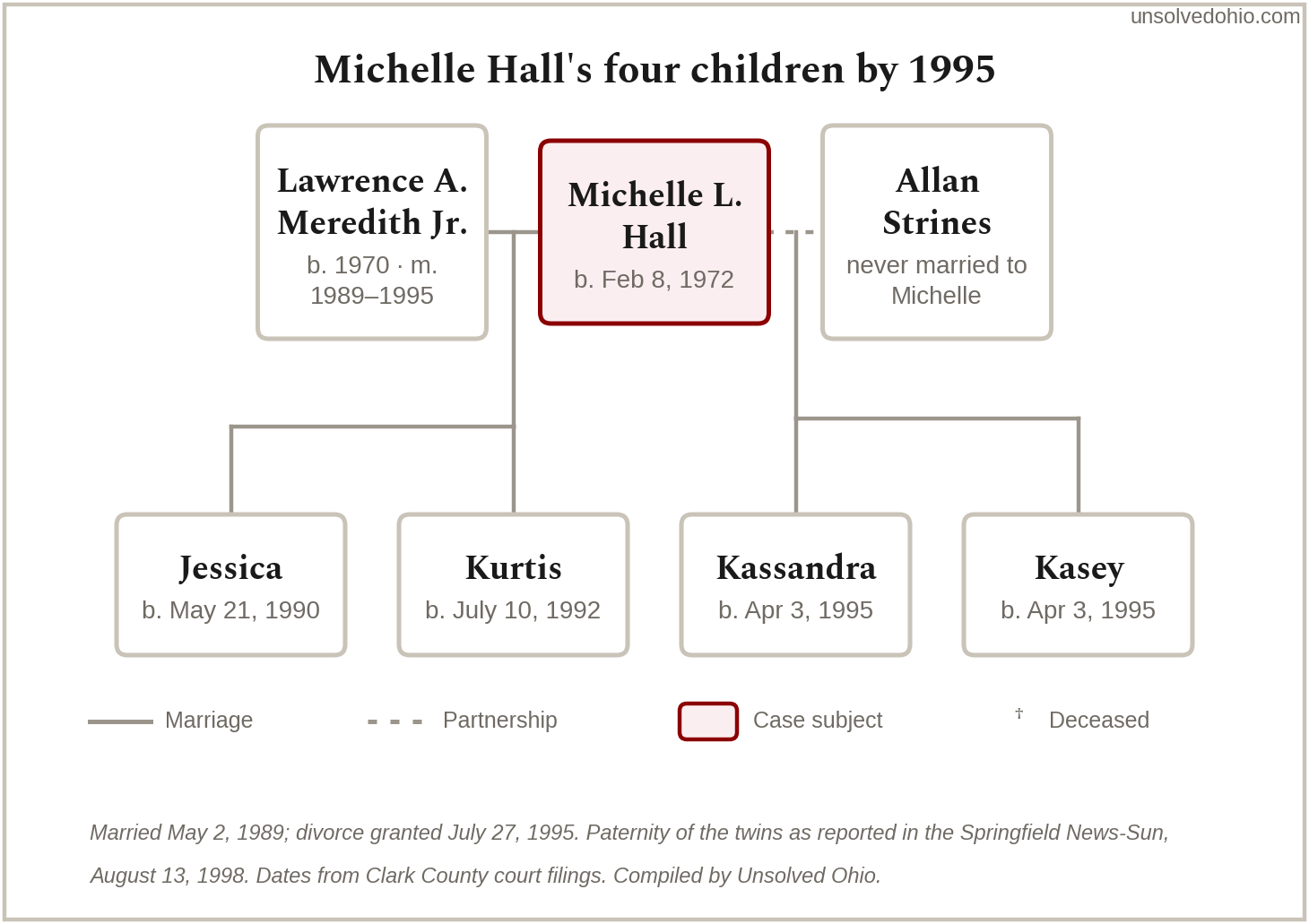
For Michelle, it was over. Michelle asked Larry to leave. Michelle was now in a home filled with all four children, and the dissolution of her marriage, the tenor of Michelle's life, shifted from quiet desperation to audible violence.
The men who drifted into Michelle’s orbit brought with them a dark, bruising weather. She was a young single mother trying to anchor a fragile household of a son and three daughters, stretching every dollar to make ends meet in a town where small-town opportunities were swiftly drying up.
The legal thread tying her to her youth was officially severed a month later. On Thursday, July 27, 1995, the divorce was formally finalized, and Michelle was no longer a woman bearing the name Meredith. She was, however, only escaping the wave to get hit by a tsunami.
Michelle gathered her children and relocated to 537 Linden Avenue. Life became a frantic, exhausting attempt to maintain balance — a routine periodically interrupted by the small, clumsy infractions of a mind stretched to its absolute limit. On Tuesday, October 24, 1995, the Springfield Police Department cited Michelle for running a traffic signal and failing to use child restraints. They were minor administrative marks on paper, but they signaled a young mother navigating life on sheer, depleted adrenaline.
If the year 1995 exposed domestic violence in Michelle’s private world, the spring of 1996 introduced an inescapable, heavy grief that would alter her family forever. It arrived not inside her own front door, but through the life of her sister, Angela K. Hall. On Friday, April 19, 1996, Angela vanished into the Midwestern air.
Angela Hall’s story is the next installment. Subscribe to follow the Michelle Rice case file as it publishes — and become a paid subscriber for the court records and case documents embedded throughout the series.
This installment names individuals whose public records and documented proximity place them within the investigative scope of this case. No one named here has been charged in connection with Michelle Rice’s disappearance, and every person is presumed innocent unless and until proven guilty. We name them to generate investigative leads, not verdicts. Unsolved Ohio reports from public court records, official registries, documented media reports, on-record interviews, and open-source analysis using Artificial Intelligence and Social Network Analysis; statistical probabilities describe populations, never individuals, and a documented association between two people is a starting point for investigation — never proof of a crime. This is an educational publication and not legal advice. If you have information about Michelle Rice’s disappearance, submit it at unsolvedohio.com — your name is never published without your written permission, and we correct factual errors promptly. Full terms: Disclaimer.