



In the twenty-six days between the twelfth of August and the seventh of September 1998, two houses burned in Springfield, Ohio. The first took Michelle Hall’s three-year-old daughter. The second took a woman named Darlene Rice, whose family line ran into Michelle’s by marriage, and whose death is still carried on the county’s books as an unsolved homicide.
Michelle was 26. She had five children left, a new address on Primm Drive, and a Red Cross caseworker.
What she did not have was a plan. What arrived instead was a man.
This is Case 4 of Unsolved Ohio. Start at Michelle Rice.
Along Came Tony Rice
Yet, there is no manual for surviving the ashes of one’s own child. For Michelle, survival did not manifest as resilience. Instead, it looked like a slow, erratic, and deeply public unraveling. The years immediately following the fire read like the map of a ghost doomed to wander aimlessly through the remnants of its own life.
The unraveling began with minor infractions. On Monday, October 5, 1998, Michelle was cited for improper backing at 1808 Stratford in Springfield. It was a minuscule legal footprint, but it was heavily indicative of a mind that was deeply and tragically distracted.
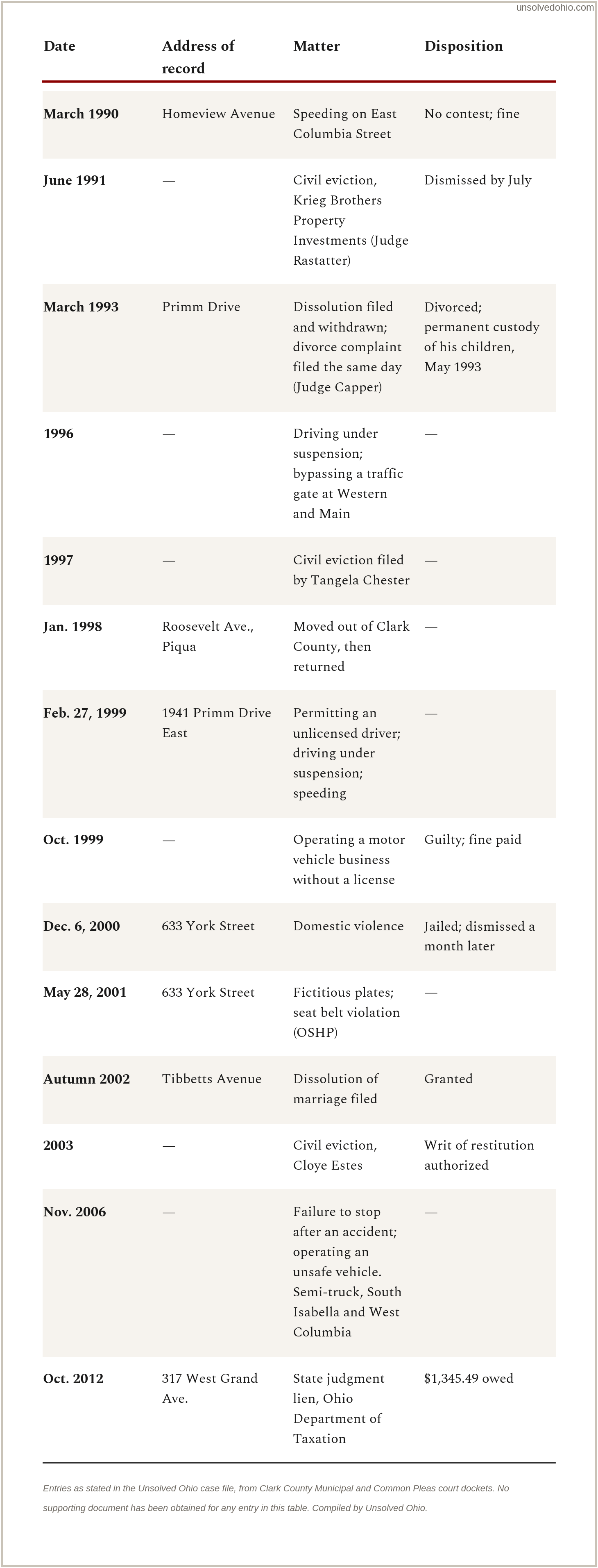
The local municipal court, an unromantic edifice of humming fluorescent lights and scuffed linoleum, serves as the ultimate cataloger of Tony Dee Rice’s struggles. It is here, within the dry, unforgiving text of court dockets and eviction notices, that the true biography of a man like Tony can be deciphered — not in sweeping arcs of triumph or tragedy, but in the relentless accumulation of petty infractions, shattered unions, and midnight indiscretions.
Born on the final day of November in 1963, a season when the Midwestern air turns biting and the skies adopt a permanent slate-gray hue, Tony Rice arrived into a world on the precipice of cultural upheaval. Yet, for men of his particular station, history is a distant rumor. Life is measured instead by the immediate: the rent, the car, the woman, the next move. By the spring of 1990, Tony was 26 years old, navigating the streets of Springfield in a brown, two-door Pontiac. He lived then on Homeview Avenue, a quiet enough street, but stillness was never a permanent resident in Tony’s life. On a cool March evening, the dusk settled over East Columbia Street, a police cruiser clocked the Pontiac exceeding the limit. It was a minor offense — a citation, a plea of no contest, a meager fine — but it was the opening entry in a ledger that would expand to document the wanderings of a deeply restless soul.
That restlessness soon manifested as a profound instability. Within a year, the first threads of economic precariousness began to fray. In June of 1991, Krieg Brothers Property Investments initiated a civil eviction against him, an action that dragged him before Judge Rastatter’s court. It was dismissed by July, but the machinery of displacement had been set into motion. He was a man perpetually packing boxes, forever one step ahead of the bailiff’s summons.
By 1993, the collateral damage of a chaotic life spilled over into his home. He had married Lorraine, but whatever warmth had initially drawn them together had curdled into irreconcilable distance. In March of that year, residing in an apartment on Primm Drive — the first of many apartments he would occupy in that complex — Tony filed for a dissolution of the marriage. It was a messy, hesitant severance. A petition for dissolution was filed and then abruptly withdrawn on a Tuesday in late March. The very same day, however, a more aggressive complaint for divorce was lodged. Judge Thomas Capper presided over the untangling of their lives. By May, Tony was granted permanent custody of their children, a rare and heavy responsibility for a man who seemed entirely incapable of keeping his own footing. He drove a yellow two-door Toyota at the time, frequently cited for expired tags, as if the very licensing of his existence was an administrative burden he could not bear.
As the decade wore on, the addresses blurred. He bounced from Primm Drive to 109 South Race Street. In his time on Race Street. Springfield noticed multiple women that went missing between 1996-1997 including Angela Hall, Michelle’s sister. This area only blocks away from the Nite Owl Bar is known as; “The Killing Fields of Springfield” This 4-block area has a high volume of drug arrests and prostitution. From 2004 to 2010 a serial killer named Prentiss Hare resided at 112 South Race street. In Springfield, Ohio, between 1992 and 1993 it was this area that serial killer and rapist William Kessler Sapp murdered three females, and sexual assault others. One of the women was 31-year-old Belinda Anderson, last seen exactly in this area.
In January 1998, Rice briefly moved out of the county to Piqua on Roosevelt Avenue, before being drawn back to the familiar, worn streets of Springfield. Tibbetts Avenue. York Street. Jefferson Street. Grand Avenue. Each address was a temporary shelter; each move, perhaps, an attempt to outrun the accumulating paper trail. But the municipal court’s memory is long and perfectly indexed.
In 1996, he was caught behind the wheel of a gold Ford sedan at the intersection of Western and Main, driving under a suspended license and foolishly attempting to bypass a traffic gate. The following year, a woman named Tangela Chester dragged him back into the sterile air of the civil court for another eviction proceeding. Tony Rice was a man defined by his vehicles as much as his failures.
He traded cars with the frequency of a man changing coats in unpredictable weather. There was the black two-door Pontiac in which he was pulled over on Home Road, caught speeding without a seatbelt. There was a silver Ford van he piloted recklessly, changing lanes improperly and bearing fictitious plates near North Limestone. And then there was the gray Ford van, stopped in the dead of the night — two o’clock in the morning on February 27, 1999 — at the corner of Lagonda and Sherman. The police found him permitting an unlicensed driver to operate the machine in the dark, a silent testament to the shadowy, fringe existence he was now leading.
There is a specific kind of Midwestern desperation that breeds amateur enterprise. In October of 1999, Tony attempted a hustle. The Clark County Sheriff’s office cited him for operating a motor vehicle business without a license. It was an attempt, however misguided and legally deficient, to carve out a living, to transform his constant shuffling of automobiles into a bona fide trade. Like all his endeavors, it collapsed under the weight of municipal scrutiny. He pled guilty, paid the fine, and retreated further into the margins.
The turning of the millennium brought no resurrection, only darker shadows. On December 6, 2000, residing now at 633 York Street, the police arrived at his door for a far more sinister reason than an expired registration. A charge of domestic violence was levied against him. He spent time in the Clark County Jail, a concrete purgatory where the heavy steel doors echo with the miseries of the local populace. Though the charge was eventually dismissed a month later, the stain of the accusation lingered. The violence, whether real or perceived, was symptomatic of a life where the center could no longer hold.
His second attempt at matrimony met an identical, bureaucratic end. In the autumn of 2002, living on Tibbetts Avenue, the paperwork for a dissolution of marriage with his new wife, Michelle, was filed. The cycle repeated itself with terrifying exactitude: the arguments, the irreconcilable differences, the quiet finality of a judge’s signature.
The years that followed were marked by a slow, agonizing economic attrition. Civil cases for evictions continued to haunt him, notably a 2003 dispute with Cloye Estes where a writ of restitution was authorized, forcing him from yet another home. The traffic citations morphed from the reckless speeding of his twenties to the careless parking of his middle age. He left vehicles abandoned on Washington Street, Clifton Avenue, and Jefferson Street, accumulating fines he likely could not afford. The cars were no longer vessels of escape; they were anchors dragging him deeper into debt.
Perhaps the most poignant metaphor for Tony Rice’s decline occurred on a cold Tuesday evening in November 2006. At the age of 42, he was operating an immense, white International Harvester semi-truck — a machine built for hauling heavy loads across great distances, a vehicle that demands respect and control. At the intersection of South Isabella Avenue and West Columbia, he lost that control. The resulting accident brought the police once again. He was cited for failure to stop after an accident and operating an unsafe vehicle. The image of the massive white truck, wrecked on a Springfield street corner, mirrored the trajectory of his own life: a heavy, unmanageable burden, operated unsafely, ultimately grinding to a violent and inevitable halt.
The final entry in the available ledger, dated October 2012, is bereft of the kinetic energy of his youth. There is no speeding car, no midnight traffic stop, no dramatic courtroom dismissal. It is merely a State Judgment Lien filed by the Ohio Department of Taxation. Residing at 317 West Grand Avenue, Tony Rice owed the state $1,345.49. It is a quiet, bureaucratic whimper, a mathematical summary of a man who spent his entire life in motion, only to find that the system had meticulously kept the receipt.
Marriage to Tony Dee Rice
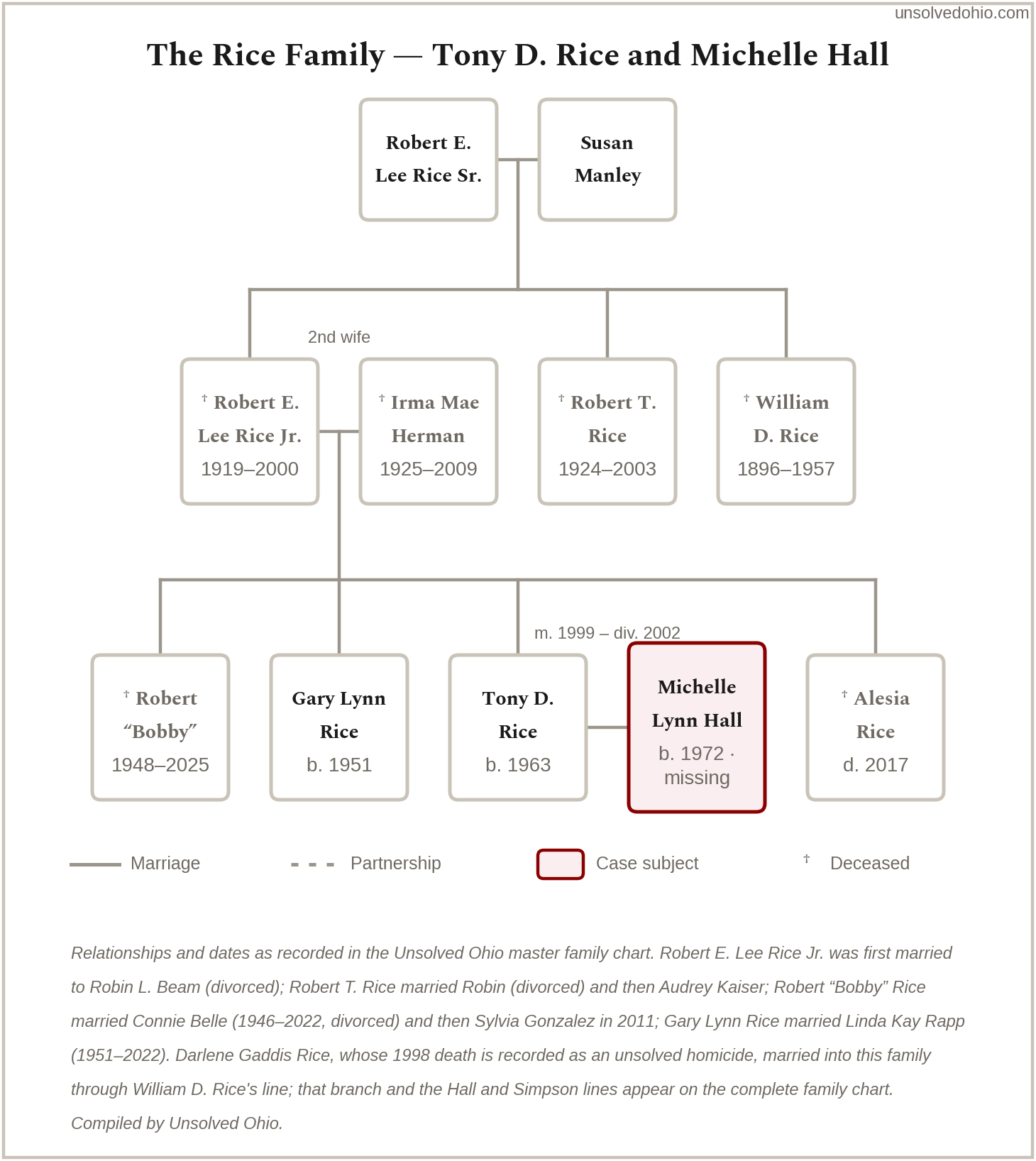
Tony is the brother of Alesia D. Rice (d. June 3, 2017) and the uncle of Alesia’s daughter, Cierra Spitler (d. June 12, 2015). It is this marriage connection into the Rice and Hall family name that connects to Darlene Rice, murdered on September 7, 1998.
This fire occurred 26 days after Michelle’s house caught fire. It was precisely into this profound, echoing void stepped Tony D. Rice once more, solidifying his presence in her increasingly chaotic world. But stability remained elusive. On Saturday, February 27, 1999, the flashing lights of the law arrived at Michelle’s doorstep again. Rice was cited at her 1941 Primm Drive East residence for a trifecta of violations: permitting an unlicensed driver, driving under a suspension, and speeding. Despite this chaotic introduction to their shared domesticity, Michelle bound herself to him.
For Paid Subscribers: The Complete Family Chart
Every person Beth and Jimmy traced across the Hall, Rice and Simpson lines — five generations, three surnames, and the single marriage that joins them. Paid subscribers can open the full chart.
Just months later, on Monday, May 3, 1999, she married Tony Dee Rice at that very same Primm Drive apartment.
The trouble, acting like an uninvited wedding guest, followed the newlyweds quickly. By Friday, October 8, 1999, the apartment became a crime scene of a different sort when Rice was criminally charged for operating a motor vehicle business without a license. The walls of their new home were papered not with the symbols of domestic bliss, but with police citations and court summons.
The dawn of the new millennium did not bring hope; it brought the final dissolution of Michelle’s fragile family structure.
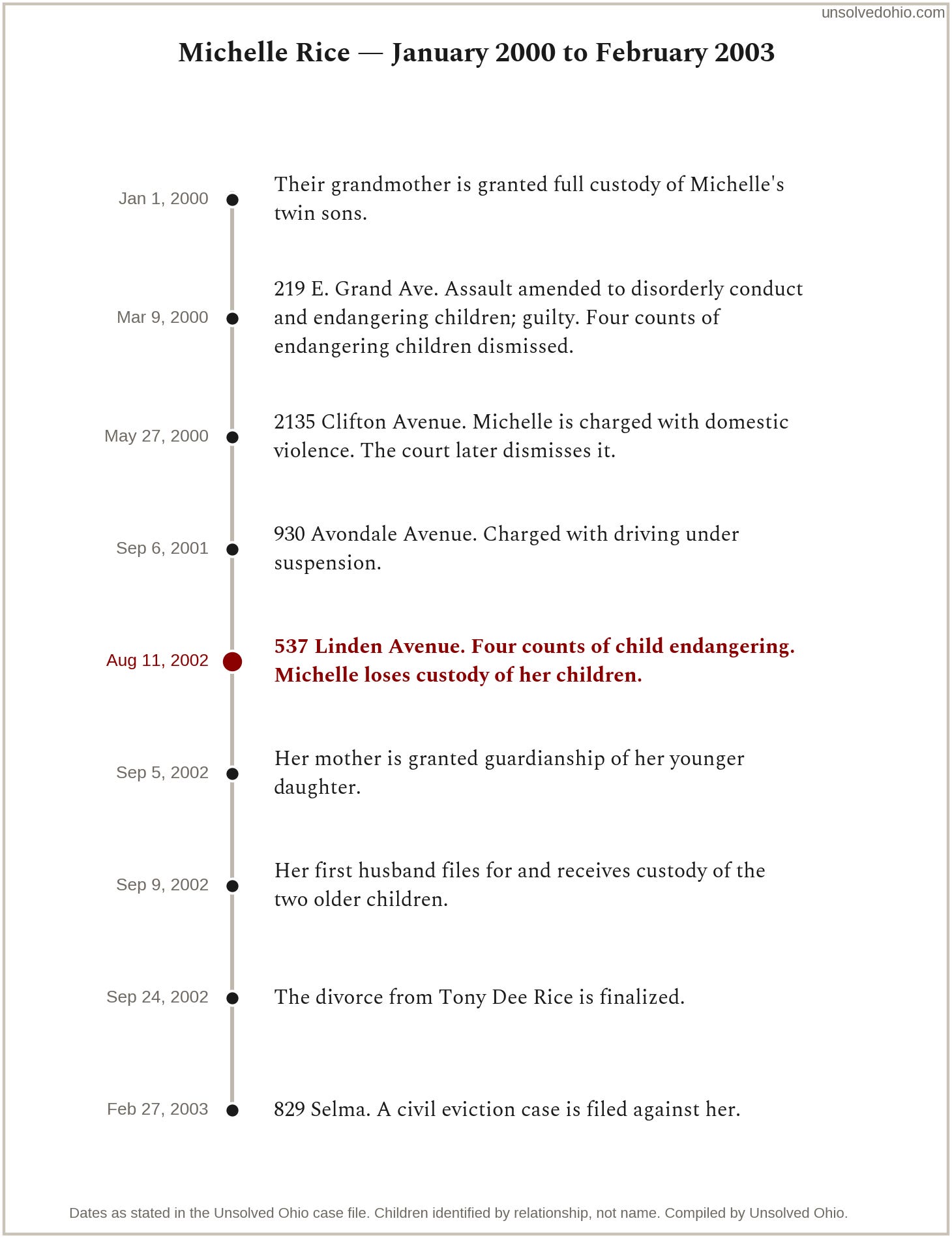
On Saturday, January 1, 2000, a legal shift formally altered the family tree: Grandmother Karen Strines assumed full custody of Michelle’s twin sons, Kyle and Kalib Strines.
Bereft of her children and haunted by the unquiet ghosts of Kenton Street, Michelle’s behavior became increasingly erratic. The addresses changed with dizzying speed, each new street corner marked by heavy sighs from court clerks.
March 9, 2000: Now residing at 219 E. Grand Avenue, she stood before a judge and pleaded guilty to amended charges of disorderly conduct and endangering children.
For Paid Subscribers: The Court Column, March 11, 2000
Two days after she stood in front of the judge, the Springfield News-Sun printed what she was actually charged with. Paid subscribers can open the page.
May 27, 2000: The violent rhythm that had ousted Alan Strines echoed again. Police were called to 2135 Clifton Avenue, resulting in a domestic violence charge against Michelle, though the courts would later dismiss it.
July 11, 2000: The father of Michelle's twin sons surfaced in the record again, two years after he had been put out of the duplex on Kenton Street. Alan Joseph Strines, 31, then living at 25½ West Clark Street, was arrested on a Tuesday, charged with child endangering, and taken to jail. He had fallen asleep, the complaint alleged, and left a window open with a 5-year-old playing around it. The Springfield News-Sun printed it two days later under a two-word headline: Endangering alleged.
For Paid Subscribers: July 2000
Two years after he left Kenton Street, Alan Strines was arrested again. Paid subscribers can open the page.
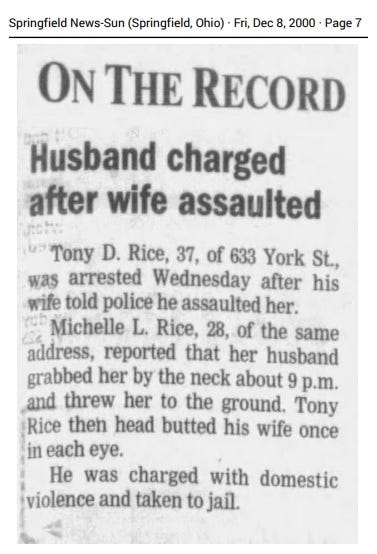
Then came December 8, 2000, just before Christmas, and the Springfield News-Sun carried four lines about the house at 633 York Street.
Michelle told police that at around nine o’clock on the Wednesday evening her husband had grabbed her by the neck and thrown her to the ground. Then he head-butted her, once in each eye. Tony Rice, 37, was arrested, charged with domestic violence, and taken to jail. Michelle was 28. They shared the address.
The charge was dismissed a month later.
Her husband, Tony, continued his own parallel pattern of legal infractions, cited by the Ohio State Highway Patrol on Monday, May 28, 2001, for fictitious plates and a seat belt violation at 633 York Street. Michelle herself was ensnared again on Thursday, September 6, 2001, charged with Driving Under Suspension at 930 Avondale Avenue.
The absolute severing of her maternal bonds — the final, grim curtain falling on her life as a mother — occurred on Sunday, August 11, 2002. While living at 537 Linden Avenue, Michelle was charged with four counts of Child Endangering. It was a definitive, devastating event that resulted in her completely losing custody of her children.
On September 5, 2002, Michelle’s mother, Sandra Simpson, was granted guardianship of Kasey. Within days, on September 9, 2002, Lawrence Meredith filed and received custody of Kurtis and Jessica.
With the children gone, the marriage to Tony lost its fragile, chaotic center, and the union finally broke. Within 20 days of Michelle losing her children, a divorce from Tony Rice was finalized, on Tuesday, September 24, 2002. Tony filed a complaint for dissolution.
This bureaucratic severing was recorded while Michelle lived at 922 Tibbetts Avenue — her ninth address in just four years. A tenth eviction soon followed on Thursday, February 27, 2003, when a civil case was filed against her by David E. Allen et al. at 829 Selma.
The next installment belongs to a man with two first names, an apartment on East Main Street, and a camcorder. Subscribe to follow the case file — and become a paid subscriber for the court records and archive pages embedded throughout the series.
This installment describes court records concerning living individuals, including charges that were dismissed and charges that resulted in convictions. A charge is not a conviction, a dismissed charge is not evidence of anything, and every person named here is presumed innocent unless and until proven guilty. No one named in this installment has been charged in connection with the disappearance of Michelle Rice or the death of any person named in this series. Unsolved Ohio reports from public court records, official registries, documented media reports, on-record interviews, and open-source analysis using Artificial Intelligence and Social Network Analysis; a documented association between two people, or between a person and a place, is a starting point for investigation — never proof of a crime. This is an educational publication and not legal advice. If you have information about the disappearance of Michelle Rice, submit it at unsolvedohio.com — your name is never published without your written permission, and we correct factual errors promptly. Full terms: Disclaimer.