




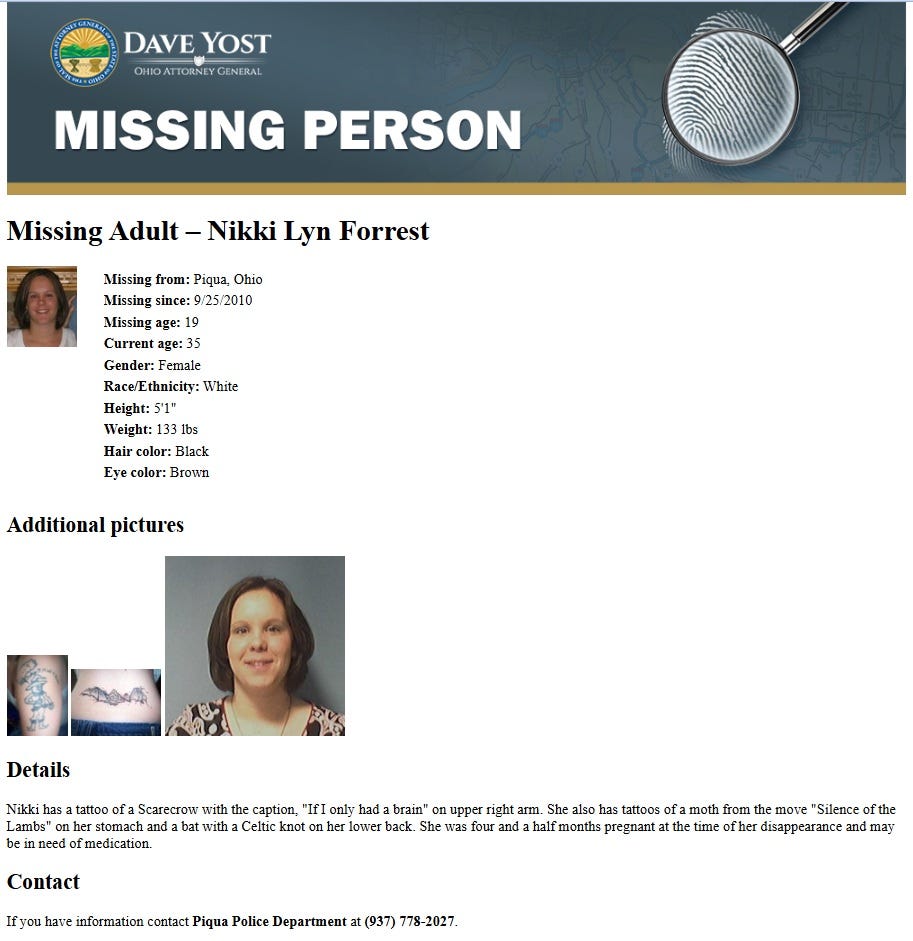
Nikki Forrest has been missing for fifteen years. Her case has been classified as an active investigation for that entire period. This post is a record of what that active investigation has communicated to the people trying to find her.
The Paucity of the Public Record
In the vast, often disorderly ledger of American civic life, there is an expectation — perhaps naive, but essential — that the machinery of justice will operate with a certain illuminating friction. When a citizen vanishes, particularly a nineteen-year-old woman carrying an unborn child, one expects the institutions of law and order to flood the public square with particulars. Specificity is the engine of investigation. Yet in the case of Nikki Lyn Forrest, who disappeared into the Ohio ether in September of 2010, we are confronted with a bureaucratic reticence so profound it borders on negligence.
Consider the paucity of the public record. In narratives of this sort, the principal figures are usually established with clinical precision. Yet here, the central characters are rendered as phantoms. The boyfriend — the man who argued with her about the paternity of her child, the man who placed her luggage on a driveway on Croydon Road, the last known person to see her before she stepped into a mysterious blue sedan — remained nameless in every public account for fifteen years. He was referred to only as “Boyfriend.” A nameless archetype rather than a citizen subject to scrutiny.
This redaction extended to the victim’s own lineage. One could perform a thousand Google searches and never acquire the names and places surrounding her disappearance. Nikki’s deceased mother, her biological father, her incarcerated brother — all rendered as ghosts in a story that desperately requires flesh and blood. Even the geography of her final days was blurred by administrative fog. We were told she stayed at a home on Young Street in Piqua — yet the specific address was withheld, transforming a potential crime scene into an abstraction. And nowhere — in any media report, any press release, any public statement — was there the slightest mention of what Nikki was wearing when she vanished.
What color was her shirt? Did she have a jacket? Was she in shorts or jeans?
Fifteen years. No one has said.
Why this opacity? One suspects it is the product of a modern institutional reflex — the prioritizing of “privacy” and “procedure” over the raw, uncomfortable necessity of truth. By withholding the name of the boyfriend and the specific coordinates of her last known movements, authorities may believe they are protecting an investigation. In reality, they are extinguishing the public’s capacity to assist.
A name triggers a memory.
A face sparks recognition.
A specific house number on Young Street might jog the recollection of a neighbor who, for fifteen years, has not realized they hold a piece of the puzzle.
The withholding of the boyfriend’s name in all media reports is particularly egregious. In the absence of a suspect, the public is left to wrestle with shadows. If he is innocent, transparency clears the air. If he is not, obscurity serves only the guilty. To leave him unnamed is to grant a kind of anonymity that is usually reserved for the victim — not the last person to see them alive.
The failure to identify the friend Nikki visited in Troy on the day of her disappearance — or even the apartment address — leaves an investigative gap that fifteen years of silence has not filled. The failure to name Nikki’s high school severs her connection to the community that might mourn her. A school is a network of peers, of teachers, of old flames and rivals. To leave it unnamed is to leave that network dormant.
There is a distinct, melancholy irony here. We live in an age of surveillance, where the digital exhaust of our lives is relentlessly harvested. Yet when the state actually needs to generate information — to name the boyfriend, to pinpoint the house number, to establish what a missing pregnant woman was wearing — it suddenly pleads a lack of capacity or a surplus of caution.
The disappearance of Nikki Forrest is a tragedy of a young life cut short. But the disappearance of the facts surrounding her case is a failure of governance. It is a silence that does not protect the innocent. It merely comforts the complacent.
The Jurisdiction Issue
Nikki Forrest’s last known location was in Troy, Ohio — Troy Police Department jurisdiction.
We requested information from the Troy Police Department.
Their response:
“We do not have any reports responsive to your request. This investigation was conducted by the Piqua Police Department.” — Records Clerk, Troy Police Department, 124 E Main St., Troy, Ohio
Troy referred us to Piqua. The last known location of the missing woman — Croydon Road, Troy — was, according to Troy’s own records clerk, not Troy’s problem.
We requested information from Mr. Glen McIntosh, Chief Investigator, Montgomery County Coroner’s Office.
In 2017, the Montgomery County Coroner’s Office received a Cold Case Grant and reopened the Nikki Forrest case. They searched the backyard of the Croydon Road house, examined the Trade Square West apartment, conducted interviews, and submitted samples for DNA analysis. Their response to our records request:
“As much as I would like to see Nikki Forrest’s case solved for her family, Ohio law prevents me from releasing investigatory information on another agency’s case that I received during an official capacity. The information I gathered on Nikki’s case was turned over to the Piqua Police Department when I left the Miami Valley Cold Case Task Force. I will respectfully have to refer you to the Piqua Police Department for any records pertaining to Nikki’s case.” — Mr. Glen McIntosh, Chief Investigator, Montgomery County Coroner’s Office
McIntosh pointed to Piqua. Troy pointed to Piqua. Everyone points to Piqua.
We requested information from the Piqua Police Department.
Record request #26-48 was processed. The message accompanying the response read:
“Here is the report you requested. This is still an active case so I have released all I can at this point.”
What they released: over 60 traffic accident reports that had nothing to do with Nikki Forrest’s case.
Sixty traffic reports.
We submitted a second request, directed specifically to Deputy Chief Dave Thomas of the Piqua Police Department.
What we received: the official missing person report. One document. Filed in 2010. Nothing produced in fifteen years of active investigation.
The Cell Phone
The Dayton Daily News reported that Piqua Police acquired Nikki Forrest’s cellular phone records. What they reported publicly from those records: the phone had not been used since she vanished.
Here is what the records process actually looked like in 2010. Piqua Police needed to fax a form to a Law Enforcement Liaison at the carrier — AT&T or Sprint. They needed a sworn statement of immediate danger to trigger the “ping.” When the Piqua detectives demanded the records, looking for a signal or a handshake with Tower #1210035 or a ping from the antennas on Dixie Drive, they received only a hollow echo. The records revealed stillness. There was no triangulation, no GPS coordinate blooming on a map. The phone had ceased all network activity.
This was not necessarily a failure of effort. In 2010, cellular forensics had significant technical limitations. But it raises questions that have never been publicly answered — about what type of phone Nikki carried, which carrier she used, whether cell phones belonging to other individuals present on September 25 were ever subpoenaed, and whether the digital trail of that evening was ever mapped with any rigor.
Those questions appear below. Every single one of them received the same response.
The Questions Asked — And Never Answered
The following questions were submitted formally to the Piqua Police Department. The responses are recorded exactly as received.
Is it possible to get a complete list, or partial list of individuals who were interviewed? — No Reply
Having a list of names, dates, times of interviews, and statements taken would allow researchers to compare known facts against facts revealed later — and identify who gave which statement. The following individuals are known to have had contact with Nikki in the days surrounding her disappearance: Brad Taylor, Donnie Ramey, Randy Wright, Neal Blackburn, Tammy S. Swartz, Tracy Dawn Poling.
Q: At any time, did you or other investigators ask Nikki’s brother Matthew Dawson if you could review the letters he received from her? If so, can you share the contents of those letters? — No Reply
Q: Based on all media reports, Nikki’s last known location was at Frank Price’s home at 1496 Croydon Road, Troy, Ohio, on September 25, 2010. Can you confirm this was Nikki’s last known location, and can you confirm this was the last time Nikki and Frank Price were at the same location? — No Reply
Q: Is there any information or evidence to suggest that Nikki was seen after this date — used her cell phone, communicated with anyone, was stopped by police, received a ticket, paid a bill, or had any bank activity? — No Reply
Q: Were cell phone call logs subpoenaed from her service provider? — No Reply
Q: Based on reports, Nikki called her stepmother Tammy Weddington on September 25. At what time did Nikki call, and what were the text messages sent and received? — No Reply
Q: Was Godmother Bobbie Schlater’s cell phone call logs subpoenaed? If so, what were the phone numbers called, and the text messages sent and received the day Nikki went missing? — No Reply
Q: Nikki Forrest had a cell phone. Was it an Android, Apple, BlackBerry, or other device? — No Reply
Q: Were cell phone pings or triangulation accomplished on the associated cell phones of all people involved? — No Reply
Q: How active was Nikki on social media, and when did that activity cease? — We are working on that.
Q: Are there any preserved records of her social media history? — We are working on that.
Q: What forensic methods were used to examine the Croydon Road property in 2010? How extensive was the search? — No Reply
Q: What forensic methods were used to examine the Croydon Road property in 2017? How extensive was the search? — No Reply
Q: What investigative measures were used at the Trade Square West apartment in 2010 and 2017? Was luminol used? — No Reply
Q: Frank Price stated Nikki left in a blue vehicle. Can we see his statement to investigators — exactly what he said about this vehicle? — No Reply
Q: Is anyone able to corroborate all or part of Frank’s statement? — No Reply
Q: What was Nikki wearing at the time she went missing? — No Reply
Q: Frank stated Nikki had bags and luggage. Did Nikki get into the vehicle with her bags? How many bags? — No Reply
Q: Did Nikki put the bags in the trunk, in the back seat, or on her lap? — No Reply
Q: Frank stated he did not notice the driver. Could he tell if the driver was male or female? — No Reply
Q: Did the driver say anything to Nikki? Could he tell from a voice whether the driver was male or female? — No Reply
Q: Did Nikki call for a ride — or is Frank stating she just happened to be standing outside with all her belongings when a car pulled into his driveway, she got in, and left without a word? — No Reply
This statement, taken at face value, does not make sense. A car pulled into a private driveway at the exact moment a pregnant woman with luggage was standing outside. Either she called for a ride — in which case she used a phone, and that call is in a record somewhere — or the car’s arrival was not coincidental. Investigators have never publicly reconciled this.
What Rinda Bell Saw
The one thing Rinda Bell made clear in her conversation with us: Nikki’s purse was in the Trade Square West apartment — Donnie Ramey’s apartment — the day after Nikki went missing. September 26, 2010.
Rinda went next door to ask if Nikki had stayed the night. When Donnie opened the door, Rinda could see Nikki’s purse sitting on the table. When she asked to speak to Nikki, Donnie said she was not there and had not seen her in days.
For approximately two weeks after Nikki’s disappearance, Rinda Bell reported smelling something putrid — something dead — coming from Donnie Ramey and Randy Wright’s apartment.
She went to the police. She told investigators.
Nothing was looked into. No one knocked on the door. Police never called back.
It was not until 2017 — six years later, after Rinda had long since moved from Trade Square West — that Mr. Glen McIntosh from the Montgomery County Coroner’s Office contacted her about her complaint. Investigators went to the apartment at 1361 Trade Square West, Apartment E. They removed several areas of drywall.
As confirmed by Mr. Glen McIntosh: they found no supporting evidence of the presence of human DNA matching Nikki Forrest.
One More Thing Glen McIntosh Told Us
According to Mr. Glen McIntosh, Chief Investigator from the Montgomery County Coroner’s Office:
Frank Price has never cooperated with investigators about the disappearance of Nikki Forrest. Not then. Not now. To this day.
No one charged with a crime in the United States is presumed guilty before trial. No individual named in this post has been charged with any crime related to Nikki Forrest’s disappearance. Every fact presented here is sourced from public records, documented media reports, formal records requests, or on-record statements. The Piqua Police Department declined to answer every substantive question we asked. That is not an accusation. It is a fact — documented above, question by question, in their own words.
Or rather: in their silence.
Case File 1.5 examines the seven individuals whose public records, documented histories, and proximity to Nikki's last known movements place them within the investigative scope of this case.