



This is Part of the Amber Whitmer case file — start at the hub: Amber Marie Whitmer.
This installment names women documented as missing or deceased in public records and reporting, and presents statistical modeling from the authors’ research. It is published to honor these women and to make a pattern visible — not to assign blame. See our full Disclaimer.
The Prelude
In the stillness of the Springfield area, where the wind smells of damp earth and the rusting iron of the city’s industrial ghosts, there exists a sorority of the forgotten — a congregation defined not by life, but by a quiet, terrible repetition.
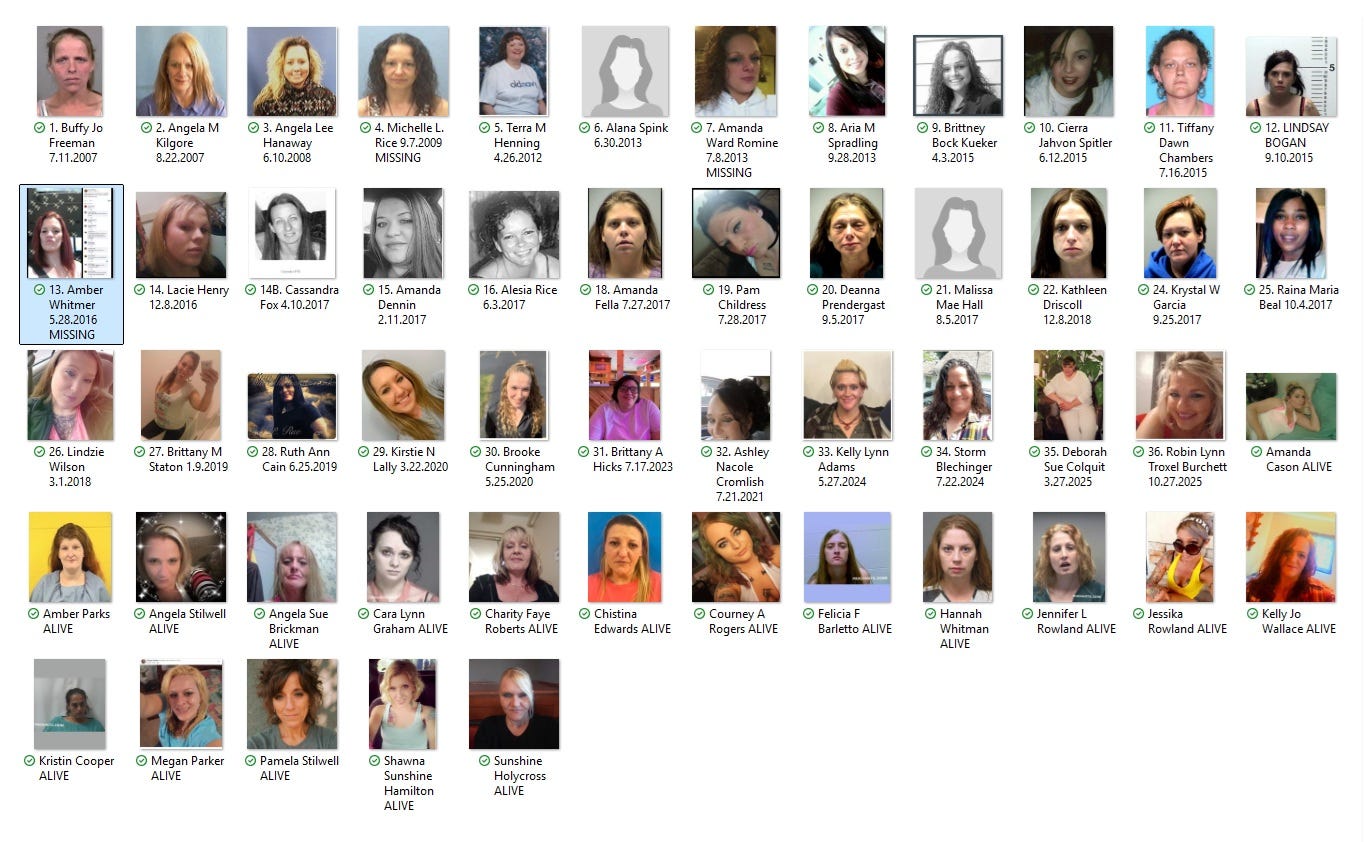
They were women of the margin, drifting through the neon-bruised corridors of Dayton and the sun-bleached alleys of Springfield. One might look at Angela Hall, lost to the Huntington Township dirt in 1985, and think her a solitary tragedy. But time in these parts is not a line; it is a web. Decades later, the same shadows lengthened over Jasmine Wadsworth and Amanda Fella, whose bodies were left in the urban discard of alleys — one in Springfield, the other in Dayton — only 36 days apart in the summer of 2017.
They are bound by a cartography of trauma. From the cisterns behind Grant Street where Angela M. Kilgore was hidden, to the dark waters of the Mad River that claimed Angela Hanaway, the distance is measured not in miles, but in the singular, cold-blooded intent of those who treat such women as disposable.
There is a terrible intimacy in their shared vulnerabilities. They moved in a world the living call “high-risk” — a clinical phrase used to distance ourselves from the dying. Whether it was the stages where Aria Marie Spradling and Amanda Ward-Romine spent their nights, or the chemical, hazy-blue mornings shared by so many others, they were all walking the same tightrope.
Consider the tragic geometry of their connections. Julie Freeman was found by Buck Creek Road with a fractured skull in 1997; ten years later, Buffy Jo Freeman was discovered in Snyder Park, her life extinguished by the same blunt-force trauma. Brandy Rene English — a woman who had seen too much as a witness in a homicide case — vanished into the Middletown air in 2016, joining the silent ranks of the missing like Michelle Rice and Amber Whitmer. Lindzie Wilson was 16 weeks pregnant when a shooting stopped her breath in 2018, a double silence that echoed through the Springfield streets.
In the mind of a predator, these women are perhaps interchangeable units of opportunity. But in the grim tapestry of the Ohio Valley, they are a single entity — the girls who went for a walk and never came back; the women found under the floorboards of abandoned houses or in the quiet of Forest Lake. Deanna Prendergast, Krystal Garcia, and Kirstie Lally, on different street corners across different decades, all under the same predatory moon. They are the “Great Connections” — a sisterhood of the silt and the cistern, waiting for the world to finally look at the map and see the pattern they left behind.
The Black Hole Model
We cannot see a black hole directly; its gravity is so intense that not even light escapes it. Yet we know with certainty that it exists, because we can measure its effect — the violent, disruptive pull it exerts on the visible matter circling it. Treat Springfield’s missing and murdered women the same way. The lives are erased; the anomalies they leave behind are measurable.
When you look at why so many women vanish or die in Springfield and the surrounding area, it is not a series of random coincidences. It begins with the environment. In neighborhoods broken by poverty, a dangerous street economy emerged. Central and southern Ohio were hit hard by the over-prescription of pain medication; when the government cracked down on the “pill mills,” the market flooded with cheap, potent illicit drugs — synthetic fentanyl, heroin. Because addiction hijacks the body, many women found themselves trapped in street-level sex work simply to stave off withdrawal and survive the day.
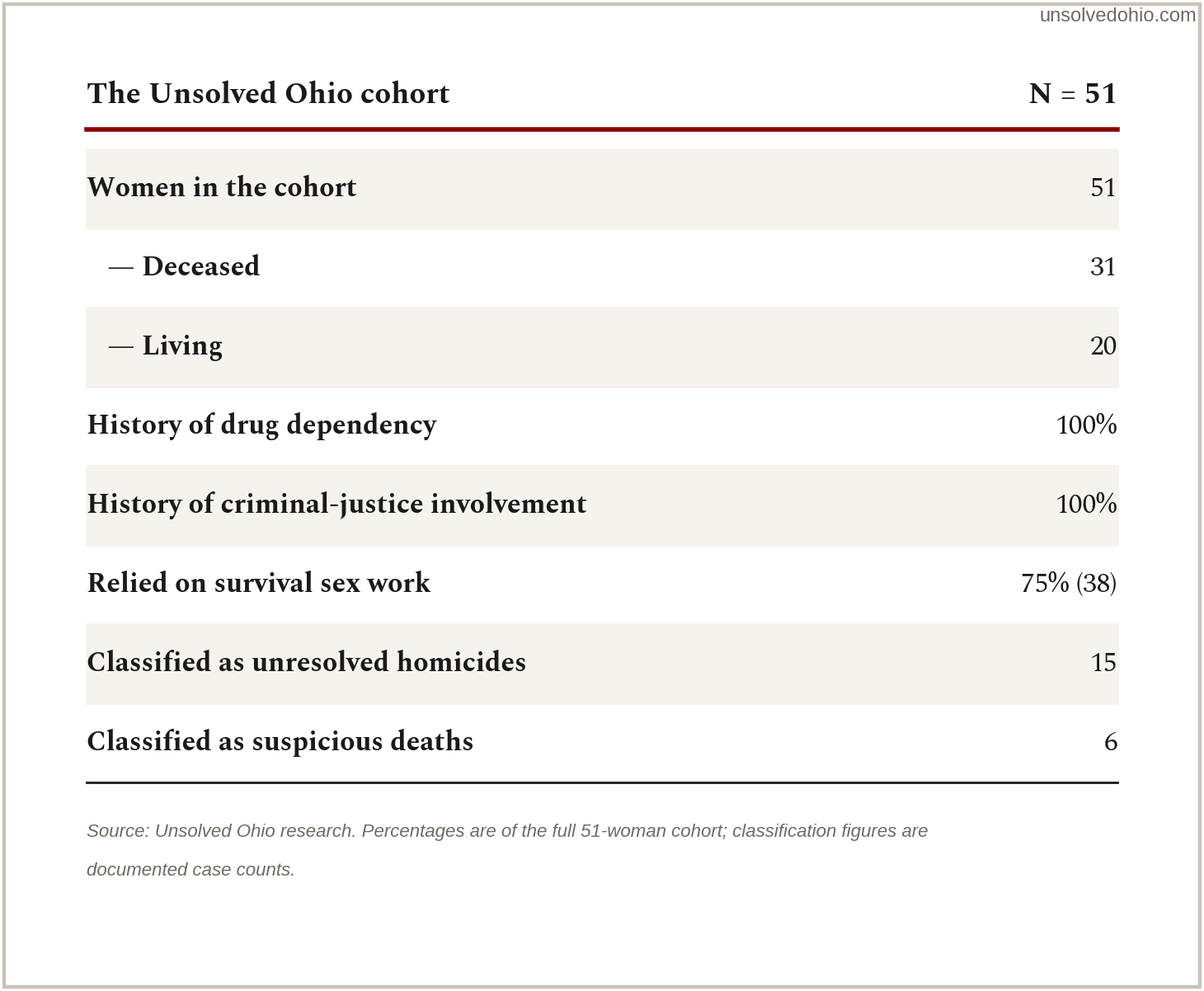
In the Unsolved Ohio cohort (N = 51 — 31 deceased, 20 living) studied for this report; 100% had a history of drug dependency. 100% had a history of criminal-justice involvement. 75% (38) relied on survival-based sex work.
This combination doesn’t just create an unstable life — it creates a state of constant, extreme danger. Violent offenders use the highways to move quickly between cities, deliberately targeting street-entrenched women because they are isolated and desperate. A predator can pick up a woman along the I-75 corridor in Middletown, Dayton, or Springfield and leave her body in a different county entirely. And because local, county, and state agencies use separate, non-connected databases, the files fragment — predators exploit the boundaries, knowing the right hand rarely talks to the left.
The invisible victim. When a young, affluent woman goes missing, the media saturates the airwaves and the public pressure forces police to pour in resources. When a woman with a drug dependency and a sex-work record goes missing, the coverage is gone the day after the police release. Worse: because Ohio criminalizes prostitution and solicitation, a woman who is stalked, assaulted, or threatened is terrified to call the police — she risks arrest herself. That insulates predators and hands them near-total impunity.
The mathematical modeling in this research suggests the true scale is hidden. In a comparable national review, of 5,712 missing marginalized women recorded by the FBI, a federal database logged only 116 — roughly 2%. On the streets of Springfield, women undergo “administrative censoring”: they move constantly between counties to escape crackdowns or find shelter, so a disappearance or death in a neighboring county severs the connection to Springfield. Many are estranged from family, so a woman can be gone for months or years before a report is filed — by which time the physical and digital evidence is gone.
Run the math on this specific intersection of poverty, fentanyl addiction, and survival sex work, and a woman trapped in this life is — by the authors’ modeling — roughly 607 times more likely to become the victim of an unsolved homicide or suspicious disappearance than an average woman in the same city. This is not a neighborhood. It is a hunting ground that structural neglect built.
The Six Questions
When a street-entrenched woman vanishes, these are the six explanations an investigator has to weigh. We test each against the record across this case. (Investigative-probability ratings below are the authors’ analytic assessments, not findings of fact.)
Overdose with body disposal (”dumped body”). — Probability: High. A fatal overdose in hidden company creates panic; to avoid a manslaughter or drug-house charge, associates move the body. Many “missing” reports are, in reality, unlocated dumped overdose victims.
Murdered by local drug networks. — Probability: High. Drug debts and informant suspicion draw violent retaliation from street-level distributors and enforcers — the largest verified cause of death in the cohort’s homicide cases.
Kidnapped for trafficking (survival-sex-work exploitation). — Probability: High. Predatory coercion target-selects the most vulnerable; the I-70/75 layout lets handlers move women between hubs, so a woman reads as “missing” in Springfield while trafficked elsewhere.
Voluntarily left the area. — Probability: Moderate–High. Women move between jurisdictions to escape crackdowns, violent partners, or debts; “administrative censoring” can mask a later, unrecorded victimization.
Serial predator. — Probability: Moderate–High. The geographic clustering along the I-75 spine, the identical target-selection metrics, and the high unresolved rate fit a profile of serial predatory activity operating with impunity.
Suicide or undetermined medical trauma. — Probability: Low–Moderate. Real risk exists, but advanced decomposition in waterways often makes it impossible to separate a suicidal drowning from a homicidal one — so it can’t be the default without exhausting the homicide and body-dumping indicators first.
These are the questions. Over the installments to come, we put Amber Whitmer’s disappearance to each of them.
If you have information about any of the women named here, submit it at unsolvedohio.com. Your name will never be published without your explicit written permission.