



The Great Miami River does not flow so much as it negotiates its way through the limestone bedrock of western Ohio. It is a dark, serpentine muscle of water — ancient and indifferent — carving a valley that smells of wet earth, decaying sycamore leaves, and the metallic tang of industry. By the autumn of 2010, the river had become something else: a repository for the things the valley wished to forget. It was low that year, the banks exposed by a summer that had lingered past its welcome, revealing the skeletal roots of trees and the rusted detritus of a century of manufacturing.
Troy — population 25,058 — is the county seat of Miami County. It sits along these banks, a town defined by the geometric optimism of the mid-century grid and the Victorian heaviness of its downtown. To the north lies Piqua — population 20,522 — a sister city bound to Troy by geography but separated by the invisible, high-tension lines of high school football rivalry and economic competition. Between them stretches a landscape of flat, unapologetic cornfields, which in late September are tall and dry, their husks rattling in the wind like parchment, whispering of the coming winter.
In September 2010, the town was suspended in the amber of the Great Recession. The financial collapse of 2008 had struck the region not with a scream but with the dull, suffocating weight of a blunt instrument. It was a silence that accumulated in the empty parking lots of factories and the “For Sale” signs that sprouted in the yards of the Westbrook subdivision like white crosses in a military cemetery. The unemployment rate in Miami County hovered near double digits — a statistical abstraction that translated into a palpable tension on the streets, a vibration felt in the jaw. Men who had defined their existence by the rhythm of the shift whistle and the weight of a paycheck now sat on porches, watching the sun dip below the horizon of a world they no longer recognized, their hands idle, their anger turning inward.
The housing market had turned into a trap. The house at 1496 Croydon Road — a central locus in the coming mystery — was a testament to this stagnation. Built in 1952, it was a small, single-story structure of 1,032 square feet, sitting on a quarter-acre of grass. In 2010, such a house was an asset that had become a liability for many, a heavy chain of mortgage debt that tethered families to a sinking economy.
Where the economy recedes, a different kind of commerce rushes in to fill the void. By 2010, the Miami Valley was drowning in opioids. It was a silent epidemic, creeping into the Victorian homes on Main Street and the trailers on the outskirts alike. In 1999, about one Ohioan died daily from a drug overdose. By 2010, that number had quadrupled. Overdose deaths had surpassed car crashes as the leading cause of accidental death in the state.
It was into this atmosphere — this valley of the vanished — that nineteen-year-old Nikki Lyn Forrest stepped.
Friday, September 24, 2010
The night before Nikki Forrest vanished, the town was consumed by the “Battle on the Miami” — the annual grudge match between Troy and Piqua, a rivalry dating back to 1899, making it one of the oldest in the state. The two towns, separated by only eight miles of river and resentment, poured their populations into the stadium.
The game was played at Troy Memorial Stadium, a concrete bowl that held the noise and fury of the night. The weather was perfect for football — cool, crisp, the air smelling of popcorn and autumn. A crowd of over 9,000 people — nearly half the population of the town — crammed into the stands. They watched as Troy dismantled Piqua. The final score was a decisive 27–14.
It was the high-water mark of the weekend. The crest of the wave before the crash.
Saturday, September 25, 2010
The astronomical data for that Saturday paints a precise picture of what was to come. The sun rose at 7:58 AM and set at 5:19 PM, casting the valley into an early twilight. The moon was in a waning gibbous phase — 88% illuminated — a bright eye in the sky that would rise late, leaving the early hours of darkness deep and impenetrable. Temperatures reached a high of 74 degrees, unseasonably warm. By evening, the valley would drop to 50 degrees — jacket weather, the kind of cold that finds you if you have nowhere to go.
Nikki Forrest had nowhere to go.
She stood five feet one inch tall. She weighed 133 pounds. She had dyed her hair black. She was 19 years old, four and a half months pregnant, and carrying a high-risk medical regimen of progesterone — a daily medication that was the chemical lifeline keeping her pregnancy viable after three prior miscarriages. She was couch surfing, rotating between the homes of friends and relatives with no permanent address, no car, and an unclaimed final paycheck from the Waffle House at 1232 East Ash Street in Piqua waiting for her. She had not gone to pick it up.
In the economy of Piqua, where gas was $2.70 a gallon and every dollar was a battle won against the recession, to leave a paycheck behind is an act of supreme disruption. It suggests a mind already checked out — a spirit unmoored from the mundane anchors of survival.
705 Young Street, Piqua — Morning
The narrative of September 25 is a study in the architecture of rejection. It is a timeline constructed from the friction between a young woman’s need for sanctuary and the limits of those around her. The day began at a modest home on 705 Young Street — a residential artery of Piqua, lined with working-class homes that have seen generations of struggle and survival — where Nikki had been staying with her Godmother, Bobbie Schlater.
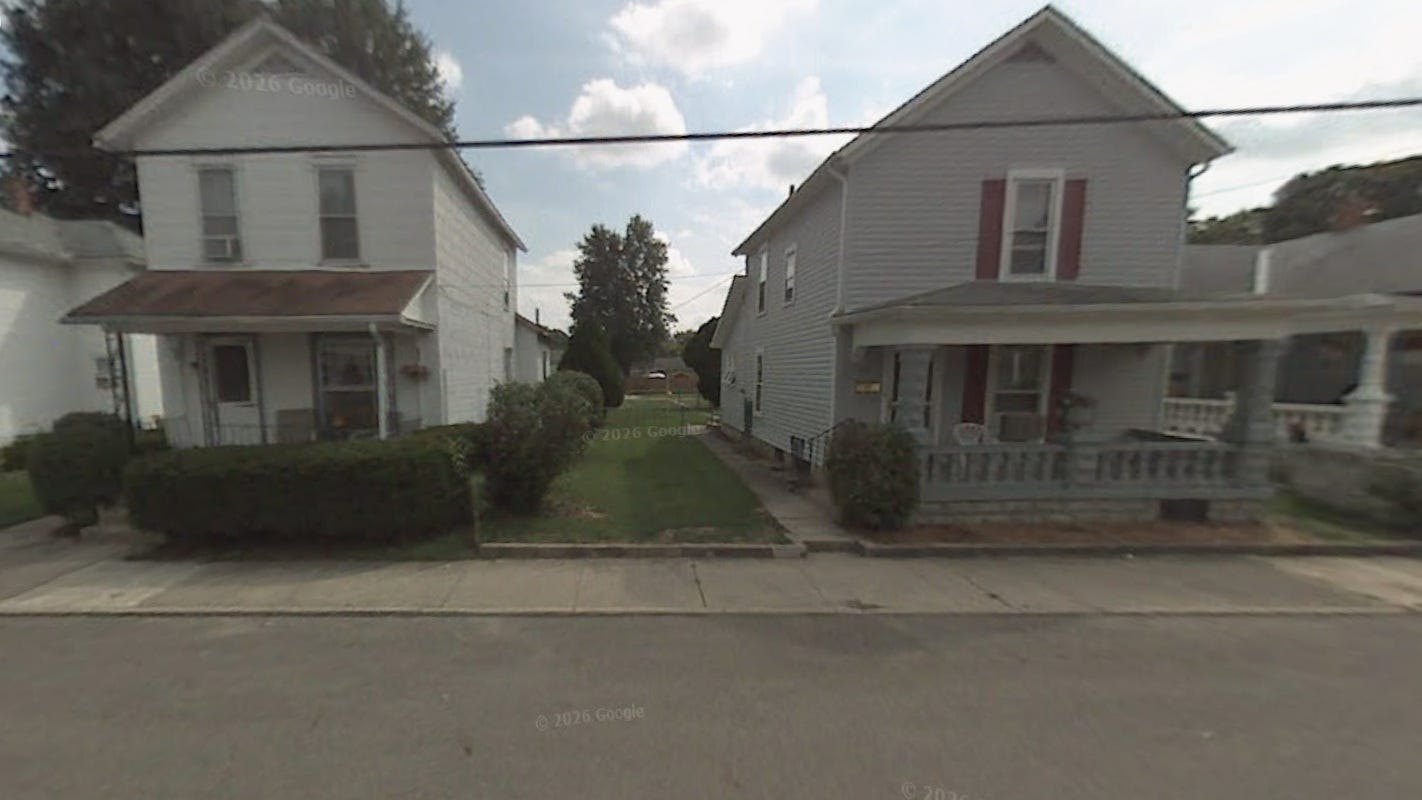
The domestic peace was fragile. An argument erupted over house rules — the banal friction of domestic life that, for the homeless, can be fatal. Nikki was asked to leave.
She packed her life into a few bags. Crucially, she packed her progesterone. She did not storm out in a fugue state — she packed with the intent to survive. Before leaving the orbit of Piqua, she sent a text message to her stepmother, Tammy Weddington. The text was reassuring, a classic deflection of youth: she was “OK.” She mentioned a vague plan to move out of state with a friend. It was the kind of optimistic plan young people make when they are running away from something rather than toward something.
It was the last digital footprint she would leave — a phantom signal sent into the ether before the silence descended.
The Waffle House — Context
Before tracing the rest of September 25, it is worth understanding the world Nikki inhabited in the weeks before she vanished.
At 1232 East Ash Street, the Waffle House sits as a sentinel of the American roadside — a structure of aggressive banality, a glass box designed to be identical to thousands of others, yet in Piqua it possessed a singular, vibrating gravity. To the uninitiated, it was merely a place of calories. But to the regulars, it was a stage where the curtain never quite fell.
The architecture of a Waffle House is an exercise in exposure. The walls are glass, rendering the interior visible to the street and the street visible to the interior. There are no secrets here — only the stark, unforgiving light that bleaches color from the skin and makes everyone look a little guilty, a little washed out. The air inside did not merely smell of food. It smelled of grease and old trouble — a heavy, lipid scent of frying pork that coats the throat and clings to the hair.
Into this atmosphere stepped Nikki Lyn Forrest on her working nights — a girl unmoored, drifting on the currents of poverty and dependency, balancing plates of eggs and mugs of coffee. She moved through the haze with the dexterity of someone who had learned to read a room quickly. Waitressing at a Waffle House requires it. One must be fast enough to serve the truckers passing through on Interstate 75, yet patient enough for the local regulars who occupied booths for hours, nursing lukewarm mugs.
The number one song in America on September 25, 2010 was Katy Perry’s “Teenage Dream” — its breezy, synthetic optimism blasting through the smell of grease and old trouble. The irony was cruel. Nikki was nineteen, but she was living the antithesis of a teenage dream. The song’s plea to run away and never look back likely resonated with a painful specificity.
Among the regulars Nikki would have known was Neal Blackburn — a local figure who frequented the Waffle House in 2010. Blackburn’s presence in Nikki’s social orbit will be examined in full in Case File 1.5.
Trade Square West, Troy — Afternoon
From Piqua, Nikki traveled south to Troy — eight miles down County Road 25-A, a two-lane artery that runs parallel to the river and Interstate 75. This road is the spine of the valley. It passes old farmhouses, light industry, and the looming skeletal trusses of the Eldean Covered Bridge. For Nikki, it was simply the distance between one rejection and the next.
She arrived in Troy as the afternoon sun began to dip. Her destination was Trade Square West — a complex of apartments and townhomes in the northern part of Troy, a neighborhood of modest, siding-clad homes. She stopped here to visit a friend — Rinda Bell, or perhaps Donnie Ramey. She was seeking a moment of respite. A pregnant woman with luggage, looking for a place to land.
She did not stay long.
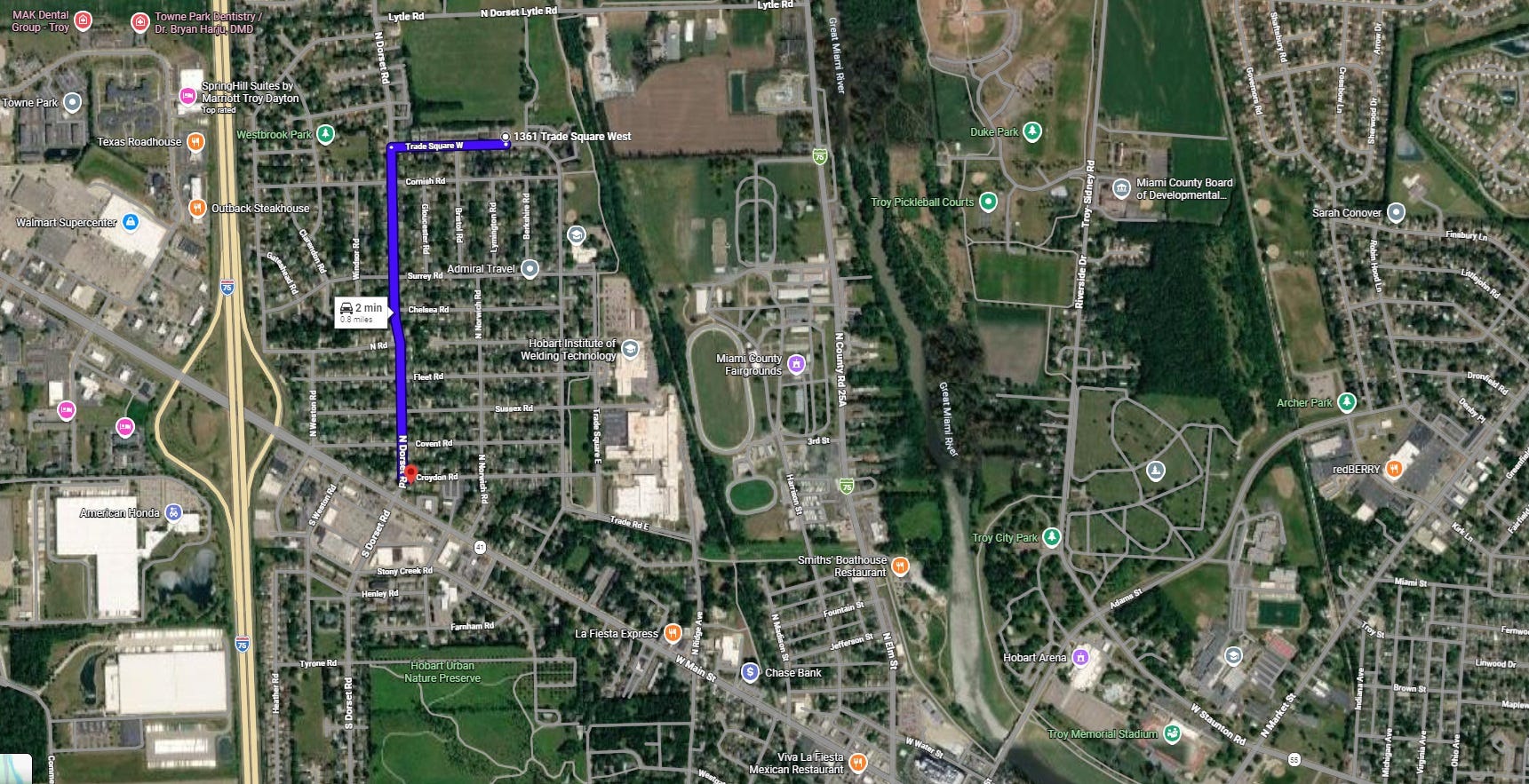
Whether she was unwelcome there too, or simply restless, Nikki left Trade Square West on foot as the sun began its descent below the tree line. The sun set at 5:19 PM that day. By 6:00 PM, civil twilight had ended and the world was turning gray — the colors draining from the trees and the siding of the houses.
Nikki began to walk. Approximately three and a half blocks. The wheels of her luggage clattering on the pavement — a lonely sound in the cooling evening air.
1496 Croydon Road, Troy — Evening
What follows is an account based on what Frank Price told investigators. He has never been charged with any crime related to Nikki Forrest’s disappearance.
Her walk ended at a single-story ranch house in the 1400 block of Croydon Road. Number 1496. A modest structure of 1,032 square feet, built in 1952, on a quiet street where neighbors knew each other’s cars. In every news and media report to date, this address had never appeared by number. The man inside had never been named.
His name was Frank Price. He was the suspected father of Nikki’s unborn child.
When Nikki arrived at the house on Croydon Road, the reception was cold. A second argument erupted — mirroring the rejection she had faced that morning in Piqua. The dispute took place in the driveway, exposed to the eyes of the neighborhood, yet curiously unseen by any witnesses who have publicly come forward.
Frank Price later told police that they argued about the paternity of the child. He questioned whether the baby was his. He looked at the girl carrying his potential child and saw a complication he could not afford in a life already straining under financial pressure. He refused to let her stay.
He did not invite the mother of his alleged child inside to rest. He placed her luggage outside on the driveway.
It was evening. The temperature was dropping toward 50 degrees. Nikki stood in the driveway, cast out for the second time in twelve hours, surrounded by her bags.
And then, according to Price, the blue car arrived.
The Blue Car
This is the singularity of the case — the event horizon beyond which no light escapes.
Price told investigators that as they stood arguing in the gathering dark, a vehicle pulled up to the end of the driveway. He described it as a sedan. Older model. Dark blue. He told police that Nikki, seeing an opportunity or perhaps recognizing the driver, gathered her bags, opened the rear door of this vehicle, and got in. He claimed she was driven away into the night, leaving him standing in the driveway.
He claimed he did not know who the driver was. He did not see a face. He just saw the car pull up, the girl get in, and the taillights fade into the darkness.
That is the last confirmed account of Nikki Lyn Forrest alive.
The Eldean Covered Bridge — Days Later
The silence of the valley was broken days after Nikki vanished by a discovery at the Eldean Covered Bridge.
Built in 1860, the bridge spans the Great Miami River five miles north of where Nikki was last seen, off County Road 25-A. It is a Long Truss design — a structure of timber and history — a place of romance for some, haunting for others. The wooden planks rumble under tires, and the roof creates a tunnel of shadow even at midday.
Nikki’s shoulder bag was found on the bridge. It was not hidden. It was left there — an artifact of interruption. Inside, investigators found her identification card, a food stamp card, and — most devastatingly — her medication. The progesterone.
The presence of the medication dismantles every theory of voluntary disappearance.
This was a woman who had suffered three miscarriages. A woman who had inked a moth of transformation on her abdomen — a symbol of the desperate desire to shed one skin and emerge as something whole. A woman fighting to keep her fourth pregnancy alive through a rigorous daily medication regimen. She did not leave that bag. A woman fighting that hard for that child does not walk away from the medicine keeping it alive.
The bag was found by passersby who — seeing the prescription label from the Covington Avenue Kroger pharmacy in Piqua — returned it to the store. They did not know they were carrying the only physical evidence of what had happened. They simply handed it over and walked away. Their identities have never been established. They have never been interviewed. They have never been heard from again.
Two more ghosts in a story already populated by the unknown.
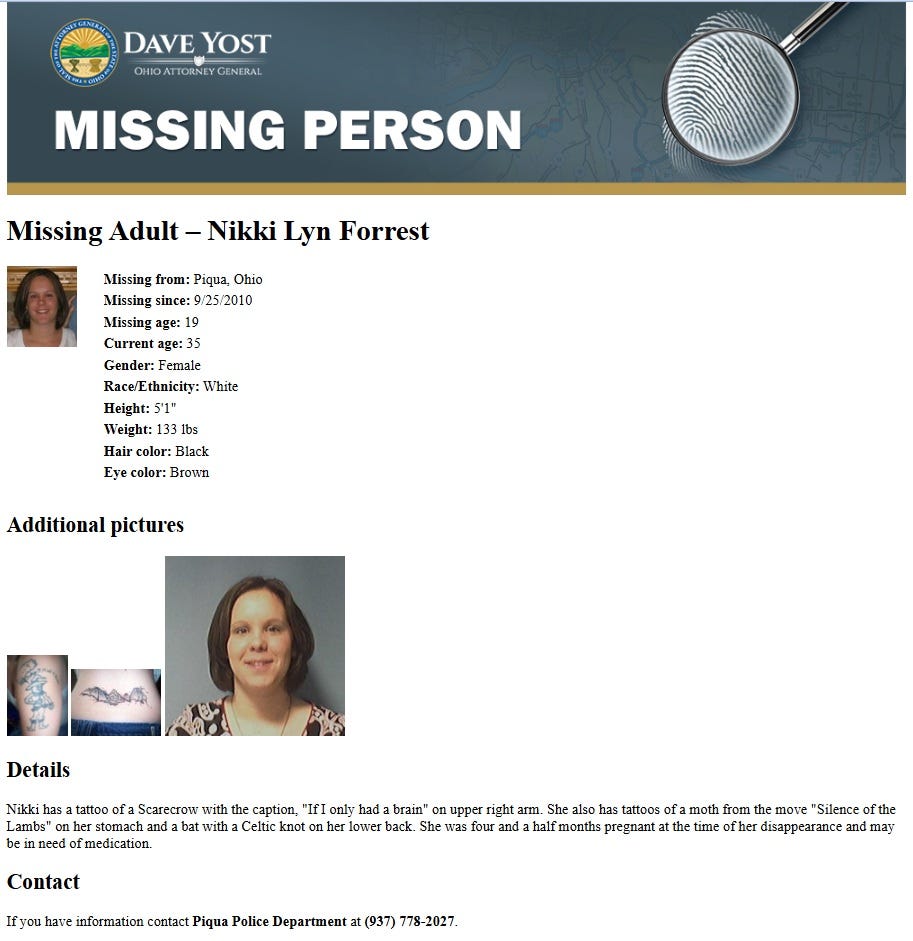
Nikki Forrest walked into the dusk of September 25, 2010 carrying everything she owned and a child she was fighting to keep. She got into a blue car and disappeared.
She has not been found.
Case File 1.4 examines what investigators asked law enforcement — and what law enforcement refused to answer.