


How Unsolved Ohio Investigates
Most true crime investigation begins with the perpetrator — mapping motive, means, and opportunity, working backward from the crime to the criminal. It is a logical framework when a suspect has been identified. It is a nearly useless one when no suspect exists.
At Unsolved Ohio, every investigation begins somewhere different. It begins with the victim.
This document explains why — and how.
The Statistical Reality of Missing Women
Before any case can be investigated effectively, the statistical landscape of missing persons cases must be understood. The numbers tell a story that law enforcement rarely publicizes and that mainstream true crime coverage rarely examines.
Based on resolved missing persons cases between 2000 and 2010 for women aged 18 to 30 in the United States, data from the National Crime Information Center (NCIC) and the National Missing and Unidentified Persons System (NamUs) establishes the following annual picture:
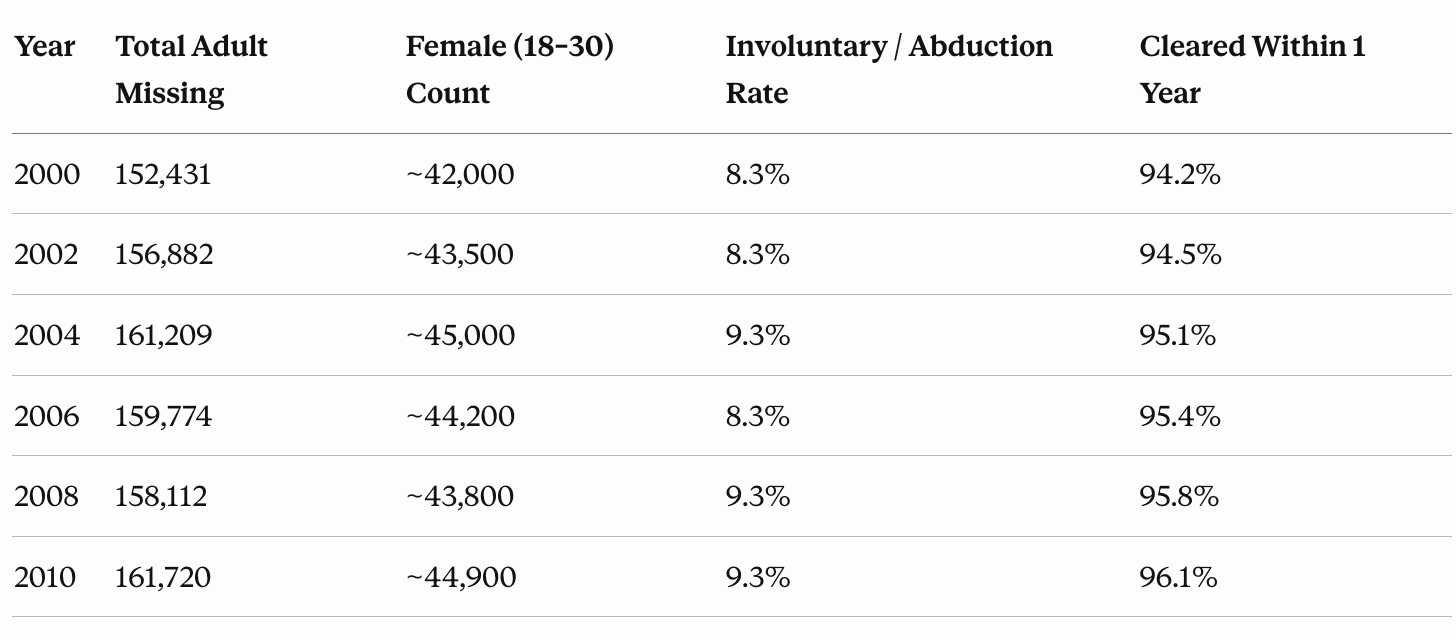
The clearance rates — consistently above 94% — suggest that most missing persons cases for this demographic are resolved within one year. That figure is misleading without context.
“Resolved” does not mean found alive. Forensically, a resolved case includes the recovery of a body, the arrest of a kidnapper, or a determination that the individual disappeared voluntarily. Resolution is a bureaucratic designation, not a measure of justice.
More critically: the cases that are not resolved within one year — the fraction of cases that fall outside that 94% clearance window — represent a disproportionate concentration of women from vulnerable populations. Women whose disappearances received minimal media attention. Women whose relationships with law enforcement were complicated by poverty, addiction, or prior contact with the criminal justice system. Women whose cases went cold not because the evidence wasn’t there, but because the institutional will to pursue it was absent.
These are the cases Unsolved Ohio investigates.
Who Is Responsible: The Interconnection Data
In resolved cases involving women aged 18 to 30, the pre-existing or opportunistic relationship between the victim and the person responsible for the disappearance follows a consistent pattern. The greatest danger is not from strangers. It is from the people closest to the victim.
The following percentages reflect the primary drivers of resolved disappearances for women in this demographic:
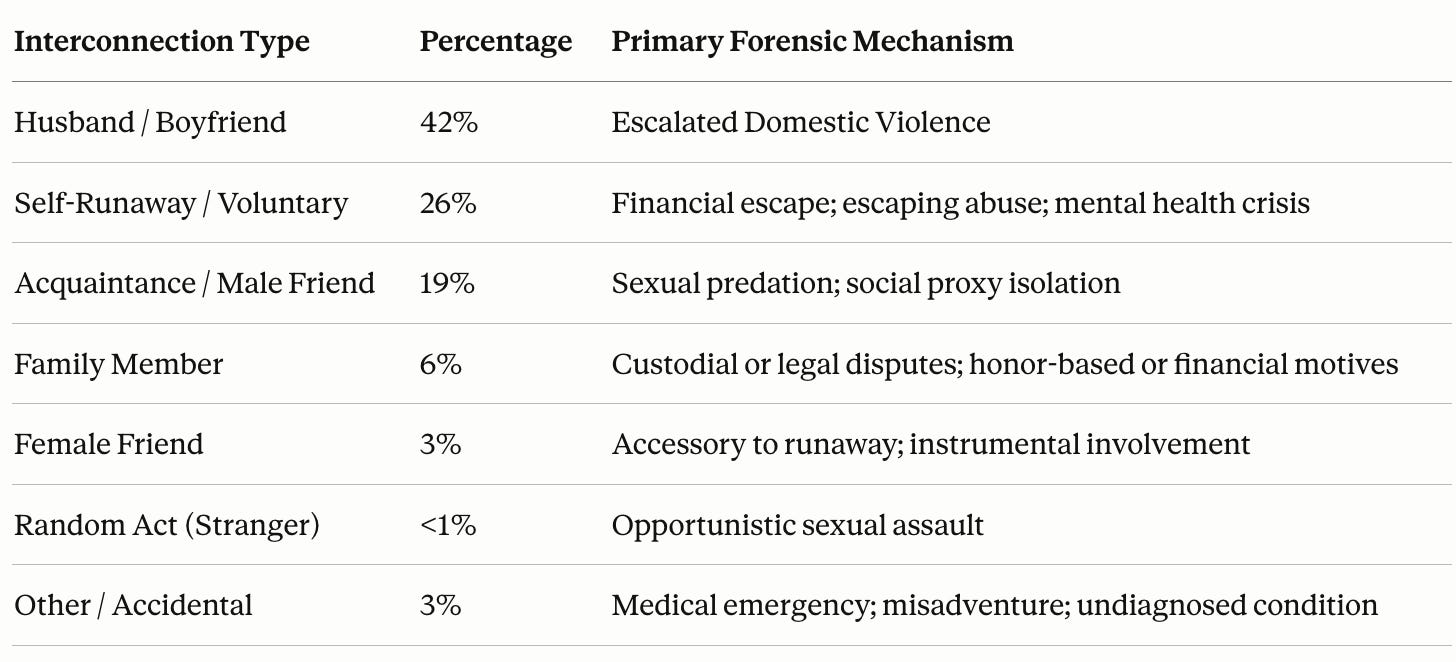
This data has direct implications for how investigations are structured. If 42% of resolved cases involve an intimate partner and 19% involve a known male acquaintance, then the inner social circle of any missing woman is statistically the most significant investigative territory — not the perimeter. Beginning an investigation by moving outward from the victim through her relationships is not a stylistic choice. It is the forensically sound approach.
The Forensic Failure Context
One of the primary structural obstacles to solving adult missing persons cases between 2000 and 2010 was what the Department of Justice characterized in its 2004 census of medical examiners as a “haphazard, disjointed, localized effort” by law enforcement agencies across the country.
Medical examiners and coroners routinely lacked the resources to retain DNA samples, X-rays, or fingerprint records. The consequence was systemic: when a missing woman was found as unidentified remains, she frequently could not be matched to her missing persons file. Cases were administratively closed as “resolved” while families waited for answers that the forensic infrastructure could not deliver.
The 2004 DOJ census found that 51% of medical examiner offices in the United States lacked formal policies for retaining records that could identify missing individuals. This single statistic accounts for thousands of cases in which a woman was found but never identified — cases that remain simultaneously “solved” and “open” in two separate systems that could not communicate with each other.
The creation of NamUs in 2007 was a direct legislative response to this failure. For the first time, a centralized national repository allowed law enforcement and the public to cross-reference missing persons profiles against unidentified remains. It was progress. It did not reach backward far enough to close the cases that fell into the gap before it existed.
Many of the cases Unsolved Ohio investigates were opened in that gap.
The Victimology Framework — Applied
Every case investigated and published by Unsolved Ohio follows the same methodological structure, regardless of geography, time period, or circumstance.
The investigation begins with the victim — her full life, not just the days surrounding her disappearance or death. Her family structure. Her relationships, friendships, and enmities. Her daily routines and the places she frequented. The economic and social conditions of the community she inhabited. The institutions — legal, medical, educational — that intersected with her life and either protected or failed her.
From this foundation, the investigation moves outward in concentric rings: from the victim’s inner circle of intimate partners and immediate family, through the secondary circle of acquaintances and social contacts, to the broader community environment that shaped the conditions of her vulnerability.
At each ring, Social Network Analysis is applied — mapping the relationships between individuals, locations, and events across time to identify the connections that traditional investigation either missed or chose not to pursue. Natural Language Processing is used to extract and analyze unstructured data across court documents, police affidavits, news archives, and digital records. The result is not a theory imposed on the evidence. It is a map built from the evidence outward.
This approach does not begin with a suspect and work backward. It begins with a person and works forward — through her life, through the documented record, through the institutional response, and into the silence where the answers have been sitting.
What This Framework Produces
An investigation structured around the victim rather than the perpetrator produces something that perpetrator-first investigation rarely does: a complete picture of the conditions that made the crime possible. This matters for two reasons.
First, it illuminates the systemic failures — the legal decisions, the institutional indifference, the community dynamics — that created the vulnerability the perpetrator exploited. These failures are not incidental to the crime. They are part of it.
Second, it generates a more complete social map. When investigators know who was in a victim’s life, where those people are now, what their documented histories show, and how they have behaved since the disappearance, the pool of investigative leads is significantly larger than what a conventional perpetrator-first approach would surface.
Every case file published by Unsolved Ohio is built on this framework. Every theory presented is grounded in documented evidence. Every named individual is included because the public record — court documents, official registries, on-record interviews, or verified media reports — places them within the investigative scope of the case.
The framework does not produce verdicts. It produces questions. The right questions, asked in the right order, about the right people.
The first case file applying this framework publishes soon. Her name was Nikki Lyn Forrest. She was nineteen years old when she disappeared from Troy, Ohio on September 25, 2010. She has not been found.
