




For the factual integrity of the Amanda Ward-Romine investigation, we need to be precise about why Ralph Richard DePriest appears in this case file at all. He is not a suspect. There is no proof or evidence connecting him to Amanda’s disappearance. Investigators map the known, local offenders around a victim to understand the ambient danger of a place — and that, and only that, is what this installment does.
But the ambient danger of Amanda’s corridor was real, and it was documented. In the summer of 2013, a registered Tier II sex offender with a history of targeting incapacitated women was living at 1579 Warder Street — the same short stretch of the near-northeast side that held Whitey’s Tavern (1070 Warder) and the Avondale Avenue houses at the center of this case. His name is Ralph Richard DePriest, and his record begins with something almost no case file contains: as a boy, he stood at the feet of a serial killer.
The boy at the crime scene
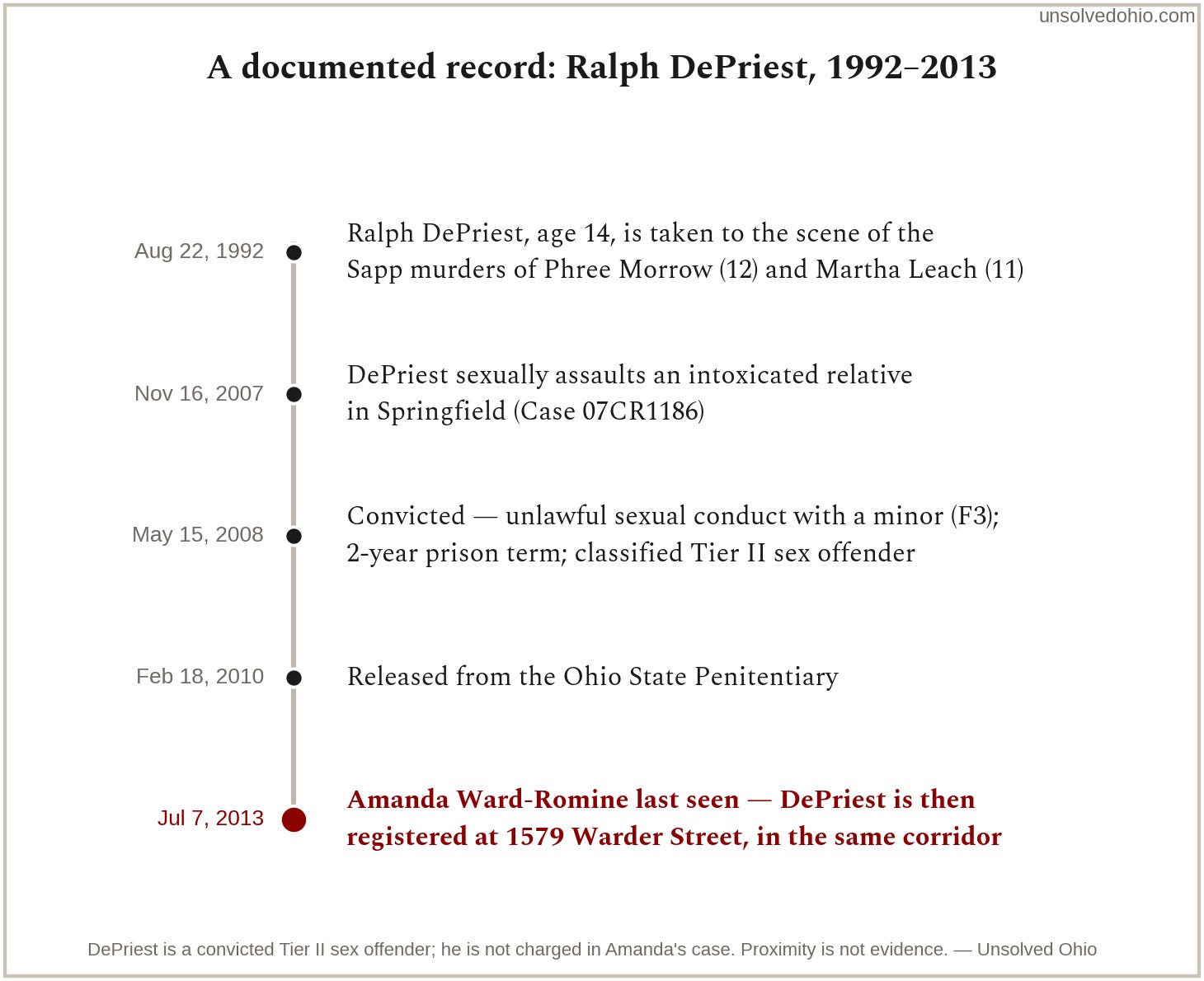
On August 22, 1992, two Springfield girls — Phree Morrow, 12, and Martha Leach, 11 — were raped and murdered near a pond behind Schuler’s Bakery. The crime is a matter of settled law: in State v. Sapp (2004), the Supreme Court of Ohio affirmed that William K. Sapp raped and killed both girls, later killed a third victim, and was sentenced to death. DNA tied Sapp to the murders, and he confessed.
Ralph DePriest was fourteen years old that day, the nephew of one of Sapp’s associates. According to the record in State v. Sapp, DePriest was brought to the scene, saw the two girls lying unconscious, was made by Sapp to take part in the degradation of the victims, and then was threatened by Sapp with death if he ever told. He turned away, the record says, before the final blow.
That is the origin the source points to. Beth’s argument — and it is an argument — is that DePriest’s later crimes echoed what he witnessed as a boy.

What DePriest was convicted of
Fifteen years later, DePriest committed the crime that put him on the registry. The account is drawn from the Springfield Police investigation and the Clark County court file, State of Ohio v. Ralph Richard DePriest (Case No. 07CR1186).
In November 2007, at a Springfield residence, DePriest gave a female relative — left redacted here — enough alcohol that she passed out, and then sexually assaulted her. When she briefly woke, per the court record, he leaned over her and asked, “You’re not going to tell anyone about this, right?” Interviewed by detectives, he admitted to giving her the alcohol and to the intercourse, saying he had been drinking and did not remember everything he did.
On April 23, 2008, DePriest pleaded guilty. On May 15, 2008, he was convicted of Unlawful Sexual Conduct with a Minor (Ohio Revised Code 2907.04), a third-degree felony, sentenced to two years in the Ohio State Penitentiary, and classified a Tier II sex offender. He was released February 18, 2010. By the summer of 2013, the Ohio Sex Offender Registry listed his address as 1579 Warder Street, Springfield.
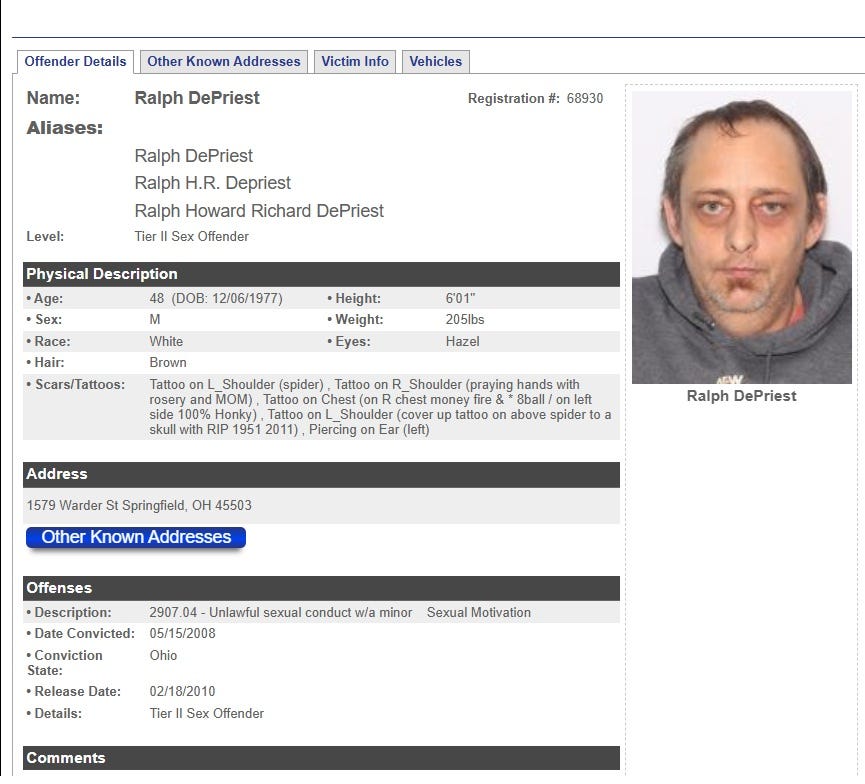
The pattern the record shows is specific: DePriest, like the men he was around as a boy, targeted a woman who had been rendered unconscious, and used the same instrument of silence — you’re not going to tell — that Sapp had used on him. That is what makes him, in geographic-profiling terms, a documented local hazard. It is also where the documentation stops. There is no vehicle, no digital trace, no forensic thread connecting him to Amanda. His porch-theft conviction in July 2010 (814 Kenton Street) and his registry address place him in the corridor; nothing places him in the case.
Can violence be learned by proximity?
The source sets DePriest’s story against a broader question: whether exposure to a killer can shape a later offender. Most of the cited cases are really about imitation at a distance — Joel Rifkin modeling himself on the uncaught Green River Killer; Stephen Griffiths, the British “Crossbow Cannibal,” studying notorious murderers to court infamy; Rex Heuermann, the Gilgo Beach killer, researching the forensic methods used to catch offenders so he could defeat them. These show killers learning from other killers’ records, not from standing beside them.
The one genuine case of apprenticeship the source cites is Robin Gecht, who worked for the Chicago serial killer John Wayne Gacy in the late 1970s and, after Gacy’s arrest, led the “Ripper Crew” through an eighteen-month spree in the early 1980s. Gecht is the exception that gives the idea any weight: a younger offender in direct physical proximity to an established predator who went on to kill. That, the source argues, is the shadow DePriest’s biography casts — a boy made to stand at a killer’s crime scene, who grew into a convicted predator of incapacitated women.
It is an argument about a pattern, not a finding about this case. DePriest was convicted of what he did in 2007. He was never charged in 1992, and he has never been charged, or linked by any evidence, to Amanda Ward-Romine.
What remains open
Strip the theory away and the documented facts are narrow but real: a registered Tier II sex offender with a history of assaulting incapacitated women was living on Warder Street the summer Amanda disappeared, in the same corridor as Whitey’s Tavern and the Avondale houses. That is context for how dangerous her immediate geography was — not evidence that any one of the offenders in it took her. As the source itself concludes, any link to DePriest would require vehicular or digital evidence tying him to the events, and that evidence does not exist. He remains, in the record’s own words, entirely unlinked.
This installment names Ralph Richard DePriest and William K. Sapp. Both are convicted: DePriest of a 2008 sex offense (registered Tier II offender); Sapp of the 1992 murders for which he was sentenced to death. DePriest is NOT a suspect in Amanda Ward-Romine’s disappearance, and no evidence connects him to it. He is examined here for one documented reason — he lived in Amanda’s immediate neighborhood during the summer she vanished, and his record describes the ambient danger of that corridor. Proximity is not culpability, and a criminal record is not evidence of involvement in this case. See our full Disclaimer.
If you have information about the disappearance of Amanda Ward-Romine, submit it at unsolvedohio.com — your name is never published without your written permission.