



This installment documents the contradictions and open questions in Amanda Ward-Romine’s disappearance using Springfield Police records, Clark County court records, the Springfield News-Sun, and cited podcast interviews — all matters of public record. It names living individuals whose proximity or records place them within the documented scope of the investigation; none is a suspect, and no evidence connects any of them to Amanda’s disappearance. It also references Daniel “Danny” Michael Romine, who is deceased and was designated a suspect by the Springfield Police Division; he was never charged. Alleged statements and reported physical-evidence findings are identified as such. Anyone not convicted of a specific crime is presumed innocent. This is an educational publication and not legal advice — read our full sourcing standard, presumption-of-innocence framing, and corrections policy in our Disclaimer.

In the last installment the vehicles wouldn’t line up. In this one, almost nothing does. Who last saw Amanda, when she left Indian Lake, whether she ever reached Springfield, and when — and by whom — she was finally reported missing: on every one of those questions, the public record gives more than one answer.
The woman renting off the Avondale house
Start with something that, as far as we can find, has never been made public. Since April 2013, a woman named Janie Lynn Lochner (born March 11, 1974) had been living in an attached sub-room she rented from Danny at 937½ Avondale Street — the same address as Amanda and Danny. If anyone had a front-row seat to the chaos between them, it was Janie.
And there is a record entry that lands squarely in Amanda's timeline: at 2:39 AM on July 5, 2013, Lochner was arrested by the Ohio Highway Patrol for OVI — pulled over in a blue Ford Explorer, cited at .211 BAC (case 1307504). Her earlier record includes an April 2011 arrest for kicking and slapping her live-in boyfriend, Rodney Ragland, in front of responding officers.
What her July 5 arrest means for Amanda’s case, we can’t say — but a person living in Amanda and Danny’s house, arrested at 2:39 in the morning the same weekend Amanda is said to have left Indian Lake, is exactly the kind of witness the public file never mentions.
When did Amanda leave Indian Lake?
The date matters more than it looks. Change it by a few days and you change the witnesses, the vehicles, the phone calls, and the entire geography an investigator would examine. And the record gives two.
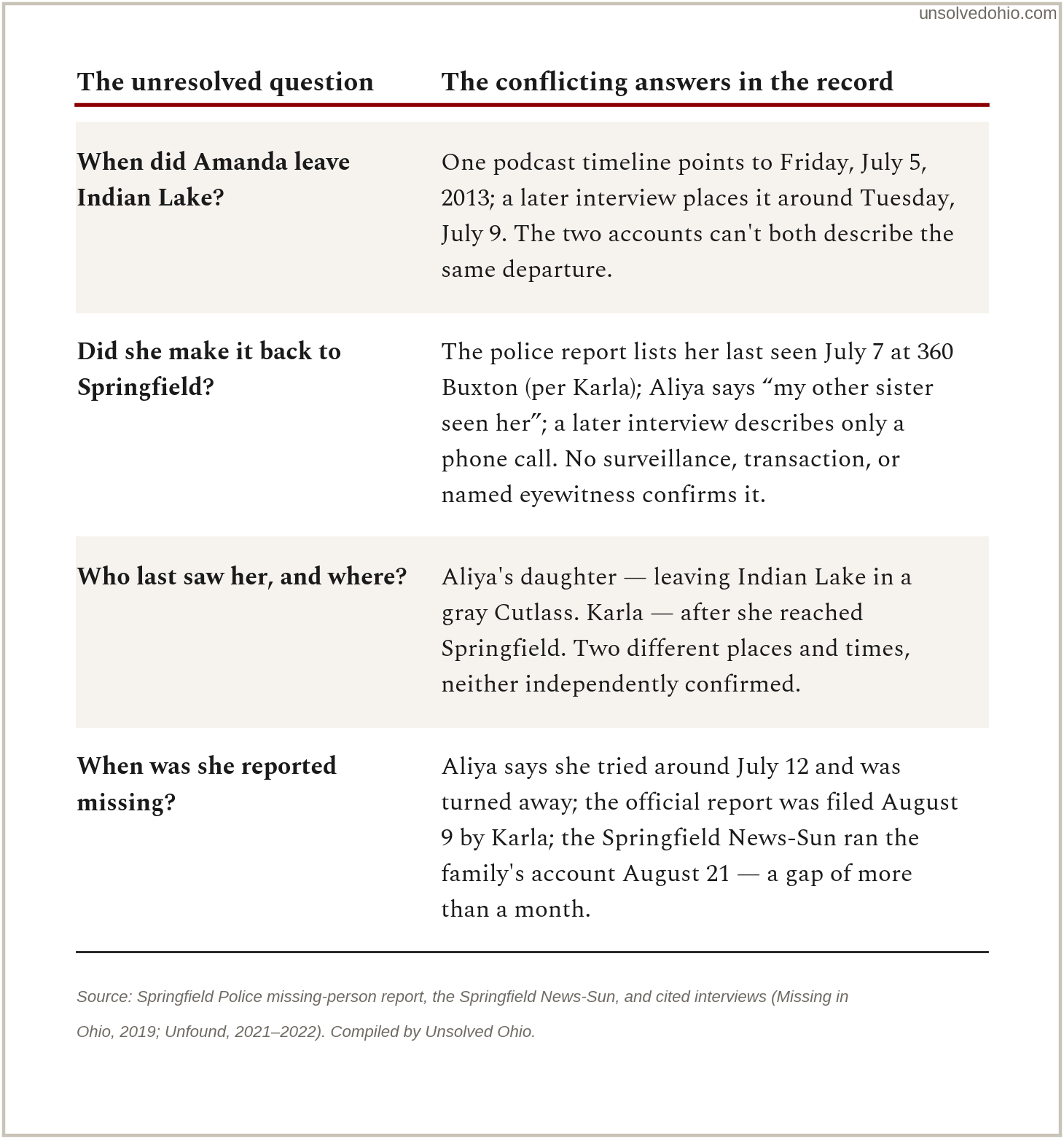
In the Missing in Ohio podcast (2019), Aliya recalls that over the “July 4th weekend” Amanda talked about returning to Springfield to reconcile with Danny; Aliya says she went to work the next day, 8 to 4, and came home to find Amanda gone. In 2013, July 4 was a Thursday — which places Amanda’s departure on Friday, July 5. In the later Unfound interview (2021), the sequence instead places her departure on or around Tuesday, July 9, and adds the gray-Cutlass driveway sighting. Both can’t describe the same departure.
Did she ever reach Springfield — and who saw her?
Everyone assumes yes. But trace the sources and it’s built entirely on family recollection, not documentation. The Springfield Police report lists her last seen July 7 at 360 Buxton — with Karla as the reporting party, and no explanation of who actually observed her there. Asked on the 2019 podcast whether Amanda made it back, Aliya answers, “She did… because my other sister seen her” — the sister being, apparently, Karla — with no date, time, or location. A later interview describes only a phone call in which Amanda asked for a ride back. The Springfield News-Sun (August 21, 2013) reported the July 7 Buxton sighting and quoted Aliya blaming the reporting delay on “family miscommunication.”
Put together, two separate eyewitness accounts describe two different moments — Aliya’s daughter watching Amanda leave Indian Lake, and Karla seeing her in Springfield. They aren’t necessarily contradictory. But no surveillance, transaction, employment record, or named, documented eyewitness independently places Amanda in Springfield after she left the lake.
A report filed a month late
The official missing-person report (case MP23304) was filed August 9, 2013 — by Karla — more than a month after the July 7 date it records. In the Unfound interview, Aliya references July 12 as the point she first went to police and, she says, was turned away. The News-Sun account (August 21) blames the gap on relatives assuming Amanda was with other family.
Aliya’s own account of those days is worth sitting with. She says her mother had just been hospitalized; when she started asking whether anyone had heard from Amanda, relatives assumed she was still at the lake. Her first stop, she says, was Danny’s house on Avondale — “no one was there.” Then she drove to Danny’s parents’ house on Beacon Street, and, before she could even open the gate, Danny and his mother came out saying they hadn’t seen or heard from Amanda — “like they had no clue why I was even there.” In the 2022 version, she says Danny himself came outside, and she told him, “You’re lying to me. You know where she is,” and he answered, “I haven’t seen her. Go away.” Then she went to the police, who, she says, would not let her file.
The Facebook that went dark

Modern disappearances leave a digital trail. Amanda’s is a question mark. Aliya says Amanda deleted or deactivated her Facebook because Danny didn’t want her using it. Yet researchers located a public profile — amanda.romine.39 — visible with activity through October 12, 2012, from which many of her 2012 posts were preserved. Whether that was her only account, whether it was deleted or merely deactivated, whether anyone accessed it after she vanished, and whether investigators ever pulled its records through legal process — none of it is answered in the public record. Facebook data could establish creation date, logins, devices, IP addresses, private and deleted messages, and any activity after her disappearance. Those are the questions that remain open.
What was she even wearing?
Three witnesses, three different answers: a white V-neck dress with pink pinstripes, cinnamon pantyhose, and beige sandals; a tan jogging suit; or black pants, a red sweater, and black shoes. The official report lists her clothing as “unknown.”
The things that don’t fit anywhere else
Some of the hardest facts in this case sit outside every tidy category:
Amanda’s DNA — hair and skin — was recovered from a two-to-three-foot crawl space at a Romine property on 1064 Warder Street, where neighbors had seen Danny working; police later excavated, and no results of that search have been posted.
A burn pile containing the remains of Amanda’s clothing was reported at the 937 Avondale house.
Danny allegedly texted Karla Ward: "If she ever tries to leave me, I'll kill her."
Amanda’s glasses were recovered near an access point to the Ohio River; her keys were left behind at the Avondale house. A drive from Springfield toward Horse Cave, Kentucky — the destination in the long-rumored “midnight run” — crosses the Ohio River near Cincinnati.
None of it, on its own, is proof of anything. Taken together, it is the reason this case will not rest.

The record does not give Amanda a clean last day — it gives contradictions. Subscribe to read the full Amanda Ward-Romine case file at unsolvedohio.com.