



This installment maps Amanda Ward-Romine's extended family from Ohio marriage, divorce, probate, and court records — all public record. It names living relatives and former in-laws and describes documented charges and convictions; none of them is a suspect in Amanda's disappearance, and naming them is not an accusation. Charges are described as filed, not as convictions unless a conviction is stated. Unsolved Ohio centers the victim and treats a documented association or family tie as a starting point for investigation, never as proof of a crime; anyone not convicted of a specific crime is presumed innocent. This is an educational publication and not legal advice — read our full sourcing standard, presumption-of-innocence framing, and corrections policy in our Disclaimer.

There is a grim and tiresome arithmetic to murdered and missing women. While the public imagination conjures a stranger lurking in the dark, law-enforcement ledgers tell a more intimate tale: criminologists find that nearly half of all women who suffer a violent end are killed by the men who claimed to love them — husbands, boyfriends, or jilted lovers.
The CDC, through its National Violent Death Reporting System, found that nearly half — 49.9% — of all female homicide victims in the United States are killed by a current or former male intimate partner. When the exact precipitating circumstances can be determined, 55.3% of those homicides are directly related to intimate partner violence. These cases usually resolve neatly, because the motive is ancient and the residences are shared; when a body is found, investigators know where to look, and the suspect is disproportionately the man who shared her bed.
But what happens when the equation breaks — when the husband is already in the ground? When statistics fail, the net must widen, and it often falls upon the family tree. Data suggests that between 10% and 19% of these women are killed by their own blood relatives — parents, siblings, or extended branches of a poisoned vine.1 Yet in the story of Amanda Ward-Romine, the file remains stubbornly open, and the math has not yet produced a conviction.
To comprehend Amanda’s disappearance, you must surrender the idea of a simple, linear lineage. The Ward family tree is a dense, thorny bramble overgrown with the tangled vines of repeated matrimony. Amanda’s mother and father were each married more than once. Amanda herself married twice. Her sister Aliya was a veteran of four marriages. Her sister Karla stood before an officiant no fewer than seven times.
When Jimmy and I investigate a disappearance, we rely on a person’s past to tell us why they vanished — establishing victimology through the extended social network of a family’s marriages. Murders are rarely random; they are the culmination of existing, intolerable stressors. Shaking a family tree can uncover long-standing feuds, retaliatory violence, or illicit family enterprises. It exposes the common drivers of premeditated ruin: money, property, contested wills, life-insurance policies, and drug debts. And it maps the “second ring” — the spouses and in-laws who are trusted with a family’s daily rhythms and home layouts, but who are not tethered by blood, and who in domestic tragedies are historically the most likely co-conspirators.
In a tidy world, a deep dive into a normal disappearance takes about two hours. Consider Laci Peterson — 27, married, no criminal record, eight months pregnant when she vanished from Modesto on December 24, 2002. Police suspected foul play almost immediately; within a week, another woman came forward about an affair with the husband, Scott Peterson, and the trail led where such trails usually lead. You always start with the husband.
But Springfield is not a tidy world, and Amanda already lived at the margins. Her world was neon-lit and populated by ghosts and grifters, where registered sex offenders circled her family like sharks. To understand her life, we have to navigate her work as a dancer, her drug-use associates, the confidants she made in prison, and the endless love triangles around her and Danny — complicated further by the new loyalties her sisters’ many marriages kept dragging into her orbit.
Are you ready to follow the white rabbit? Step carefully. It gets strange.
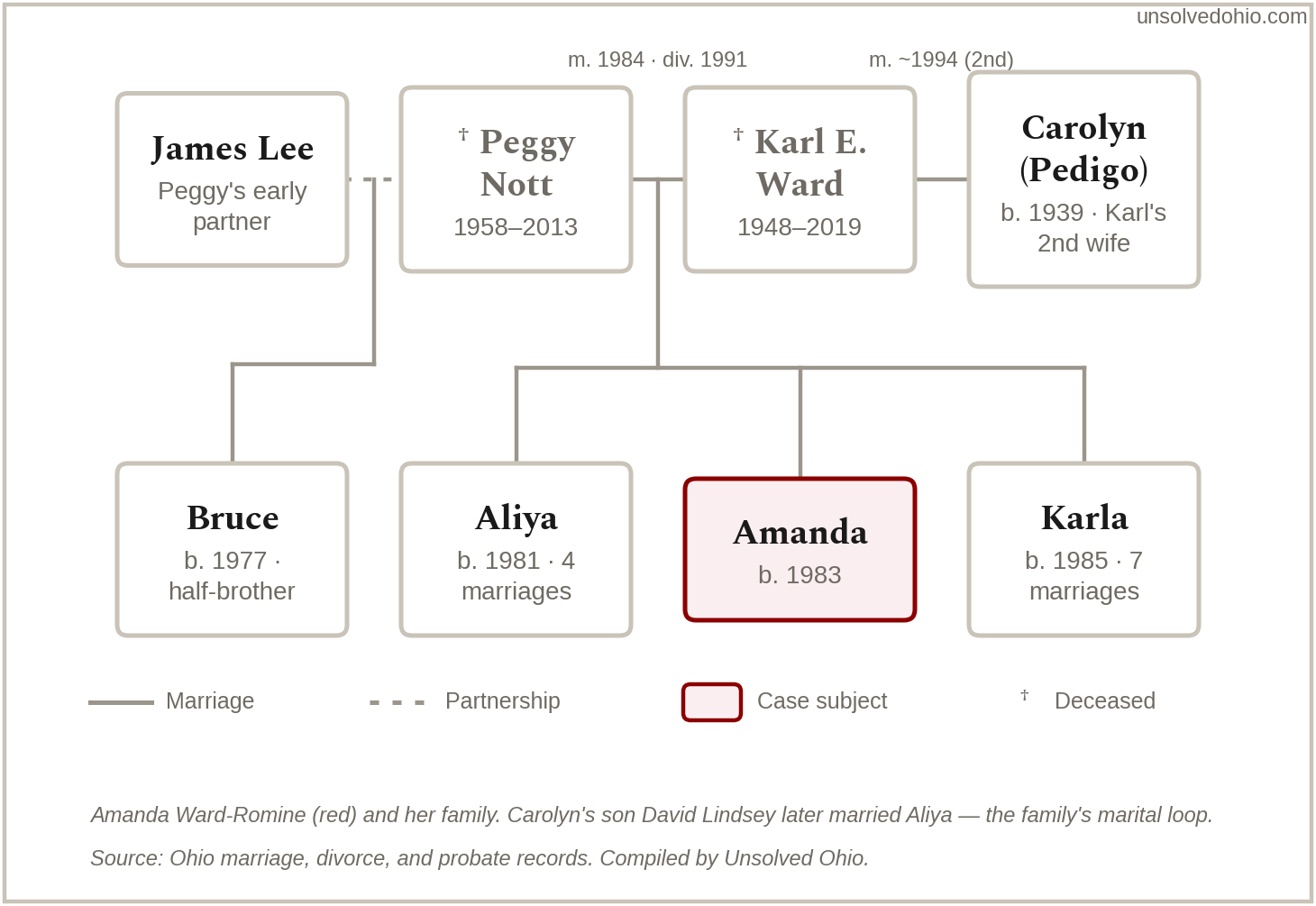
The Parental Foundation
The structure is anchored by Karl E. Ward and Peggy J. Nott. Karl was born August 17, 1948, in Dayton, served in the Marine Corps, drove a truck, and late in life worked for Dancer Trucking — the company owned by his daughter Aliya’s fourth husband, Dennis Dancer. Karl died October 28, 2019, at 71.
Peggy was born May 2, 1958, in Springfield, one of twelve children of William Nott and Edna Uptergraph-Nott. One of Edna’s sons, Larry J. Nott (born September 2, 1975), is Amanda’s maternal uncle, and he plays a critical part later in this story. Before Karl, Peggy had a son in 1977 named Bruce — his father a man named James Lee. (Yes: Bruce Lee. The names in this case are not always subtle.) Karl and Peggy married October 12, 1984, a tumultuous union with repeated police calls and domestic-violence arrests; they divorced in 1991. Peggy later took up with a man named James Pennington, her longtime boyfriend until her death. Peggy died August 16, 2013, at 55 — exactly one week after her daughter Amanda was officially reported missing.
Karl’s second wife was Carolyn Ruth (Pedigo) Lindsey, born May 7, 1939, in Knox County, Tennessee. The court record is silent on the marriage certificate — social media points to 1994 — but notes an attempted 1996 divorce that was invalidated and never re-filed. Carolyn had two sons by Paul E. Lindsey; one of them, David Lindsey (born December 31, 1956), would later create a strange marital loop inside this family. Hold that name.
Karl and Peggy had three daughters: Aliya (May 8, 1981), Amanda (February 24, 1983), and Karla (October 7, 1985). If you follow the math, two of the three were born before their parents married in 1984.
The half-brother next to the tavern
Bruce — Peggy’s son, born 1977 — matters for one reason of geography. In 2012 and 2013 he lived at 1064 Warder Street, next door to Whitie’s Tavern at 1070 Warder Street, tying him directly to the Romine family’s turf.
In August 2012, Bruce was arrested for domestic violence against his partner, Amy L. Swyers, during an argument as the couple faced eviction from that address. He left the relationship, and the records indicate he has never married.
Amanda’s own life and marriages — and the day Springfield finally called her disappearance a homicide — are the subject of a later installment. For now, we map the family around her, beginning with her older sister.
Aliya’s Four Marriages
Aliya Marie Ward (born May 8, 1981) married four times. The bare record is in the table above; the meaning is in the overlaps.
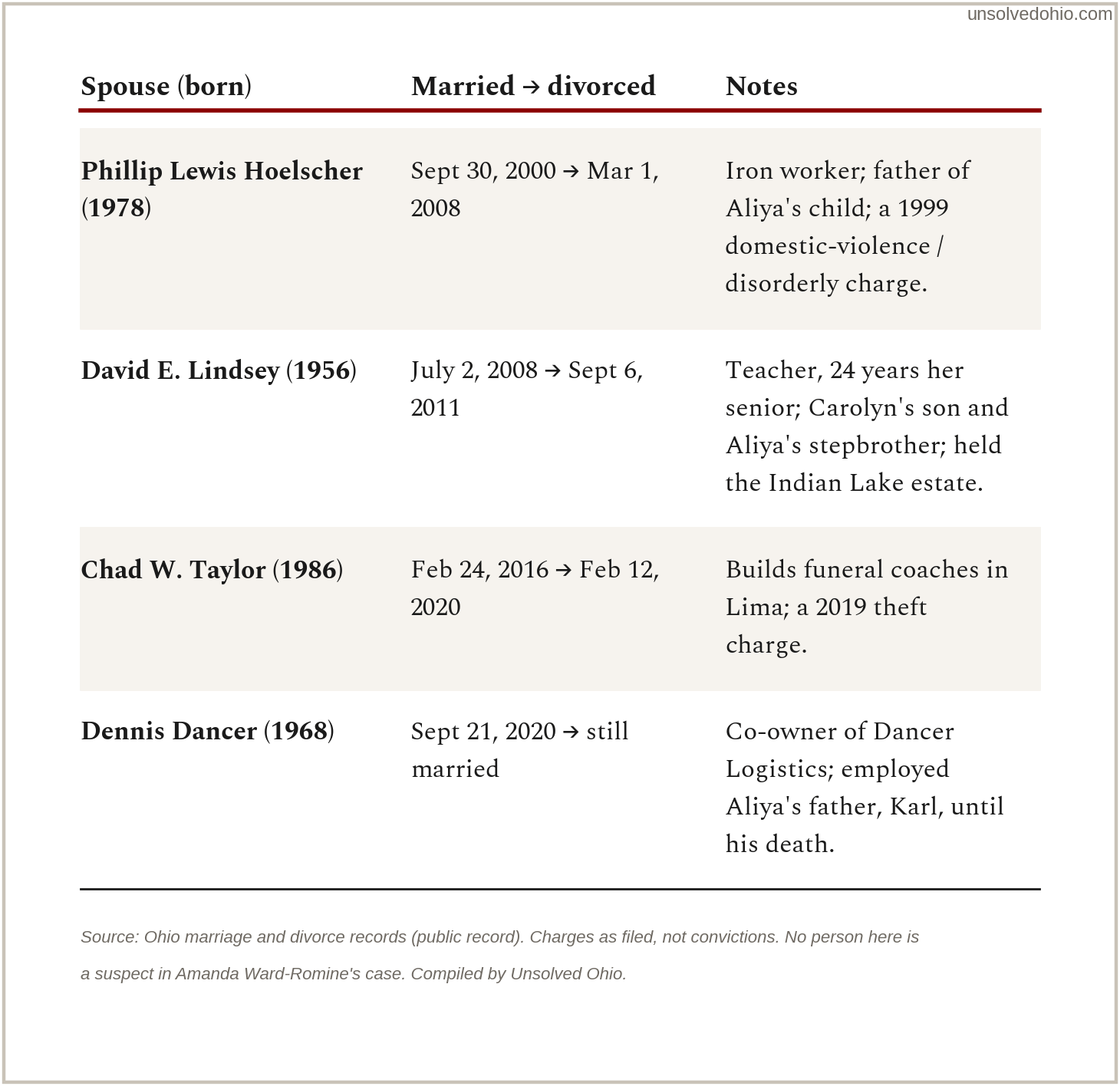
Marriage 1 — Phillip Lewis Hoelscher. Aliya married Phillip (born October 1978) on September 30, 2000, and divorced him March 1, 2008. This union produced the first of the Ward grandchildren, including a daughter — Amber Hoelscher — who would later be a witness to the digital and social interactions preceding Amanda’s disappearance. Through court records (parking, traffic, criminal, probate, and civil), Phillip’s and the family’s addresses can be tracked year by year, and two facts jump out.
First, a shared family node. On June 11, 1999, Aliya listed her address as 116 North Plum Street, Springfield. Nearly three years later, in April 2002, her sister Karla listed the same address for her own marriage. By 2001, Amanda, Aliya, Karla, Justin Minnick (Karla’s first husband), and Phillip Hoelscher were all tied to 116 (or 116½) North Plum Street — a long-term Ward family residence and a hub through which two future in-law husbands entered the family.
Second, a pattern of volatility and entanglement. On April 13, 1999 — months before Aliya is documented at Plum Street, and a year and a half before the marriage — Phillip had a domestic-violence/disorderly-conduct incident at Oak and Kewton (the DV charge was dismissed; he pleaded to reduced disorderly conduct). Whether or not Aliya was the victim, it establishes a baseline. And years after their 2008 divorce, the entanglement persisted: on July 2, 2008, Aliya married David Lindsey while listing 2807 Lansing Drive #3 in Dayton; she divorced Lindsey September 6, 2011; and just 22 days later, on September 28, 2011, Phillip Hoelscher is documented using that same Dayton apartment. Aliya has a child with Phillip, and it appears the two reunited immediately after her second divorce. The Phillip–Aliya line was never fully severed.
Marriage 2 — David Lindsey, the loop. This is where it gets strange. David E. Lindsey (born December 31, 1956) was Carolyn’s son — which made Aliya’s second husband her own stepbrother. He was also 24 years her senior. David had been married before, to Janice Elaine Lawson (married 2001; Janice died January 14, 2007); through her estate, David took control of Indian Lake–area property worth well over $100,000 — the houses at 27839 Township Road 130 (also recorded as 27839 Goshen Road 130), Lakeview, and at 11439 Elm Street, Avondale-Lakeview — along with vehicles, a motorcycle, a 2000 Corvette, a teaching retirement fund (~$125K), and Janice’s annuity (~$120K). Aliya, by contrast, brought a 2005 Dodge Caravan, a couch, and a bed.
That Township Road 130 address is not incidental. In late 2012 and into 2013 — up to the day she disappeared — Amanda listed 27839 Goshen Road 130, Lakeview as her residence. It is the address police reports tie to “a gray car” that allegedly picked Amanda up and drove her to Springfield to see Danny Romine, and the address near Coyote’s, the bar where she worked less than a mile up the road. We will return to all of it.

Marriage 3 — Chad W. Taylor. Aliya married Chad Taylor (born July 1986) on February 24, 2016, and divorced him February 12, 2020. Chad builds high-end funeral coaches for a nearly-150-year-old specialty manufacturer in Lima — he lists his work address as his residence. The marriage carried its own court paper trail, including a 2019 theft charge.
Marriage 4 — Dennis Dancer. In 2020, Aliya married Dennis Dancer (born August 1968), co-owner of Dancer Logistics, a Delphos trucking and warehousing firm. Dennis employed Aliya’s father, Karl, until Karl’s death. Aliya and Dennis are still married and live in Delphos.
What Does This Mean for Amanda?
By now you’ve likely noticed what investigators notice: these are not isolated lives. They form an interconnected social network in which marriages, divorces, shared residences, criminal histories, and family ties continually overlap. In a case like Amanda’s, those intersections often matter more than any single event seen in isolation.
What does that mean for Amanda Ward? As you’ll see in what comes next, it may have everything to do with her homicide. And we have not yet reached the most tangled branch of this tree — Karla, and her seven marriages.
The next installment follows Karla Ward’s seven marriages and the men who moved through them. Subscribe to read the full Amanda Ward-Romine case file from the beginning at unsolvedohio.com.