



Evil rarely announces itself. It arrives quietly — in ordinary houses, on familiar streets, in the shadows of taverns and late-night parking lots. In the summer of 2013, one woman disappeared into that landscape in Springfield, Ohio. Her name was Amanda Ward-Romine.
Two months before she vanished, a man named Jonathan Wayne Hilbun was released from a Louisiana correctional facility. His history was not ordinary. Long before Springfield entered the story, Hilbun’s name was attached to kidnapping, aggravated robbery, and rape — a documented pattern of forcibly moving victims and controlling them by force. He is not a suspect in Amanda’s case, and no evidence connects him to it. But the intersection of his record, his timing, and his geography is the kind of thread a cold case cannot leave unpulled.

A documented history of violence
Hilbun’s record is a matter of public court and law-enforcement documents in Louisiana and Ohio.
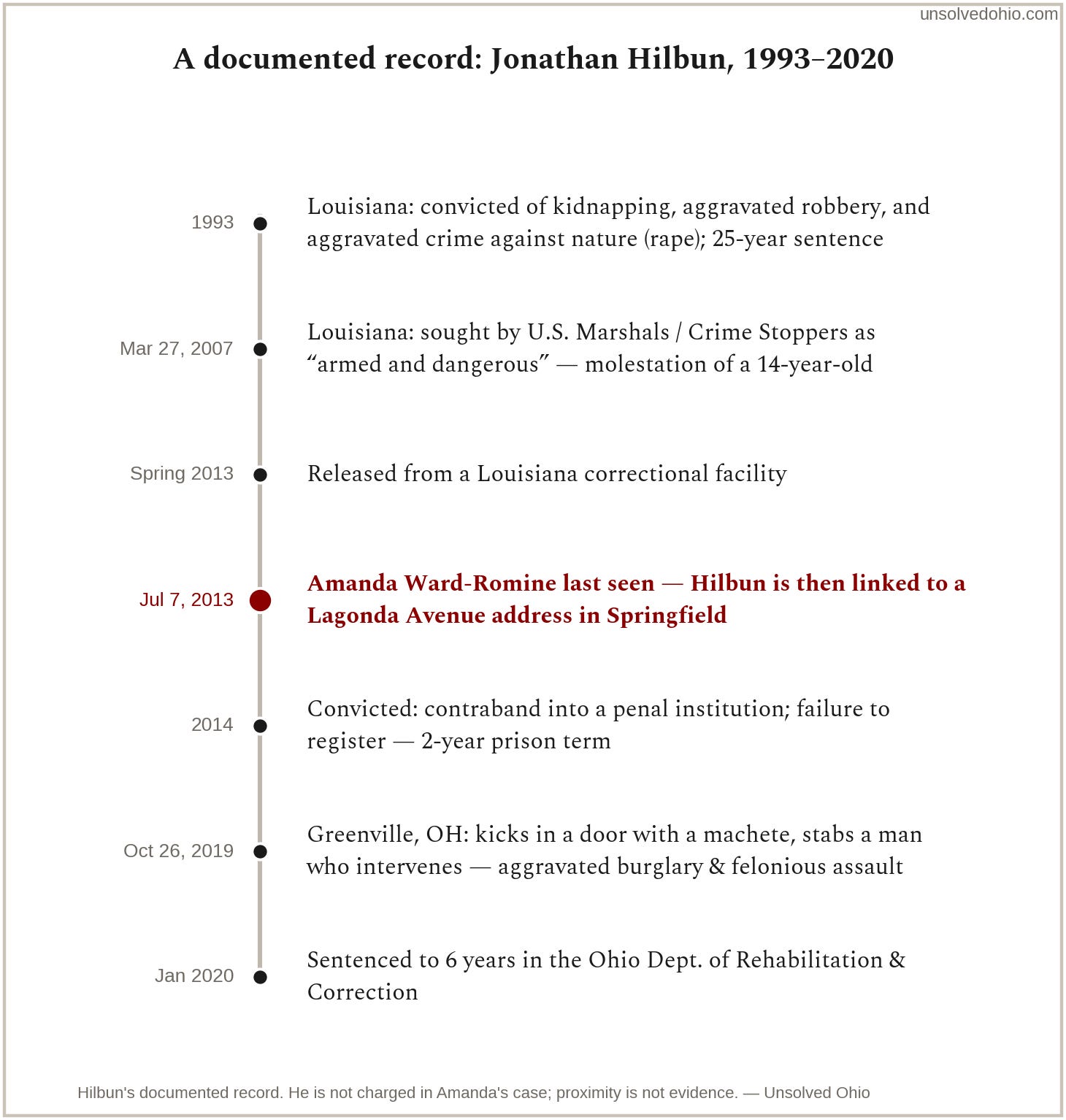
In 1993, in Louisiana, he was convicted of severe violent felonies — kidnapping, aggravated robbery, and aggravated crime against nature (rape) — and sentenced to 25 years, though he did not serve the full term. In 2007–2008, he was sought by the U.S. Marshals and Baton Rouge Crime Stoppers, who labeled him “armed and dangerous,” in connection with the molestation of a 14-year-old; subsequent charges included carnal knowledge of a juvenile. In 2014, records show convictions for taking a controlled substance into a penal institution and for failure to register, resulting in a two-year prison sentence.
Then, on October 26, 2019, in Greenville, Ohio, Hilbun forced his way into a home by kicking in the door, wielding a machete. He tried to drag a woman out of the residence against her will; when a man intervened, Hilbun stabbed him in the face, back, and shoulder, causing critical injuries that required surgery and seventeen stitches. He was charged with aggravated burglary (a first-degree felony) and felonious assault (a second-degree felony), and on January 17, 2020, he was sentenced to six years in the Ohio Department of Rehabilitation and Correction (Darke County Common Pleas; reported by the Daily Advocate, January 21, 2020).
Why Springfield — and why it matters
Timing and geography are what put Hilbun in this file. He was released from Louisiana just months before Amanda disappeared in July 2013, and public records later connected him to an address on Lagonda Avenue in Springfield — a short distance from the Warder Street and Avondale corridor at the center of this case. Amanda’s documented last-known location was 360 Buxton Avenue; the small geographic circle around Whitey’s Tavern, the Avondale houses, and the blocks between them is where ordinary life and unanswered questions collide.
The frightening thing about predators, the source observes, is not that they look monstrous. It is that some blend in — they wait, they observe, they learn the landscape. Hilbun’s own record, from 1993 to 2019, is a repeated demonstration of one specific behavior: taking a person from one place to another against their will.
That is a documented capacity. It is not a link. To date there is no public confirmation, no forensic evidence, and no investigative finding tying Jonathan Hilbun to Amanda Ward-Romine. He remains entirely unconnected to her disappearance and homicide.
What remains open
More than a decade later, the honest questions are the ones the record raises but cannot answer: a man with a long, documented history of violent abduction was released from prison and surfaced in Springfield the same summer Amanda vanished, blocks from her world. That overlap is real, and it is only an overlap. Cold cases are rarely about certainty; they are about the space between what is known and what is suspected. The question worth putting to investigators is simply: where was Hilbun in July 2013, and has anyone ever asked?
This installment documents the public criminal record of Jonathan Wayne Hilbun — convicted in Louisiana (1993) and Ohio (2020) — drawn from Louisiana and Ohio court and law-enforcement records and contemporaneous news reports (WAFB, 2007; the Daily Advocate*, 2020). Jonathan Hilbun is not a suspect in Amanda Ward-Romine’s disappearance, and no evidence connects him to it. A violent criminal record and geographic proximity to a victim are matters of public record; they are not evidence of involvement in this case. The names of the victim and bystanders in his 2019 Ohio case have been withheld. Anyone not convicted of a specific crime is presumed innocent. This is an educational publication and not legal advice — read our full sourcing standard, presumption-of-innocence framing, and corrections policy in our Disclaimer.*
If you have information about the disappearance of Amanda Ward-Romine, submit it at unsolvedohio.com — your name is never published without your written permission.