



This installment names Jennifer and Jessika Rowland, two living individuals, and reasons from documented records toward possible explanations. Neither sister is a suspect in the disappearance or homicide of Amanda Ward-Romine or in any other death discussed here. Neither has been charged in connection with any of them. There is no evidence connecting either to these cases. What follows is explicitly labeled as theory and speculation — one investigator’s reading of how documented facts might fit together — not a finding of fact and not an accusation that any named person committed any crime. Everyone not convicted of a specific crime is presumed innocent. Read this alongside the documented record in the previous installment, and see our full Disclaimer.
The previous installment laid out what is documented: two sisters in Amanda Ward-Romine’s orbit, and Jessika Rowland’s twenty-five-year arrest record across six states. This installment does something different, and we want to be exact about what it is. It reasons from that record toward a hypothesis — and a hypothesis is not a finding.
There is a pattern in the timeline. Again and again, a violent incident or a disappearance occurs in Ohio, and within days Jessika leaves for Florida. As an investigator reviewing the file, that pattern is striking. It is also, on its own, only a pattern — circumstantial proximity, not proof. Proximity does not equal guilt, and coincidence is not conspiracy. We hold both of those thoughts at once through everything that follows.
What we do below is walk the coincidences the record actually contains, then set out — clearly, as a labeled hypothesis — how a prosecutor might read them. Then we tell you, just as plainly, everything that hypothesis cannot establish.
What follows is a speculative reconstruction and investigative theory built from the documented evidence in the previous installment. It is one possible reading of the facts — not an assertion of what happened, and not a claim that any named person is responsible for any death or disappearance.
The coincidences the record contains
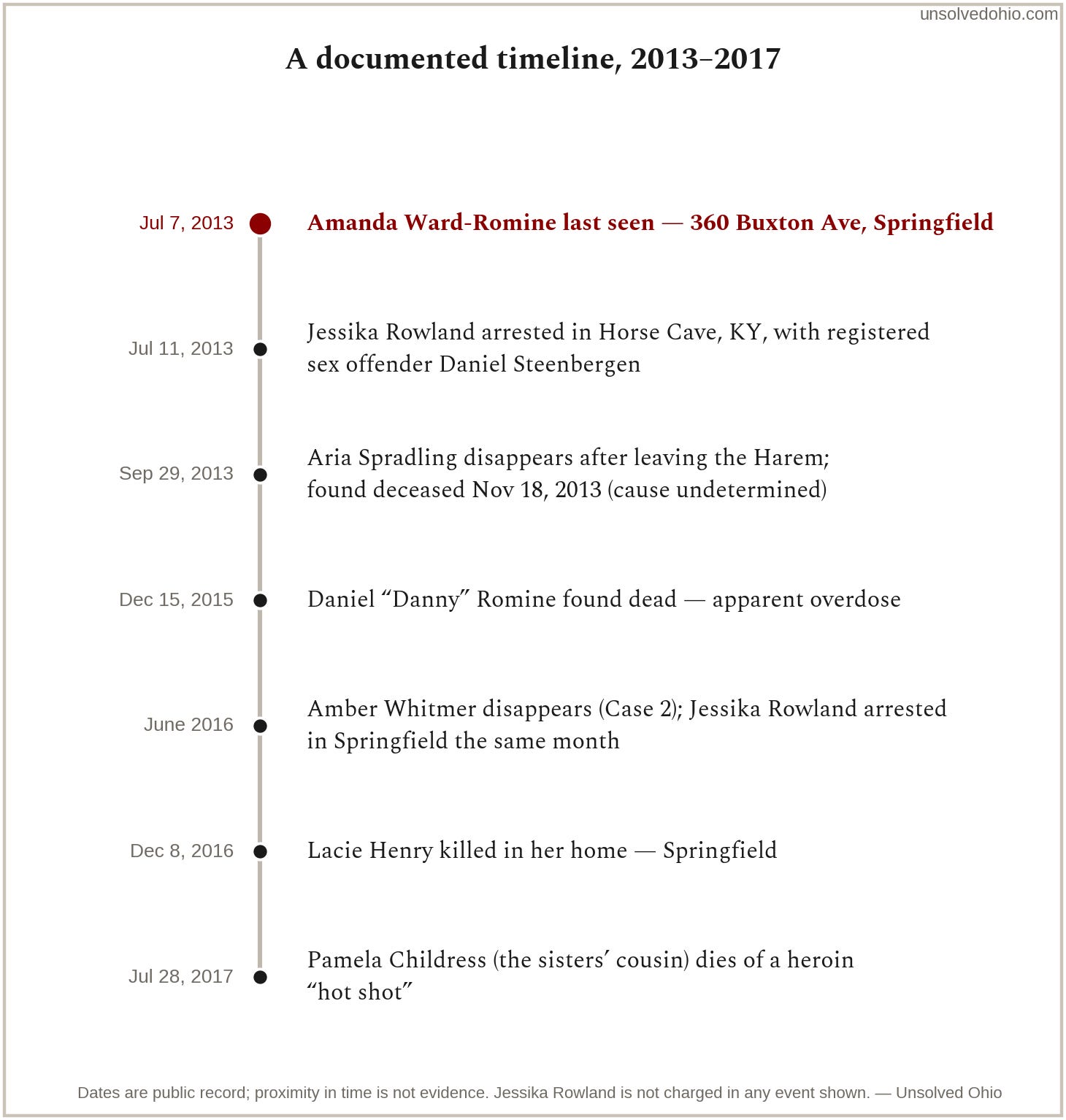
Begin with the anomaly at the center of Jessika’s timeline: the sudden departures, and how often they line up with a death or a vanishing in her orbit.
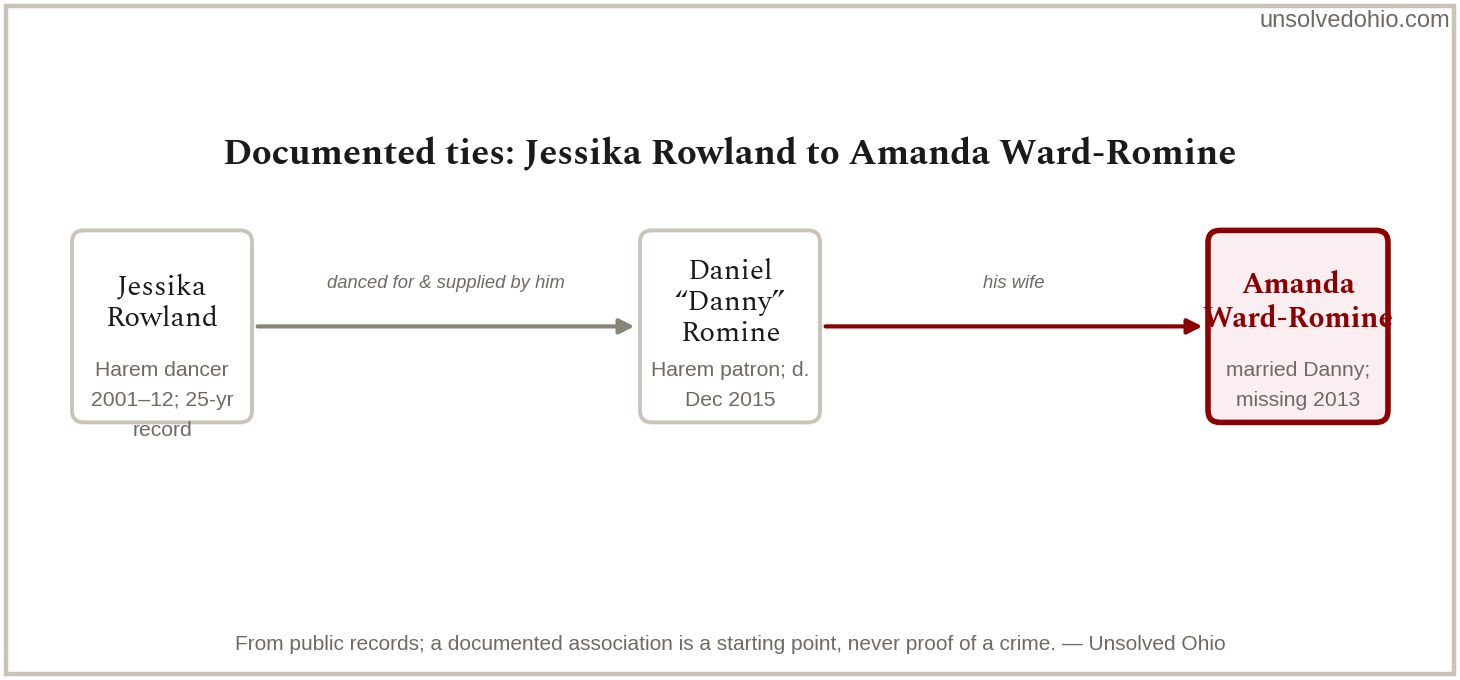
Amanda Ward-Romine — June 2013. In the same month Amanda vanished, Jessika fled south to Horse Cave, Kentucky, where she was arrested in the company of Daniel Steenbergen, a registered sex offender and her later co-defendant on a Kentucky burglary case.
Police reports from that Kentucky arrest are said to note another woman present who left before she could be questioned. Was that woman Amanda? Or another woman among the missing? The record poses the question; it does not answer it.
On the 2019 Missing in Ohio podcast, Amanda's sister Aliya stated that someone told detectives a confidential informant drove Danny Romine and two or three others to Kentucky for a drug deal in June 2013, and that a body they believed to be Amanda was with them — and that the informant later led detectives to Kentucky, then recanted, claiming he had lied, and served two years for it.

Aria Spradling — September 2013. Aria Spradling died in 2013; her body was found November 18, 2013, in Art Van Atta Park in Vandalia, Ohio, roughly two miles from the Harem, per WHIO reporting. Medical examiners were reportedly unable to determine a cause of death. A regular performer at the Harem since 2009, she disappeared on September 29, 2013, after leaving the club. Eaton Police Chief Chad DePew told reporters he had been told a woman was seen running naked in the road before three men in a minivan pulled her in and drove off (WHIO). Jessika remained entrenched in that same club's world at the time.
Danny Romine — December 2015. Daniel "Danny" Romine was found dead of an apparent drug overdose on December 15, 2015, as established earlier in this case file. He was the patron who had watched Jessika and Amanda dance, who bailed Jessika out in 2010, who let her tend bar at Whitey's, and who — by her arrest records — kept her supplied with cocaine and heroin. Jessika was in Springfield at the time of his death, and left for Florida shortly after.
Amber Whitmer — June 2016. Amber Whitmer is the missing woman at the center of Unsolved Ohio's Case 2; she disappeared from Springfield in June 2016. That same month, Jessika drifted back to Springfield and was arrested for a transaction involving drugs and prostitution.

Lacie Henry — December 2016. Lacie Henry was killed by gunfire in her own home on December 8, 2016, in what the record treats as a narcotics dispute; her two young children were present. Described as a close friend and drug supplier to the Rowland sisters. Jessika was in Springfield for about seven days spanning the window of the killing, then returned to Florida.

Pamela Childress — July 2017. Pamela Childress, a cousin to Jessika and Jennifer, died July 28, 2017, of a heroin "hot shot"; two people — Michael Jerome Crowley II and Kristie M. Bevington — were later charged in her death. Both were figures within the sisters' documented social network.
There is also a Florida thread — Prentiss Hare, a man from Springfield the source describes as a serial killer, tied to the July 2015 death of Michael James Frazier in Jacksonville, the subsequent death of witness Tiffany Chambers in Springfield, and the December 2015 strangulation of Deshun D. Lumford in Springfield.
To track Jessika Rowland through the American landscape, the source argues, is to follow a hurricane by the wreckage it leaves behind. That is a vivid line, and it is the authors’ characterization — a way of describing a pattern of coincidences, not a statement that she caused any of these deaths.
Motive and means: a labeled hypothesis
Everything in this section is an investigative hypothesis — a reasoned guess about how the documented facts might fit, offered to generate leads. None of it is established fact. None of it is a charge. Jessika Rowland has not been accused by any authority of involvement in any of these deaths.
The source sets out, for each of five cases, a possible motive and a possible means, “based strictly on the provided case files.” We reproduce that structure, with the hypothesis labeled as such in every instance.
Amanda Ward-Romine. Hypothesized motive: jealousy, financial competition, or silencing a liability. Hypothesized means: luring a victim toward violent associates. The documented basis offered: Amanda and Jessika both danced at the Harem and both had relations with Danny Romine; Amanda vanished in June 2013; that month Jessika was arrested in Kentucky alongside Steenbergen; and Aliya’s unverified podcast account of a body driven to Kentucky. The hypothesis: that Jessika, through her connections, either participated in or facilitated Amanda’s disappearance. We stress that this is speculation. There is no evidence for it, and Jessika has never been charged.
Aria Spradling. Hypothesized motive: territorial vice disputes or unpaid debts. Hypothesized means: an abduction using male associates. The documented basis: Aria worked the same club; witnesses described a woman pulled into a minivan by three men; Jessika’s 2011 arrests establish her entrenchment in the local drug trade and her proximity to violent men. The hypothesis: that Jessika had the connections to coordinate such an act. Speculation; no evidence; no charge.
Danny Romine. Hypothesized motive: silencing a co-conspirator or severing a compromised supply line. Hypothesized means: a lethal “hot shot” of narcotics. The documented basis: Jessika’s long history with Danny, her presence in Springfield at his death, her departure afterward. The hypothesis: that as an addict and dealer she had the means to administer a fatal dose. Speculation. The documented finding is an apparent overdose, not a homicide.
Amber Whitmer. Hypothesized motive: eliminating a witness or a debt. Hypothesized means: trafficking or targeted disappearance through her network. The documented basis: the coincidence of Jessika's June 2016 Springfield arrest with Amber's disappearance, and the broader Hare-adjacent network. The source also raises — as a question — whether Jessika was connected to Brian Stoops. Speculation; no evidence; no charge.
Lacie Henry. Hypothesized motive: eradicating a drug debt. Hypothesized means: a contracted home invasion or acting as a trusted front. The documented basis: Lacie supplied the sisters; Jessika’s seven-day presence spanned the killing window. The hypothesis: posed entirely as questions in the source. Speculation; no evidence; no charge.
The “Blonde Barbie” comparison
What follows is analysis and analogy — the authors’ argument about a behavioral archetype. It is opinion and speculation, not a statement of fact about Jessika Rowland, who has never been charged with any violent crime.
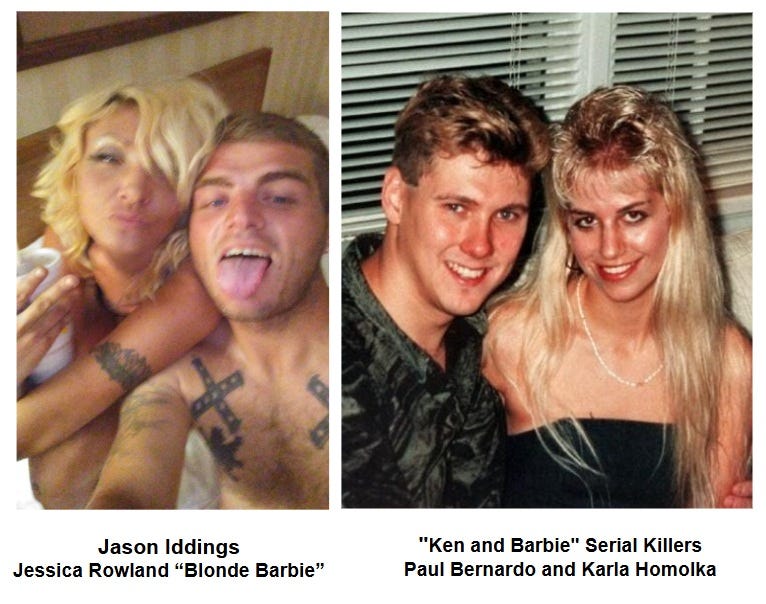
The source argues that Jessika’s persona resembles the “Ken and Barbie” archetype — a reference to Karla Homolka and Paul Bernardo, the Canadian couple convicted for the abduction, rape, and murder of teenage girls in Ontario between 1990 and 1992. The recovered evidence in that case established Homolka as a calculated, active participant who used a conventional, non-threatening appearance to disarm victims — including her own younger sister, Tammy — before their assaults and deaths.
The comparison the source draws is behavioral: that a woman’s ordinary, unthreatening presence can lower another woman’s guard in a world otherwise populated by predatory men. It applies that lens to Jessika’s movement through the Harem’s world and the transient drug networks around it, and to the argument that severe, daily addiction can erode moral boundaries. The source is careful, at its own turns, to frame this as a hypothesis about why someone in Jessika’s position might cross a line — not a claim that she did.
We reproduce the comparison because it is the authors’ argument. We label it, without qualification, as speculation. Karla Homolka was convicted. Jessika Rowland has not been charged with any violent crime, and the resemblance the source describes is one of archetype and environment, not of proven conduct.
What the record shows about flight and supervision
Set the homicide hypotheses aside for a moment, because the record supports a narrower, firmer observation on its own terms: Jessika Rowland has repeatedly moved across state lines in ways that frustrate supervision.
The documented facts: a 2014 multi-state felony extradition from Fort Worth, Texas back to Kentucky; a trail of failure-to-appear and fugitive warrants, including a February 2018 arrest in Clearwater on a Brevard County warrant; and a five-year Ohio probation term imposed in October 2015 during which she was repeatedly arrested in Florida. The source’s argument — again, an argument — is that a person on probation who is continuously arrested out of state should ordinarily be violated, and that the failure to revoke points either to gaps in interstate tracking or, as a labeled alternative hypothesis, to some informal status.
The source then drafts a proposed statement of probable cause and pattern of flight — a document the authors would send to courts in Clark County, Ohio and Duval County, Florida, asking that Jessika be declared a fugitive from justice and entered into NCIC with nationwide extradition parameters.
The following is the authors’ own petition and advocacy — a document they propose to submit to the courts. It is their argument to the authorities, not a court finding, a charge, or an established fact.
The petition’s documented basis, stripped to what the record supports: a 25-year history of arrests and structural recidivism; a verified 2014 interstate felony extradition; repeated failure-to-appear warrants; and, in January 2019, a charged (not yet, in this file, adjudicated) incident of smuggling contraband into a Jacksonville detention facility. The authors ask the courts — the bodies that actually hold that authority — to act.
A colleague’s reply
The source closes with a reply from a colleague in law enforcement, whom Beth consulted.
The response, in substance: that different states, counties, and judicial circuits handle probation violations, extradition, and warrants differently; that coordinating a response across jurisdictions is rarely simple; that many in law enforcement agree repeat offenders who move across state lines exploit real administrative gaps; and that the most productive path is to keep sharing well-documented, verifiable information with the agencies that currently hold jurisdiction over the active cases. It is a measured, noncommittal reply — supportive of the documentation, careful about the conclusions.
What remains open
Strip away the hypotheses and here is what the record actually leaves standing. A woman moved through the same clubs, the same men, and the same drug networks as Amanda Ward-Romine and at least four other people who are now dead or missing. Her departures repeatedly coincided with those events. She has been arrested across six states for twenty-five years without a prison term. None of that is evidence that she harmed anyone. All of it is a set of documented coincidences that no investigation has ever resolved — in either direction.
That is the honest state of it. The pattern is real; the explanation is unproven. We publish the questions so that someone who knows an answer can come forward — not to supply a verdict the evidence does not support.
If you have information about the disappearance of Amanda Ward-Romine — or about any of the deaths and disappearances named here — submit it at unsolvedohio.com; your name is never published without your written permission. Naming a person as a subject of investigative interest is not an accusation of guilt, and we correct factual errors promptly.