



In reviewing the familial background pertinent to this case, it is necessary to examine the history of Daniel Clifton Romine, father of Daniel M. Romine. Daniel M. Romine is a suspect in the homicide investigation of his wife, Amanda Ward-Romine. It must be explicitly stated, however, that there is no proof or evidentiary link suggesting the elder Romine had any involvement in Amanda's disappearance or death. The following documentation of Daniel Clifton Romine's criminal and assaultive behavior is detailed strictly to establish historical context, entirely independent of Amanda's case.
This is Part 9 of the Amanda Ward-Romine case file — start at Amanda Ward-Romine.
The Master of Warder Street
“Springfield bar owner accused of shooting at patron” — Parker Perry, WHIO-TV, September 11, 2018.
The town of Springfield, Ohio, is the sort of Midwestern enclave where secrets linger in the stale air of local taverns and grudges outlive the people who hold them. At the center of this specific gravity sat Whitey’s Tavern — or Whities, as the municipal dockets sometimes preferred — a dimly lit outpost at 1070 Warder Street. To the casual passerby it was merely another brick-and-mortar tavern anchoring a nondescript corner; to those who understood the internal mechanics of the neighborhood, it was a kingdom of shadows.
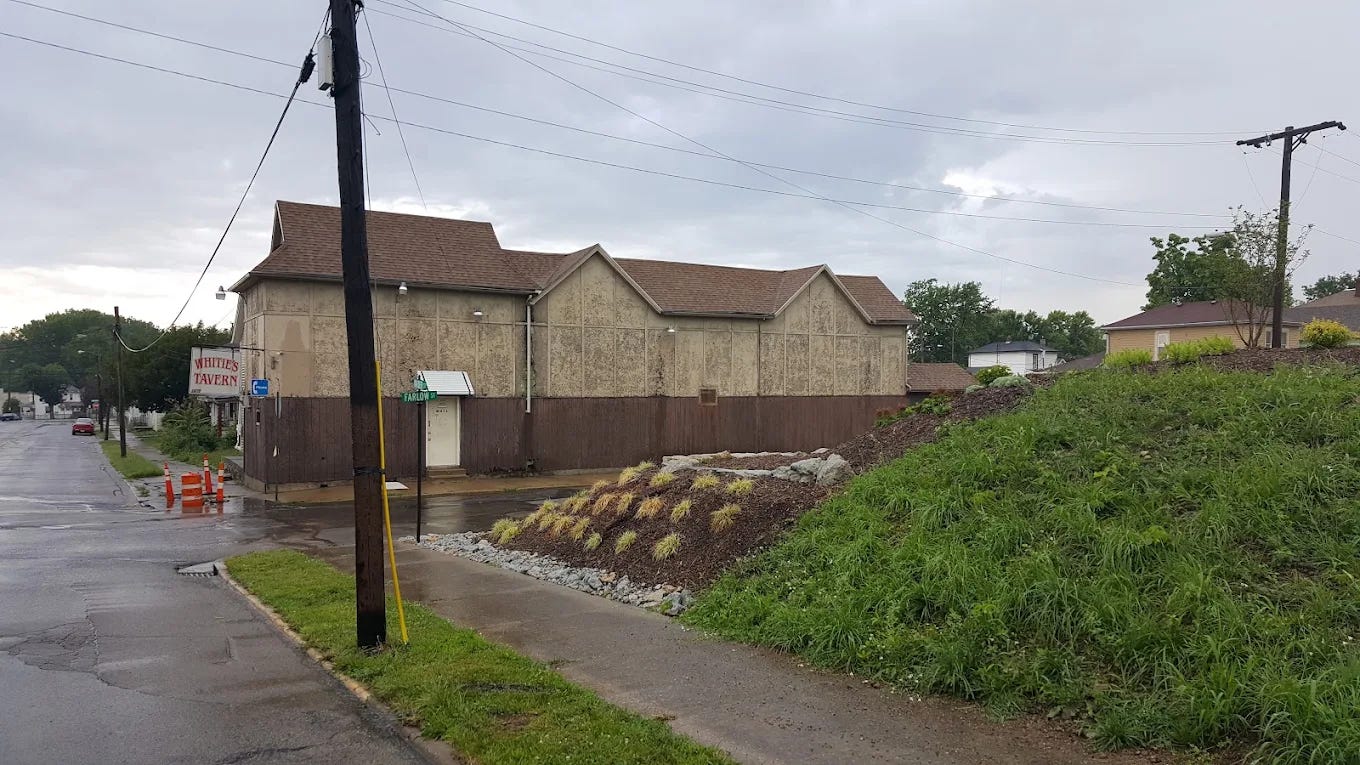
Behind the bar stood the patriarch, Daniel Clifton Romine. Born on February 18, 1951, Romine was a man whose physical presence was inextricably linked to the wood and neon of his establishment — a figure whose life would eventually bleed, quite literally, into the criminal records of Clark County. In his earlier years the community viewed him through the lens of petty commerce and minor infractions: underage girls sipping beer in the dark corners of his establishment, sudden administrative raids for electronic gambling devices and drugs. Yet beneath the mundane exterior of a provincial barkeep lay a volatile internal architecture. Time, financial ruin, and a suffocating love for his son, Danny, would eventually twist Daniel from a beleaguered tavern owner into a man capable of startling, explosive violence.
The long slide
Long before the sirens became a regular fixture outside the tavern, there was the quiet, corrosive terror of financial ruin. The descent of the Romine family was not a sudden plunge but a slow leaking of resources — a decades-long struggle chronicled entirely within the dispassionate ink of civil court filings. Daniel and his wife, Pamela Jane Romine, spent their early years outrunning creditors, moving from one crisis to the next while trying to maintain the illusion of stability.
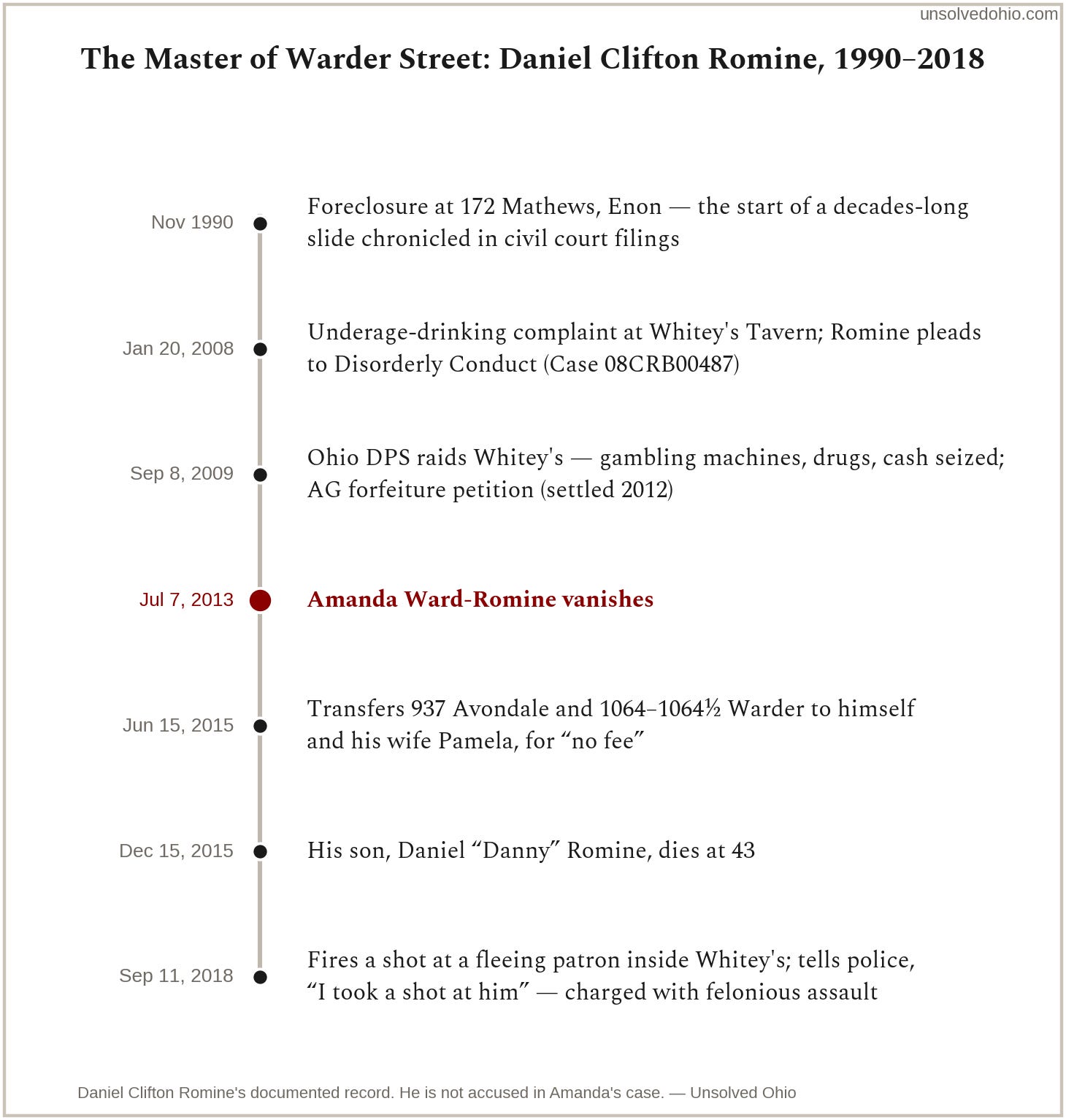
In November of 1990, while residing at 172 Mathews in Enon, Ohio, the couple found themselves caught in a web of foreclosure. The civil suit brought down the heavy hand of the United States District Attorney and corporate entities like the El-Bee Charge It Corp, indicating a complex situation involving potential federal tax liens and multiple aggressive creditors. By September of 1998, the family’s destitution had reached a point where they were fending off a debt-collection suit from Grandview and Southview Hospitals over a mere $358.40 in unpaid medical services — a microscopic sum that nevertheless illustrated the depth of their desperation. These cumulative civil judgments built a wall around Daniel Romine, fostering a profound paranoia toward the outside world and its regulatory institutions. He began to view society not as a community but as a predatory collective of lawyers, tax collectors, and state agents designed to strip a man of his dignity and his livelihood.
A kingdom of small vices
The administrative blueprint of Whitey’s Tavern began to shift as Daniel sought out alternative, illicit avenues of revenue to sustain his slipping kingdom. The tavern, once a simple watering hole, became a theater of minor vices and regulatory defiance, and the local authorities watched it with increasing, hawk-like scrutiny.
The first major rupture came in the early morning hours of January 20, 2008. At 0042 hours, Springfield police responded to a report of a physical fight inside Whitey’s Tavern; Officer Thomas Selner arrived to a chaotic scene that ended in the arrest of a 17-year-old female patron, who admitted she had been permitted to drink beer inside the establishment. Selner filed a criminal complaint against Daniel Romine for Offenses Involving Underage Persons, a first-degree misdemeanor (Case 08CRB00487). True to his stubborn, defensive nature, Romine initially pleaded not guilty; after months of legal posturing he was found guilty of an amended, lesser charge of Disorderly Conduct, and the case closed on April 1, 2008.
But the truce with the state was temporary. On September 8, 2009, agents from the Ohio Department of Public Safety executed a raid at Whitey’s, seizing cash, miscellaneous drugs, and electronic video gambling devices. On November 5, 2009, then-Ohio Attorney General Richard Cordray filed a “Petition for Forfeiture” against Romine in the Franklin County Court of Common Pleas (Case No. 09CVH-11-16567), asserting the seized items were ties to illegal gambling in a liquor-permitted establishment. Represented by defense attorney Kurt O. Gearhiser, Romine denied all allegations and attacked the state’s methods, alleging an unlawful, warrantless entry. The strategy stalled the machinery of justice for over two years; not until January 12, 2012, did an Agreed Judgment Entry finalize a compromise, returning the cash, the gambling devices, and various gas cards to Romine while the remaining items were forfeited. Daniel had saved his machinery, but the long war with the state had permanently embittered him.
The fortress around his son
To understand the father, one must understand the fortress he built around his own blood. Daniel M. Romine — known to the town and his father as Danny — was the epicenter of the elder Romine’s universe. Where the father was broke, weary, and trapped behind a bar, the son represented the continuation of the family line, an extension of self to be preserved at all costs. When dark shadows began to fall over Danny’s life, the elder Daniel responded not with panic but with cold, administrative precision.
The catalyst was the highly publicized investigation into the disappearance of Danny’s wife, Amanda Ward-Romine. As law enforcement swirled around the family and the public looked on with mounting suspicion, the elder Romine recognized a mortal threat to his son’s freedom and the family’s material survival — and his response was a masterclass in bureaucratic insulation. On June 15, 2015, a strategic real-estate maneuver was quietly executed in the county records: the elder Romine transferred the primary family properties — 937 Avondale Avenue, where Danny and Amanda had resided, along with 1064–1064½ Warder Street — into his own name and that of his wife, Pamela J. Romine. The transaction was completed for “no fee.”
It was a blood-pact in the form of a deed — designed, the source argues, to keep the real estate within the family line and shield it from the impending crush of civil suits, wrongful-death claims, or liens hovering around the scrutiny of Amanda’s vanishing. He was determined to protect his son and the “Romine” assets from the probing eyes of outsiders, no matter the legal or moral cost.

The king loses his son
The fortress was strong, but it could not protect the family from mortality. In December of 2015 the fortress lost its king when Danny died suddenly at the age of forty-three, of an apparent drug overdose.
The loss shattered something in the elder Daniel. With Danny gone, the purpose of his long administrative warfare disappeared, leaving an aging man trapped in a dark tavern, stewing in his resentments and eyeing every patron across the bar as a potential enemy.
As his mind darkened, his physical reality deteriorated in tandem. In the summer of 2017, the 66-year-old Romine became a victim of the very environment he had cultivated. At about 1:00 a.m. on July 11, he encountered a belligerent, heavily intoxicated first-time customer named Robert Stansel Jr. After Stansel’s companion vomited onto the barroom floor, Romine ordered Stansel to leave. The altercation seemed to end there — but when Romine later walked into the dark alley to take out the tavern trash, Stansel was waiting. The ambush was swift and brutal, leaving Romine with a broken jaw, a shattered eye socket, a broken nose, extensive facial bruising, and permanent damage to his teeth. Though the state convicted Stansel of felonious assault and sentenced him to five years — affirmed by the Court of Appeals on May 17, 2019 — the damage to Daniel was irreversible. He had been broken in his own domain, and the memory of that helplessness fermented into a lethal resolve.
The final eruption
The eruption came on a late-summer night in 2018. At 1:30 a.m. on September 11, Whitey’s Tavern was steeped in its usual atmosphere — the sour scent of spilled liquor, the low hum of old televisions. Daniel was behind the bar, heavily intoxicated and bearing a fresh laceration above his right eyebrow from an earlier confrontation. Earlier in the evening, during a workplace argument, he had assaulted a patron named Gary L. Booth Jr., grabbing Booth’s arm, twisting it, and shoving him into a bar stool, re-injuring Booth’s previously dislocated shoulder. But that was merely the prelude.
At 0130 hours, Daniel turned his fury toward another patron, Nicholas S. Speakman. Under the dim beer signs, an enraged Romine ordered Speakman to leave — and then, without warning, stepped forward and punched him in the face. As Speakman turned and scrambled toward the exit, Daniel reached beneath the worn wood of the cash register, closed his fingers around a chrome-plated Rohm .38 special revolver, leveled it at the fleeing man’s back, and fired a single shot into the shadows of the doorway.
When Springfield police arrived, they did not find a standoff or a denial. They found Daniel Clifton Romine standing amid the wreckage of his own making, devoid of fear or theatricality. He offered no frantic plea, no legal defense. Looking directly at the officers, he spontaneously said: "I took a shot at him." On the bar counter behind him sat the chrome revolver, loaded with five live rounds and one spent casing. Officers booked the 67-year-old into the Clark County Jail on charges of felonious assault, illegal possession of a firearm in a liquor establishment, and weapons under intoxication. The fortress had finally fallen — not to the outsiders he had spent his life fighting, but to the unhinged vengeance of the master himself.
If you have information about the disappearance of Amanda Ward-Romine, submit it at unsolvedohio.com — your name is never published without your written permission. Naming a person as a subject of investigative interest is not an accusation of guilt, and we correct factual errors promptly.