



In the precarious orbit of the Romine household, a figure moved in the periphery — a shadow woven into the very fabric of their dysfunction: Amanda L. Young.
Born on July 18, 1982, she was a contemporary of Amanda Ward. They shared more than just a first name; they shared the same turbulent ecosystem. But Amanda Young was not merely a bystander in the tragedy that would eventually unfold. The lingering question that haunts the archives of the Springfield Police Department is chilling in its simplicity: did Amanda have anything to do with the absence of Amanda?
Amanda L. Young is not a suspect in the disappearance of Amanda Ward-Romine, and there is no proof or evidence connecting her to it. The detail that follows documents a verified pattern of criminal and assaultive behavior — her character and the volatile ecosystem in which she operated — not guilt in this case.
This is Part 8 of the Amanda Ward-Romine case file — start at Amanda Ward-Romine.
The keystone: August 19, 2010
To understand the disappearance, one must first understand the triangulation of loyalties that existed in the dark hours of the morning. The answer to whether Amanda Young was involved in the disappearance of Amanda Ward begins not with a missing person’s report, but with a seemingly mundane domestic disturbance.
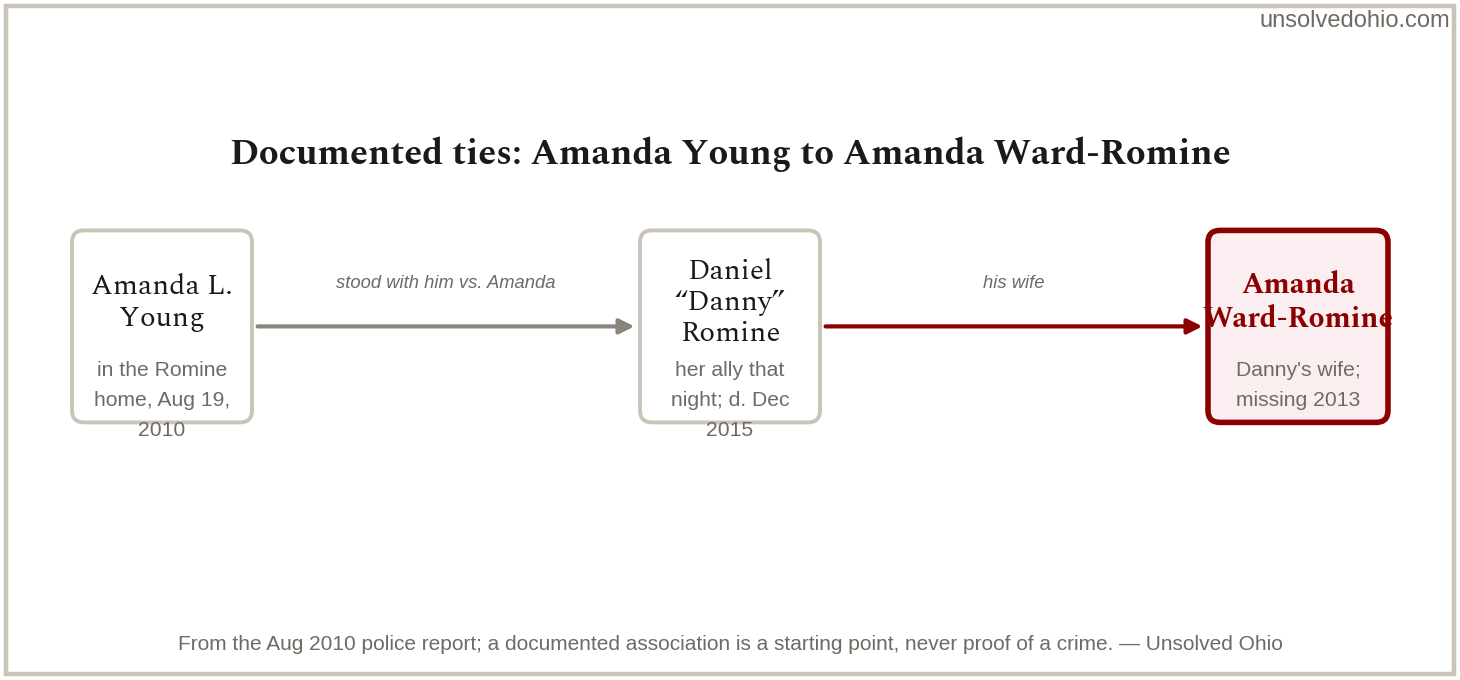
On August 19, 2010, the flashing lights of police cruisers illuminated the peeling paint of 1064 Warder Street. Inside, the atmosphere was suffocating. Daniel Romine claimed that Amanda Ward had slapped him. But Daniel was not alone with his accuser. The police report notes a singular, crucial witness: Amanda Young. The official record states that Young “witnessed the event and attempted to call 911, but Amanda Ward slapped the phone out of her hands.”
This incident is the keystone. It establishes a critical dynamic. Amanda Young was comfortable enough to be inside their home late at night. More importantly, at that frantic moment, she was firmly aligned with Daniel — attempting to bring the weight of the law down upon Amanda Ward.
Was there a rivalry festering between the two Amandas? A friendship gone sour, curdled by proximity and shared vices? Or was Amanda Young simply another denizen of the Whitey’s Tavern ecosystem, a woman caught in the crossfire of a volatile romance? Her presence raises the specter of an accomplice — or, at the very least, a witness who saw far too much and said far too little.
A capacity for violence
To believe that Amanda Young was capable of aiding in a disappearance, one must first believe she was capable of violence. The court dockets of Clark County tell the story of a woman well-acquainted with the application of brute force — a record of brawling, disorder, and blood spilled on the sidewalks of Springfield.

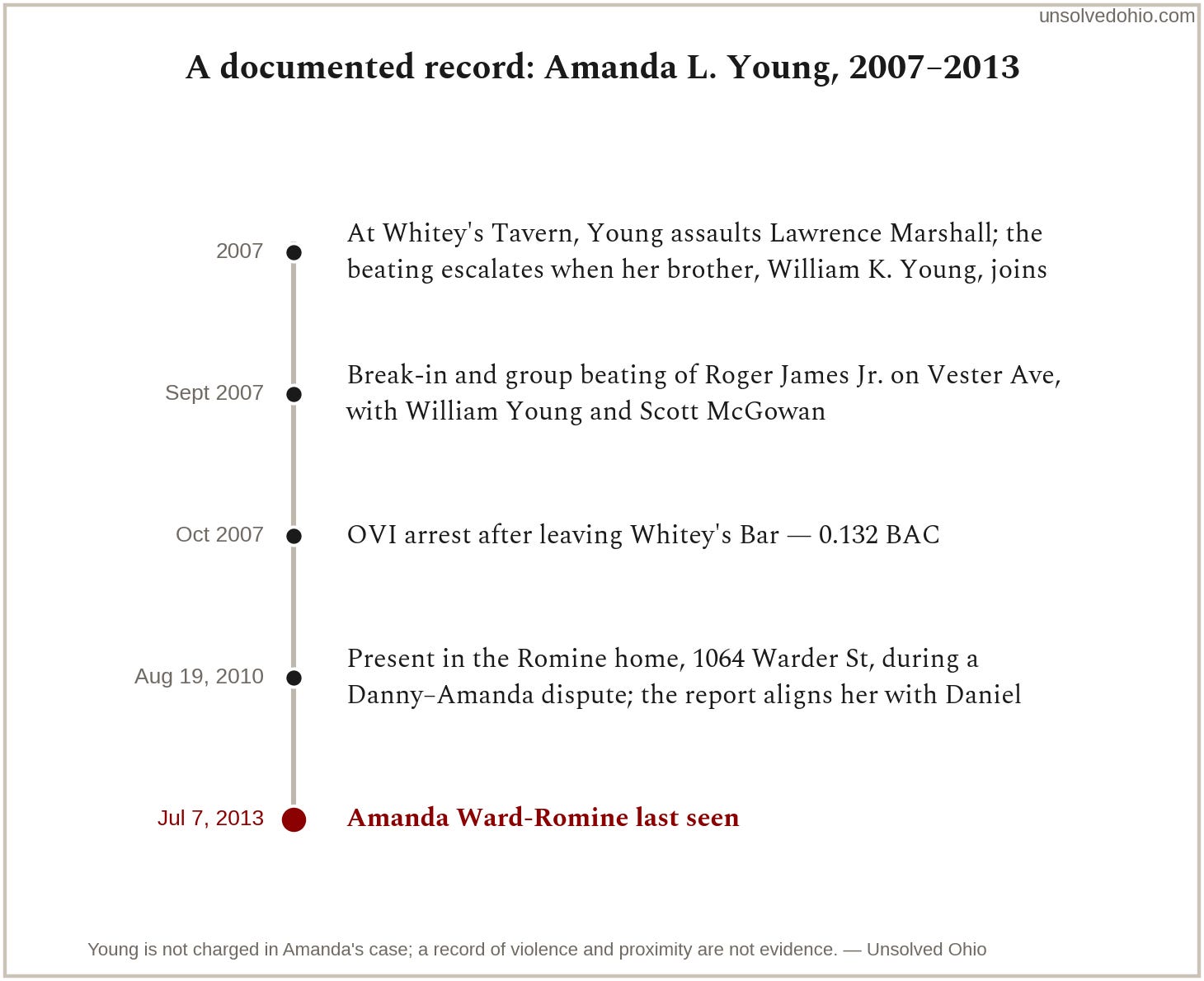
She was a woman intimately familiar with the interior of Whitey’s Tavern. It was here, in 2007, that she inserted herself into an argument involving a man named Lawrence Marshall. Per the docket, “def. Amanda Young exited the bar and approached Marshall and knocked his glasses from his face.” When her brother, William K. Young, arrived at the scene, the violence escalated into a beating: the two punched and struck Marshall about the head and face, leaving him with a laceration above his left eye before fleeing into the night.
A timeline of transgressions
This was not an isolated loss of temper; it was a pattern of behavior that defined her interactions with the world. Whether she was choking a woman on Chestnut Avenue or setting her boyfriend’s clothes ablaze over suspected infidelity, Amanda Young used violence as her primary language. And she did not act alone — she hunted in packs. During the September 2007 assault on Roger James Jr., Young broke into a residence on Vester Avenue with her brother William and another accomplice, Scott McGowan; per the docket, the defendants grabbed James, beat him about the back, neck, and head, and dragged him outside as the three continued. After setting the boyfriend’s clothes on fire, she fled the scene, refused to meet officers, and vanished from the police headquarters lobby before she could be questioned — the hallmarks, the source writes, of a woman who knows how to hide.
Her disregard extended to the asphalt. Amanda Young’s life was a whirlwind of suspended licenses, drug paraphernalia, and midnight collisions. On a dark October night in 2007, she was pulled over for swerving across marked lanes; sitting in the back of the cruiser, she tearfully admitted she had been at Whitey’s Bar and registered a 0.132 BAC. In 2010, driving on a suspended license, she crashed a white Chevrolet Monte Carlo into another vehicle while taking a child to school. (Could it have been a gray car?)
Did the other Amanda have a hand in it?
What follows is a speculative reconstruction and investigative theory built from the documented record above. It is one possible reading of the facts — not an assertion of what happened, and not a claim that Amanda Young is responsible for anything. She has never been charged in connection with Amanda Ward-Romine’s disappearance.
So, did Amanda L. Young have a hand in the disappearance of Amanda Ward? The data, the authors argue, aligns with the psychology of a co-conspirator. We know that on August 19, 2010, the lines were drawn in the Romine household: Amanda Young stood with Daniel; Amanda Ward stood against them both, slapping a phone from Young’s hands. A woman who is capable of choking an acquaintance on the street, who drags her own lover out of a house to beat him with a mob, who fights on the pavement outside Whitey’s Tavern until police have to peel her hands from another woman’s hair — this, the source contends, is a woman entirely capable of crossing the ultimate line.

Amanda Young lived in a world where problems were solved with fists, fire, and sudden disappearances into the night. She was fiercely loyal to her circle and possessed a terrifying capacity for violence; and if Daniel Romine needed help managing a situation that had spiraled out of control, there was — in the source’s words — “no one in his chaotic zip code more perfectly suited for the grim task” than the third wheel of Warder Street: Amanda L. Young.
Yet that is capacity and allegiance, not proof. Although Young’s record establishes a clear capacity for violence and her social circles overlapped heavily with the victim, law enforcement has found no actionable link between these past incidents and the ultimate fate of Amanda Ward-Romine. She remains legally unconnected to the disappearance and homicide, and has never been charged.
What remains open
Set the theory aside and the documented facts are narrow: a violent woman who shared Amanda Ward’s world was inside the Romine home in 2010, aligned with Danny against Amanda. That is a relationship and a proximity, not a role in a disappearance. The honest question the record leaves is the one the source ends on — whether anyone ever asked the other Amanda what she saw — and it remains unanswered.
If you have information about the disappearance of Amanda Ward-Romine, submit it at unsolvedohio.com — your name is never published without your written permission. Naming a person as a subject of investigative interest is not an accusation of guilt, and we correct factual errors promptly.

This installment names Amanda L. Young, a living individual, and reasons from documented records toward a possible explanation. Amanda Young is NOT a suspect in Amanda Ward-Romine’s disappearance, and there is no evidence connecting her to it. She has never been charged in connection with it. Her documented criminal record is a matter of public court and police records; it is not evidence of involvement in this case. The theory of involvement offered later in this piece is explicitly labeled as speculation — a reading of how documented facts might fit, not a finding of fact. Anyone not convicted of a specific crime is presumed innocent. See our full Disclaimer.