



This is Part I of the Amber Marie Whitmer case file.
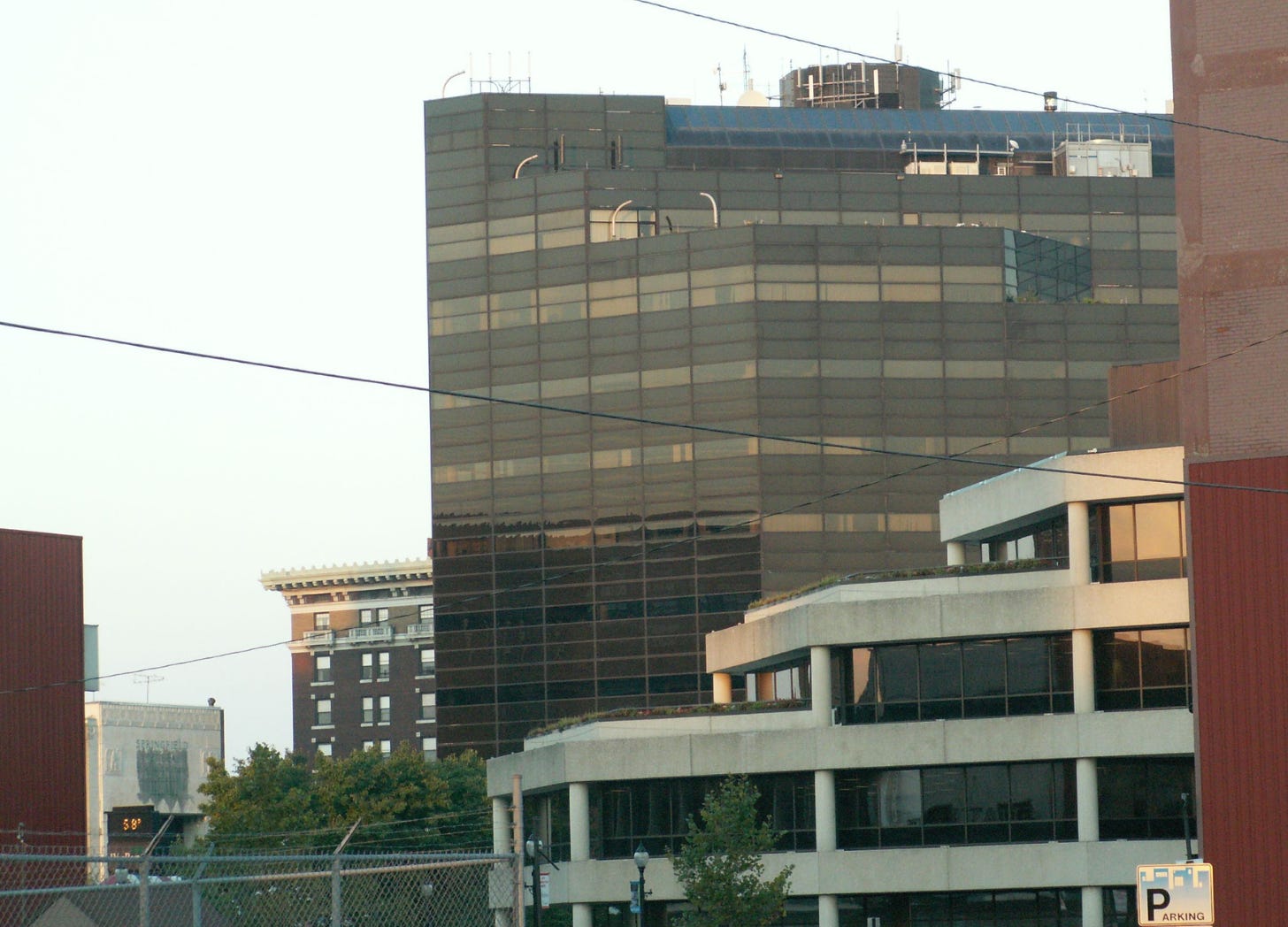
In the heart of Ohio, at the crossroads of a nation, lies a city haunted by its own name. They call it the Champion City; a name forged in the clamor of foundries and the rhythmic churn of assembly lines that once built the machines that fed the world. Springfield, Ohio, was a place of ambition and industry, a city of roses and American pride. But the ghosts of that glory now wander through empty factories and down streets scarred by the long, slow rust of a forgotten prosperity.
This story is about the other ghosts of Champion City, the ones who don’t have statues, the ones whose names are whispered in the digital ether of a Facebook comment thread long after their voices have gone silent. It is the story of the lost women of Springfield.
At the center of this story is a single, haunting question:
What happened to Amber Marie Whitmer?
When she vanished in the late spring of 2016, her absence was met with a year of official indifference. She was not a missing daughter; she was a “known prostitute,” a “career criminal” whose disappearance was treated as an occupational hazard, a predictable consequence of a life lived on the margins. The system designed to protect her instead rendered her invisible, allowing the forensic trail to decay and the whispers of her last known whereabouts to fade. Amber became a ghost long before she was ever considered a victim. Her case is not an anomaly. It is a single, stark data point in a tragic and repeating pattern. The streets she walked were a hunting ground, a lethal ecosystem where the lines between victim and perpetrator blurred into a chaotic web of addiction, exploitation, and violence. It was a world where a woman’s life could be extinguished over a drug dispute, to cover up a crime, or simply because she was deemed disposable. For decades, women like Amber have been vanishing from this same environment, their cases collecting dust in the cold, quiet archives of unsolved crimes.
This story is not another recitation of those cold facts. It is an autopsy of that lethal ecosystem. It is a new kind of investigation, one that begins where the official trail ended. In a world drowning in digital noise — court records, police affidavits, news archives, and the sprawling, cryptic world of social media — the clues to what happened to Amber and the other lost women are not missing; they are buried.
Finding them is a task beyond the limits of human analysis, a search for a single, critical sentence hidden within millions of pages of unstructured data. To uncover these hidden truths, we employed the tools of the 21st century. Using the power of Artificial Intelligence and the precision of Social Network Analysis, we will reconstruct the world Amber and others inhabited. We will map the intricate web of relationships that connected them, their friends, their accomplices, and their predators. We will follow the digital echoes they left behind, transforming a confusing tangle of names and places into a clear, terrifying architecture of risk.
This is not a story about a single monster, but about the system that allows monsters to thrive. It is an investigation into the red lines drawn a century ago that still dictate who has access to safety and who is confined to the forgotten corners of a city. By connecting the dots that no one else could see, we will give a voice to the ghosts. We will follow the trail of digital breadcrumbs to the doorsteps of pimps, violent felons, convicted murderers, and serial killers revealing a world far more dangerous and interconnected than was ever officially acknowledged.
This is the story of Amber Whitmer, but it is also the story of Cierra Spitler, Lacie Henry, Tiffany Chambers, and 25 others. It is an attempt to find an answer, not just for them, but for every woman who has ever been told that her life doesn’t count. The ghosts of Champion City have been silent for too long. It is time to listen.
Author’s Note
Let us consider the proposition laid before us: A society is burdened by the presence of a career criminal, a peddler of vice, and a consumer of narcotics — in this case, the tragic figure of Amber Whitmer. A predator eliminates this burden. Therefore, should the state, acting as a prudent steward of limited municipal resources, simply look the other way, silently grateful for the grim street-sweeping performed by a murderer?
To the purely utilitarian mind, the logic is seductively tidy. The ledger is balanced. The taxpayer is spared the cost of the victim’s future incarcerations, and the police are spared the shoe leather required to apprehend her killer.
But conservatism, properly understood, is not a utilitarian enterprise. It is a philosophy rooted in the understanding that civilization is a terribly fragile achievement, maintained only by strict adherence to the rule of law. When we ask if society is “best served” by ignoring the murder of the marginalized, we are asking if society can survive the voluntary abdication of its most essential duty.
The answer, emphatically, is no.
The majestic, albeit imperfect, machinery of the American justice system does not exist to determine the moral worthiness of the victim before deciding whether to prosecute the crime. The law wears a blindfold not merely to ignore the wealth or power of the accused, but to deliberately ignore the virtue — or lack thereof — of the deceased.
When the state declares that a citizen’s life is forfeit to the whims of a predator simply because that citizen was engaged in illicit commerce, the state has ceased to be a republic of laws and has reverted to a Hobbesian state of nature, where life is solitary, poor, nasty, brutish, and short. The social contract, as Locke and Madison understood, demands that the state maintain a strict monopoly on legitimate violence. When law enforcement decides not to investigate a murder because the victim was a “known prostitute,” it is tacitly franchising out the state’s monopoly on violence to private actors. It is deputizing the serial killer. Furthermore, as we (Beth and Jimmy) the pragmatic investigators of these stories must recognize a behavioral truth: predators who hunt on the margins rarely contain their appetites.
The man who strangles a prostitute in the shadows of a Rust Belt town does not do so because he is performing a public service; he does so because he is a monster.
If the state grants him a hunting license by way of apathy, he will not stop. The impunity granted to him by the victim’s social standing only sharpens his predatory instincts. Today, he hunts the addicted and the invisible; tomorrow, emboldened by the silence of the detectives, he hunts the unwary citizen waiting for an Uber. How, then, is society best served?
It is not served by allowing the police blotter to become an instrument of moral triage. Society is best served by the relentless, uncompromising pursuit of the murderer, regardless of how thoroughly the victim had squandered her own potential.
We do not hunt the killer of Amber Whitmer to validate her choices, nor to pretend that her life was not a chaotic engine of societal damage.
We hunt him because the law must be vindicated.
We hunt him because a society that tolerates murder — even the murder of the undesirable — is a society that has lost the moral authority to govern itself.
The expenditure of justice, manpower, and effort is not a defense of the prostitute’s vices; it is the necessary ransom we pay for the preservation of civilization itself.
The Murders and Missing Women of Springfield (2000–2023)
A city is more than a collection of streets and buildings; it is an ecosystem with its own pulse, its own unique vulnerabilities, and its own deep, well-hidden basements where the uncomfortable truths are swept.
To understand the sudden, quiet vanishing of a human being, or the violent punctuation of an unsolved murder, one cannot look merely at the final, desperate moment of the crime. A victim does not exist in a vacuum. They belong to a place, a specific landscape that either protects its vulnerability or, through a complex machinery of indifference and decay, allows them to slip through the cracks unnoticed.
This introduction is an intentional, exhaustive excavation of a dark reality: women who have gone missing or whose murders remain entirely unsolved across Ohio, with the vast majority tied to the tight geographic confines of Springfield. Looking directly into these fifty heartbreaks of Springfield requires something more than a superficial true-crime timeline. It requires an understanding of the soil from which these tragedies grew.
This initial opening is designed with a deliberate, expansive scope. Before we can trace the footsteps of the lost, we must understand the architecture of the town they walked through. Springfield, Ohio, is a community rich with history, defined by a proud industrial past, intersecting transit lines, and the sharp, mid-century economic shifts that left deep fractures in the social fabric. By dissecting the nuances, the neighborhoods, and the unique socio-economic realities of Springfield here at the outset, we establish a permanent framework for everything that follows.
Understanding how local geography, industrial corridors, and specific neighborhoods created localized networks where vice and vulnerability intersected.
Recognizing how systemic issues within the community formed an environment where the vulnerable could be targeted with terrifying repetition.
Laying down this historical and structural groundwork now ensures that the broader mechanics of the town do not need to be constantly re-explained. This architecture remains the constant backdrop for every individual briefing to come.
Once the stage is set, the lens narrows to our first deep dive: the volatile, interconnected world of Amber Whitmer. Her story serves as the heavy, complex gateway into an underworld that would ultimately claim dozens of lives, revealing a labyrinth of relationships where less than two degrees of separation frequently divide the living from the dead.
Welcome to Unsolved Ohio. Let us begin with the anatomy of the place itself.
Springfield, the Black Heart of Ohio
Springfield is right at the “Crossroads of America.” Interstate 70 (I-70) passes right through Springfield. The interstate is a major east-west artery in the United States, stretches approximately 2,153 miles from its starting point in a quiet Utah town to its terminus in the bustling city of Baltimore. This vital transportation corridor traverses ten states, connecting diverse landscapes from the Rocky Mountains to the Atlantic coast. The interstate’s journey begins in the small, unincorporated community of Cove Fort, Utah. Here, I-70 commences its eastward trek at a junction with Interstate 15. From this remote starting point, the highway winds its way through the vast and varied terrain of the American West. After crossing through Colorado, Kansas, Missouri, Illinois, Indiana, Ohio, West Virginia, and Pennsylvania, I-70 reaches its destination in Baltimore, Maryland. The interstate officially ends at a park and ride lot near the interchange with Interstate 695, the Baltimore Beltway.
A short 30-minute drive west from Springfield is a major north-south artery of the nation’s Interstate Highway System, Interstate 75 (I-75), which covers a vast distance of approximately 1,786 miles. Its journey takes it through six states, connecting the Great Lakes region to the subtropics of Florida. The interstate’s southern terminus is located in Hialeah, Florida, a city within the Miami metropolitan area. Specifically, it begins at an interchange with State Road 826 (the Palmetto Expressway) and State Road 924 (the Gratigny Parkway). From there, I-75 travels the length of the Florida peninsula before heading north through Georgia, Tennessee, Kentucky, and Ohio. The northern end of I-75 is at the Canadian border in Sault Ste. Marie, Michigan. It concludes at the approach to the Sault Ste. Marie International Bridge, which connects to Sault Ste. Marie, Ontario, Canada.
The City That Made Things
Springfield, Ohio, was a city that made things. It was a place forged in the clamor of foundries and the rhythmic churn of the assembly lines; a town whose ambition once cast a shadow as long as Chicago’s. Situated in the fertile plains of southwestern Ohio, at the confluence of the Mad River, Buck Creek, and Beaver Creek, Springfield grew from a frontier settlement founded in 1801 into a global titan of industry. Its identity was not merely shaped by manufacturing; it was hammered into being by it, giving rise to civic pride so potent it became the city’s very name:
The Champion City.
The genesis of this identity can be traced to a single, revolutionary invention. In 1856, a local man named William Whiteley perfected the combined self-raking reaper and mower, a machine that transformed the back-breaking labor of the harvest and, in doing so, revolutionized the agricultural world. They called it the Champion Reaper, and from the workshops of Springfield, it went out to feed the world. The economic boom that followed was seismic. By 1880, Whiteley’s two-man shop had metastasized into a colossal trust whose great plant on East Street was said to be the second-largest industrial facility under one roof on the planet, surpassed only by the Krupp Munitions Works in Prussia. From the Civil War to the 1950s, most agricultural machinery in the United States was built in Springfield, and the city’s industrialists — the Whiteleys, the Warders, the Bushnells — challenged Chicago for primacy as the farm equipment makers of the world.
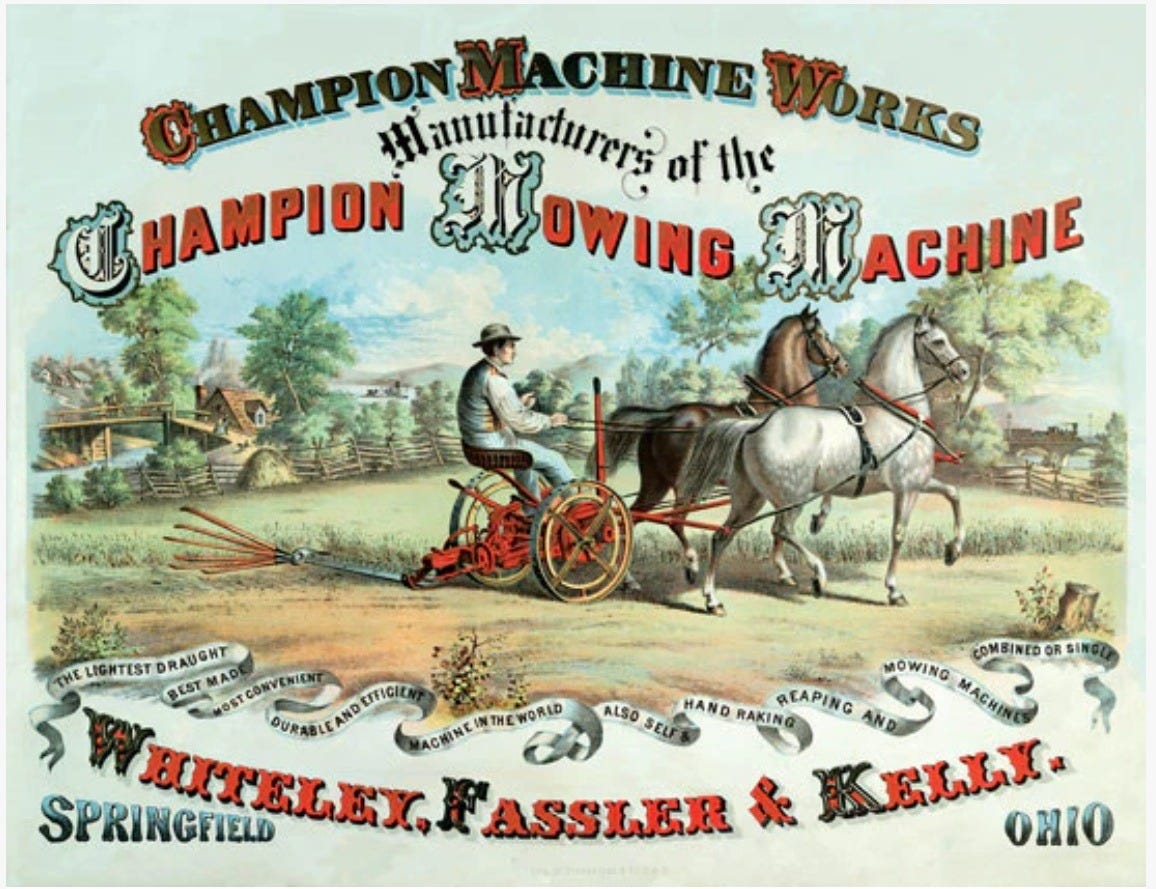
This industrial engine found its ultimate expression in the corporate behemoth of International Harvester (IH). The company was formed in a 1902 merger, a deal brokered by the financier J.P. Morgan himself, which brought together the McCormick Harvesting Machine Company, the Deering Harvester Company, and three smaller manufacturers, including Springfield’s own Warder, Bushnell, and Glessner, makers of the Champion brand. The son of the reaper’s inventor, Cyrus McCormick Jr., had met Springfield native Benjamin Warder, and together they began manufacturing farm machinery at the Lagonda Agricultural Works, laying the foundation for what would become International Harvester. With IH as its anchor, Springfield became a quintessential company town, its fortunes and failures inextricably linked to the humming factories that dominated its skyline and economy.
The city’s prosperity was reflected in its many nicknames, each a testament to a different facet of its golden age. It was the “Champion City,” a nod to the machine that started it all. For a time, it was the “City of Roses,” a name born in 1919 when its 33 greenhouses produced more roses — an astonishing 24 million — than any other city in the world, shipping them across the globe. And in its early days, it was known as “The City at the End of the Road,” when a lapse in federal funding caused the great National Road to terminate there for a decade in 1839, making it a vital western terminus for a growing nation. This proud history is not merely a relic of the past; it is a carefully curated identity deployed in the present. The “Champion City” moniker is a brand; a tool used in the ongoing battle against the narrative of decline. It is the name of the official visitor center, Champion City Guide + Supply, a venture whose stated mission is to build on local pride, paying homage to the past while looking to the future. It is the name of a local church, the Champion City Church, which explicitly chose the name to “honor the victories of the past” and “speak victory over the future of our city.”

This conscious revival of a historical identity reveals a city acutely aware of its own story. This community draws strength from the memory of its former glory as it confronts the harsh realities of its present. It is a testament to a deep-seated pride, but it also creates a poignant and persistent tension between the city Springfield was and the city it has become.
The Long, Slow Rust
The same forces of industrial capitalism that built Springfield into a global powerhouse also rendered it profoundly vulnerable. The second half of the 20th century brought with it a great unraveling for American manufacturing. For cities like Springfield, the decline was not a sudden cataclysm but a long, slow bleed. The Midwest, once the nation’s industrial heartland, saw its manufacturing employment begin a steady decline after its peak in 1979, a trend that would accelerate dramatically in the decades to come.
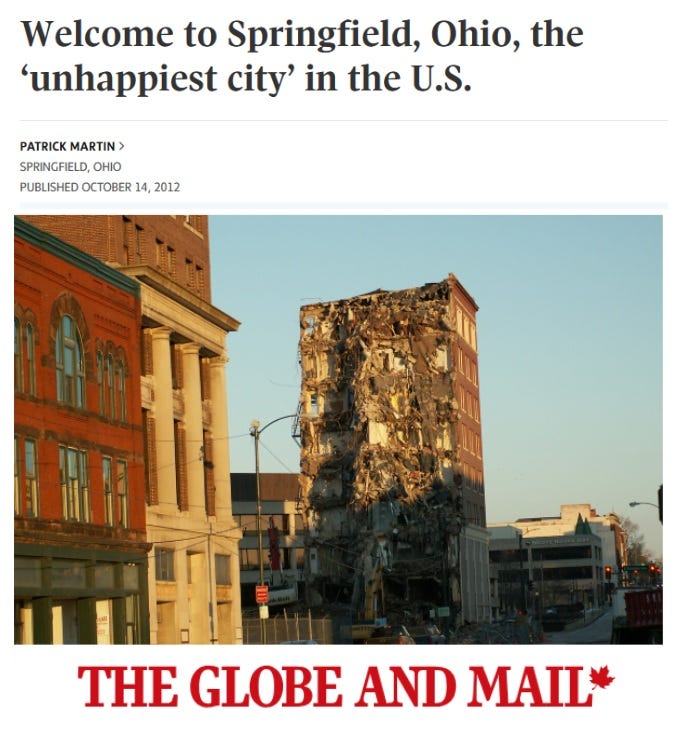
Since the 1980s, Springfield has been caught in this downward spiral, marked by the closure of major factories, the hemorrhaging of industrial jobs, and a steady demographic decline that saw its population fall from a peak of over 80,000 to just 58,662 by 2020.
A pivotal moment in this story of decline, a moment that felt like a victory but was in fact a harbinger of the precarity to come, occurred in 1982. A debt-plagued International Harvester, struggling to survive after a disastrous six-month strike, announced it had to consolidate its truck production and close one of its two major plants: an aging facility in Fort Wayne, Indiana, built in 1922, or its more modern counterpart in Springfield, built in 1961. What followed was an aggressive courtship by both states, a battle of financial incentive packages that made national news. In the end, Springfield won. IH President Don Lennox announced the company would close the Fort Wayne plant and consolidate in Ohio, vowing to make the state “the heavy truck capital of the world.”
The decision was based on cold, challenging logistics: Springfield’s plant was newer, its automated warehouse was larger, and its layout was better suited for high-volume operations. The city celebrated the retention of its 2,300 jobs and the promise of 1,500 more. Ohio’s governor at the time, James A. Rhodes, captured the city’s profound sense of relief and dependence, stating, “We want to thank the Lord for International Harvester remaining here. If this thing had gone the other way, misery would have set in in Springfield.”
Yet, this was a pyrrhic victory. While Springfield had “won” the plant, the event laid bare the city’s precarious reliance on the decisions of a single, struggling corporation. It marked the end of an era of guaranteed industrial stability and the beginning of a new reality defined by corporate restructuring and economic uncertainty. The victory of 1982 did not stop the long-term decline; it merely postponed the inevitable reckoning that would come for so many Rust Belt towns.
The city’s industrial history is also marked by what might have been. While no definitive records point to a specific failed proposal, the story of Henry Ford’s decision not to build one of his revolutionary automobile plants in Springfield persists in local lore. In the early 20th century, Ford expanded aggressively, opening assembly plants across the country, including in Columbus and Cincinnati. In the late 1940s, when the company sought a site for a new engine plant and foundry, hundreds of communities across five states vied for the project. The plant ultimately went to Brook Park, near Cleveland, drawn by its proximity to the Great Lakes and the New York Central Railroad.
For Springfield, it was a missed opportunity to diversify its industrial base beyond agricultural machinery and buffer itself from the sector’s eventual decline. The final, symbolic death knell for Springfield’s 20th-century consumer economy came with the closure of the Upper Valley Mall. Opened in 1971, the mall was for decades the retail and social hub of Clark County, “a place where people came together to go to the movies to hang out with friends.” But as shopping habits shifted online and anchor tenants like JCPenney, Macy’s, and Sears shuttered their doors, the mall entered a state of terminal decline. By 2018, the property was purchased by the Clark County Land Bank in a bid to stave off foreclosure and spark redevelopment, but the bleeding could not be stopped. The mall cost the county roughly $3.5 million over three years before the decision was made to close it permanently in June 2021. Its 13 remaining tenants, including a family-owned Chinese restaurant that had been there for 28 years, were given notice to vacate. The property was sold to a developer with plans to convert the once-bustling center of community life into a mixed-use business park, a stark symbol of the city’s transition from a consumer-driven economy to one based on logistics and light industry. The human cost of this long, slow rust has been staggering. Between 1999 and 2014, Springfield experienced a 27% decrease in its median income, the most significant and most devastating decline of any metropolitan area in the entire country. The city that once drew workers from across the nation now watched as its children left, its population shrank, and its economic vitality withered on the vine.
The Red Lines That Still Divide
To understand the deep-seated inequalities that fractured Springfield today is to know that they are not the result of accident or organic decline, but of deliberate design. The city’s contemporary landscape of poverty and racial segregation was meticulously engineered nearly a century ago through the practice of redlining, a system of government-sanctioned housing discrimination. Shockingly, Springfield was not merely a passive victim of this federal policy; it was, in a tragic and profound irony, a laboratory for the very ideology that would later be used to systematically disinvest in its own communities. In the 1930s, as part of the New Deal response to the Great Depression, the federal government created the Home Owners Loan Corporation (HOLC).
The HOLC introduced the modern, long-term, government-backed mortgage, making homeownership accessible to millions of white Americans and helping to build the American middle class. But this dream was explicitly denied to others. The HOLC, in collaboration with local real estate professionals, created color-coded “Residential Security” maps for metropolitan areas across the country. Neighborhoods were graded from “A” (green, for “Best”) to “D” (red, for “Hazardous”). The primary factor in determining this risk was not wealth or property condition, but race.
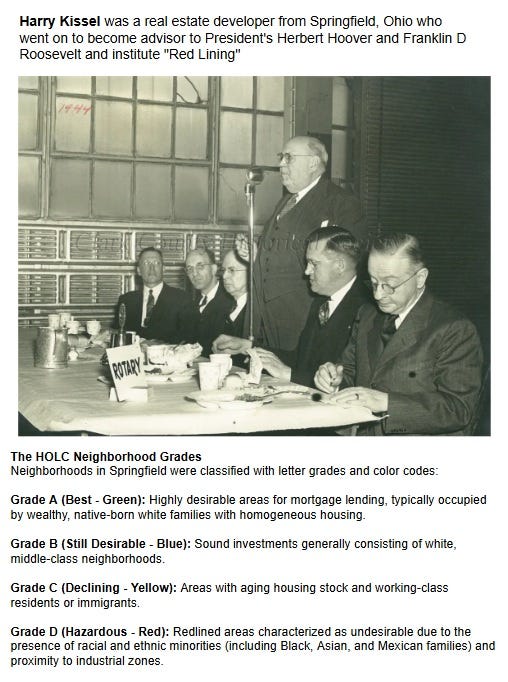
The presence of Black residents, immigrants, or Jewish families was enough to earn a neighborhood a “D” rating, effectively cutting it off from the flow of capital and investment. This practice became known as redlining. The intellectual and practical groundwork for this national system was laid, in part, by one of Springfield’s own. Harry S. Kissell was a young, energetic, and influential real estate developer in the city. In 1915, long before the famous post-war suburb of Levittown, New York, Kissell created Ridgewood, one of America’s first thoroughly planned and entirely racially restricted suburban neighborhoods. With its tree-lined avenues and large lots, Ridgewood was marketed as a picturesque utopia, a clean and orderly refuge from the industrial grime of downtown. But this utopia was built on the foundation of explicit exclusion. The deeds for properties in Ridgewood contained racially restrictive covenants with language that was as blunt as it was brutal: “Said premises shall not be sold or leased by the grantee or his heirs to a colored person or occupied by a colored person other than a servant to the owner or tenant.”
For 70 years, this neighborhood remained exclusively white; the first Black family was not able to purchase a home there until 1985. Kissell’s ideas did not remain confined to Springfield. He took his model of planned, racially exclusive communities to Washington, where his concepts heavily influenced the creation and policies of the Federal Housing Administration (FHA).
The FHA’s 1935 Underwriting Manual, the bible for the new mortgage industry, explicitly endorsed segregation, stating that “incompatible racial groups should not be permitted to live in the same communities” and that neighborhoods should have “protection against the infiltration of inharmonious racial or nationality groups.” The very system of exclusion that Kissell had pioneered in his own hometown became a cornerstone of national housing policy. This creates a devastatingly circular narrative: a model of segregation developed in Springfield was exported to the federal government, which then formalized it into a national system and imposed it back upon Springfield, institutionalizing the city’s racial divides with the full weight and authority of the United States government.
The town became both an architect and a victim of its own segregation. The lines drawn on the HOLC maps in the 1930s were never erased. They have become the enduring architecture of inequality in Springfield, their ghostly presence still visible in the city’s 21st-century data. The HOLC map for Springfield designated 16% of its residential areas as “Hazardous” (Grade D) and another 43% as “Definitely Declining” (Grade C), effectively walling off more than half the city from private and public investment. The consequences of this systemic disinvestment have been catastrophic and multi-generational. A 2019 analysis of Springfield’s neighborhoods reveals the stark, quantifiable legacy of these maps. Vacancy rates in the formerly redlined “D” neighborhoods are seven times higher than in the “A” (Best) and “B” (Still Desirable) neighborhoods, and twice as high as in the “C” neighborhoods. The landscape of these areas is scarred by empty lots and abandoned houses, a direct consequence of decades of denied capital, which made it impossible for homeowners to secure loans for repairs and for businesses to grow.
The economic chasm created by redlining is just as profound. In 2018, the median house sale value in a greenlined “A” neighborhood was $93,450. In a redlined “D” neighborhood, it was a mere $17,000 — less than one-fifth the value. This destruction of property value in Black communities has had a devastating impact on the ability of families to build and pass on generational wealth, a primary driver of the racial wealth gap that persists today. Critically, these historically disinvested “D” communities are still home to the city’s highest concentration of low-income residents.
Today, more than 50% of all Black children in Springfield live within the boundaries of these old red lines, born into a landscape of inherited disadvantage. The legacy of redlining extends beyond economics into environmental justice and public health. The same “D” zones that were starved of investment were also deemed suitable for industrial activity. Today, these neighborhoods have the highest density of toxic release facilities per square mile (0.7), while the historically white “A” and “B” zones have none. This has created a legacy of health disparities, with issues like asthma disproportionately affecting Black and brown communities due to exposure to environmental toxins and lead paint in poorly maintained housing stock. The lines on the map did more than just deny mortgages; they determined who would have access to clean air, safe housing, and a healthy life. For all its struggles, Springfield holds fast to the rhythms of a quintessential American town. It is a place where the community gathers under the bright glare of stadium lights on a Friday night, where neighbors meet for a craft beer in a repurposed factory, and where summer evenings are filled with the sound of free concerts drifting from a downtown park.
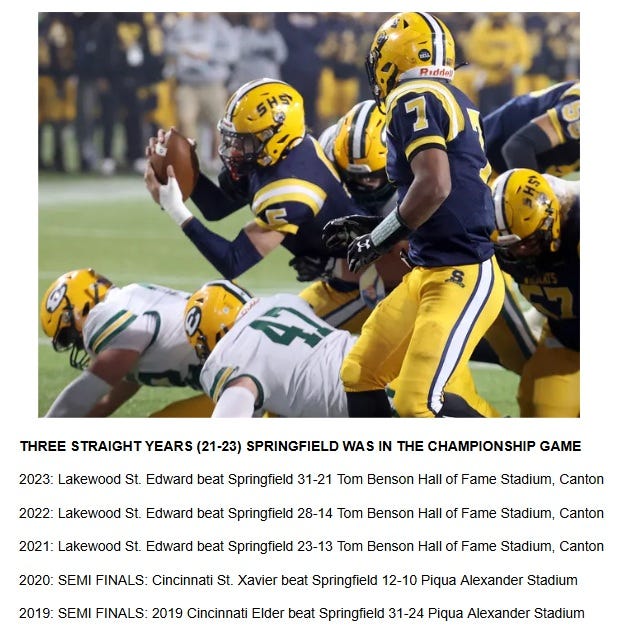
To understand today’s Springfield is to understand the importance of high school football. When the Springfield Wildcats take the field, the entire city feels a surge of collective energy. The team’s success in recent years, including five straight regional championships and three consecutive appearances in the Division I state finals, has provided a powerful, positive narrative for a community often defined by its hardships. The atmosphere inside the stadium on game night is electric. As one player described it, “You can just feel it in the air. You can feel the city behind you.” This is a symbiotic relationship; the players feed off the crowd’s intensity, and the crowd, in turn, draws a sense of unity and pride from the team’s performance on the field. For Coach Maurice Douglass, the team’s success is more than just about football; it is “an opportunity for us to let people see Springfield from a positive light,” a “shining moment” that counteracts the persistent negative perceptions of the city.
This sense of community extends beyond the football field into the city’s social spaces. In recent years, a concerted effort to revitalize the walkable downtown has created several popular hangouts. Residents gather at Co-Hatch the Market, a vibrant space in the historic Myers Market building that combines co-working offices with local food vendors, a coffee shop, and a bar. Another local favorite is Mother Stewart’s Brewing Company, a family-owned brewery with a spacious outdoor beer garden that regularly hosts live bands and a rotating lineup of food trucks, creating a lively, family-friendly atmosphere. The city’s nightlife includes bars like Station 1, which offers over 50 beers on tap, and traditional spots like O’Connor’s Irish Pub and the Hickory Inn, which have been community staples for years. Every summer, Springfield’s calendar is filled with events that bring the community together. The Springfield Summer Arts Festival, the longest-running free arts festival in the country, spans six weeks and offers more than 30 nights of admission-free concerts and theater performances. In September, Culture Fest celebrates the diverse heritages that make up the city with music, dance, and food. Throughout the warmer months, the Springfield Farmers Market offers fresh local produce and artisan goods.
At the same time, other events like the Springfield Antique Show, Woeber’s Mustard Fest, and the Springfield Rotary Gourmet Food Truck Competition draw crowds from across the region. These gatherings, from the roar of the crowd at a football game to the quiet chatter at a farmers’ market, create the fabric of everyday life in Springfield — a baseline of normalcy, peace, and shared identity. This is the Springfield its residents know and cherish — a city of quiet normalcy and deep-seated community pride.
But in the 1990s, this cherished self-image was shattered by a series of brutal crimes that revealed a terrifying darkness lurking just beneath the surface, proving that even in an All-American town, monsters can be homegrown.
Springfield and Its Darkest Secret
In August 1992, that baseline of normalcy was violently ripped apart. The city was rocked by the discovery of the bodies of two young girls, 12-year-old Phree Marrow and her 11-year-old best friend, Martha Leach. The girls had been returning home from a bakery when they were abducted, brutally raped, and murdered, their bodies left near a pond behind Penn Street. For a town that saw itself as a safe, all-American community, the crime was an unthinkable horror. The investigation that followed was long and torturous, plunging the community into a years-long nightmare of fear and uncertainty. Investigators soon learned that four local misfits had been accomplices to the girls’ murders, a shocking revelation that suggested a deeper rot within the community itself.
Yet, despite their involvement, DNA tests proved that the primary culprit, the man who had raped and killed the girls, was still on the loose. Inexplicably, the four accomplices continued to mislead the police for years, supplying false clues and leads that sent the investigation down one blind alley after another. While a cold-blooded killer remained at large, the terror continued. In September 1993, 30-year-old Belinda Fay Anderson went missing on her way to her parents’ house; her body would not be found for nearly two years, buried under a garage. Another woman, Helen Preston, was raped, beaten, and left for dead. The city was being stalked by a predator who moved in its midst, unseen and unknown. The break in the case finally came in 1996, not from a brilliant piece of detective work, but from the sheer will to survive of another victim.
A prostitute who had been offered a ride, smoked crack-cocaine with her attacker, and was then brutally beaten and stabbed, managed to escape and identify her would-be slayer. The man she identified was William Kessler Sapp, who was already in jail for the attempted murder of another woman, Una Timmons. With Sapp in custody, the pieces of the puzzle began to fall into place. A DNA sample confirmed he was the man whose semen had been found on the bodies of Phree Marrow and Martha Leach. Throughout an 18-and-a-half-hour videotaped interview, Sapp confessed to it all: the murders of the two girls, the murder of Belinda Anderson, and the attempted murder of Hazel Pearson.
Investigators also linked him to a possible fourth murder in Jacksonville, Florida, from 1981.
His history was a textbook portrait of a budding psychopath: a childhood record from Children’s Services noting his “hostility toward all women,” an early arrest for animal cruelty, and a history of physical and mental abuse. On October 13, 1999, Sapp was convicted on 27 counts, and days later, he was sentenced to death.
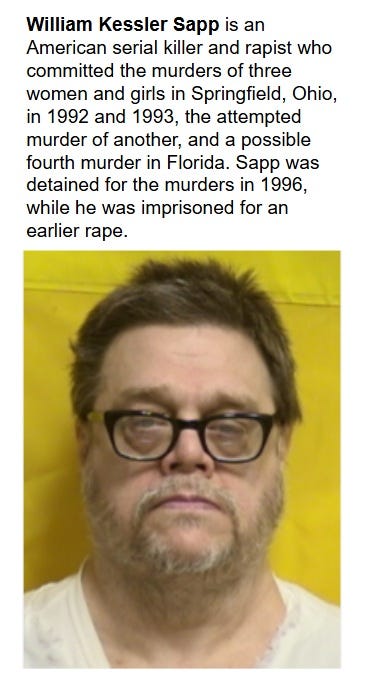
The William Sapp case was more than just a horrifying true crime story; it was a profound trauma for the city of Springfield. It shattered the town’s perception of itself as a safe haven. The fact that the killer was not an outsider but one of their own, and that other local men had been complicit in his most heinous crime, exposed a dark underbelly that could no longer be ignored. The years of fear, misdirection, and the brutal nature of the crimes left an indelible scar on the community’s psyche, a chilling reminder that the “black heart” of the chapter’s title was not just a metaphor, but a terrifying reality that had walked among them.
New Wounds on Old Scars
The historical vulnerabilities of Springfield — its post-industrial economic fragility and its deep-seated racial tensions — did not disappear with the turn of the century. Instead, they created fertile ground for the defining American crises of the 2020s. Since 2013, the city has found itself grappling with a devastating opioid epidemic that preyed on its communities of despair, while simultaneously becoming the epicenter of a national political firestorm over immigration. These new wounds landed on old, unhealed scars, pushing a resilient but battered city to its limits. From 2013 to 2020, opioid unintentional deaths were increasing in Springfield at rates higher than the national average and the state average.
From 2017 to 2020, the opioid crisis had morphed into a new and far more lethal phase, driven by the proliferation of illicitly manufactured fentanyl. This synthetic opioid, up to 50 times stronger than heroin, flooded communities across the country, turning experimentation and addiction into a game of Russian roulette. In Ohio, the pandemic years saw a record surge in overdose deaths. During the second quarter of 2020 alone, the state’s opioid overdose death rate reached 11.01 per 100,000 population, the highest it had been in a decade.
Clark County was hit particularly hard. In 2021, the county recorded 70 accidental overdose fatalities, a staggering 32% increase from the previous year. Authorities pointed to fentanyl as the primary driver of this surge. Statewide data confirms this grim reality: in 2023, illicit fentanyl or its analogs were involved in 78% of all unintentional drug overdose deaths in Ohio, often mixed with other substances like cocaine or methamphetamine without the user’s knowledge.
While recent statewide data has shown some encouraging signs, Ohio saw a 5% decrease in overdose deaths from 2021 to 2022, followed by a 9% decrease from 2022 to 2023 — the crisis remains acute. Provisional data for 2024 suggests a continued national and state-level decline, with some projections showing overdose deaths in Ohio could fall by 35% or more. However, these statistics do little to capture the profound and lasting trauma inflicted on the community. For every number, there is a story of a family shattered, a life cut short, and a community struggling to cope with the relentless tide of grief and loss.
The New Firestorm
Springfield’s story from 2013 to 2020 is a microcosm of 21st-century America, a case study in how a city’s attempt to solve a decades-old economic problem by embracing a modern solution made it a battleground for the nation’s most toxic political conflicts. The city’s long decline had created a depopulated landscape and a weakened economy. However, a concerted revitalization effort in the 2010s led to an unexpected new problem: a labor shortage that the local population could not fill. The most ambitious and ultimately most consequential of Springfield’s Mayor Warren Copeland’s policies was the “Welcome Springfield” initiative, launched in 2014. Facing a dwindling population and a surplus of jobs, the city officially passed a resolution to become an “immigrant-friendly city.”
The solution arrived in the form of thousands of Haitian migrants. For Copeland, it was a pragmatic solution to the city’s demographic and labor crises. “We have these folks in our community,” Copeland stated, “and they need to be included and considered part of the community.” This policy was not merely an economic development tool, it was an act of “doing justice” in his city, creating a welcoming space for newcomers while simultaneously working to save the community from economic stagnation.
This deliberate fusion of social and economic policy was the hallmark of “Theologian Mayor.” The Haitian migrants were fleeing the political and economic instability that had wracked their home country, and many possessing Temporary Protected Status (TPS) that allows them to live and work legally in the U.S., they began arriving in Springfield around 2017. They were drawn by the promise of jobs in local factories and warehouses, as well as the city’s affordable cost of living.
By 2024, an estimated 15,000 to 20,000 Haitian nationals had settled in the Springfield area, a massive and rapid demographic shift for a city of less than 60,000 people. This influx, while providing a much-needed workforce for local businesses, placed an immense strain on the city’s social infrastructure. Schools, hospitals, housing, and law enforcement were stretched thin, struggling to accommodate the needs of the new population, which led to rising tensions among some long-time residents.
In Springfield, Ohio, a school bus crash resulted in the death of an 11-year-old boy, Aiden Clark, after a collision with a minivan driven by Hermanio Joseph, a Haitian immigrant.
The crash, which occurred on the first day of school, August 22, 2023, involved a minivan veering onto the school bus’s path, causing it to overturn. Joseph, who was driving without a valid license, was convicted of involuntary manslaughter. The incident became a focal point in the immigration debate. These local resentments, now simmering for years, exploded onto the national stage in September 2024 during a presidential debate.
Former President Donald Trump amplified a rumor circulating on social media, which was first made by Ohio Senator JD Vance from Middletown, Ohio, to a televised audience of millions. Speaking of the situation in Springfield, he said of the Haitians:
“They’re eating the dogs, they’re eating the cats, they’re eating the pets of the people that live there.”
The fallout was immediate and terrifying. The city was inundated with dozens of bomb threats targeting schools, hospitals, and government buildings, forcing repeated evacuations and creating a climate of fear. The Haitian community, which had come to Springfield seeking opportunity, found itself the target of a national immigrant deportation campaign. The city’s Mayor, Rob Rue, described this media blitz as being “in the middle of a hurricane that was swirling.”
King George and First Diversity
Beneath the surface of the political firestorm lay darker issues of vulnerability and exploitation. An extensive federal and state investigation began in Springfield, Ohio, targeting George Ten, known as “King George,” and his staffing company, First Diversity Staffing Company LLC. The probe, which initially focused on human trafficking, has now broadened to include allegations of identity theft, wage and tax fraud, and immigration fraud.
George Ten cultivated a significant business empire through First Diversity Staffing between 2017 and 2025, generating an estimated $180 million in gross revenues over the last five years, a figure nearly four times the city of Springfield’s annual revenue. Ten presented himself as a community benefactor who understands the immigrant experience, citing his parents’ journey from Puerto Rico. He claimed his company provides dignity and opportunity for marginalized communities.
The business, initially started by his father, was given to George around 2010. A significant shift in the company’s business occurred around 2019 when it began to heavily recruit Haitian migrant workers. Company executives justified this by describing local hires as a “nightmare” with high turnover and attendance issues. The influx of Haitian workers, facilitated by programs like Temporary Protected Status (TPS), coincided with what Ten called an “explosion” in his business, fueled by the availability of jobs and affordable housing in Springfield.
The investigation, conducted by the FBI and the office of Ohio Attorney General David Yost, is built on numerous allegations from whistleblowers and victims. As early as 2019, sources reported that unmarked vans were used to transport Haitian workers from Florida to Springfield for First Diversity. Pastor Jean André of the first Haitian church in nearby Columbus described the living conditions for these workers as “paid slavery,” noting they were housed in cramped, overcrowded spaces with multiple men sharing a single bathroom.
The probe expanded after a young Haitian American woman discovered the IRS believed she had earned around $20,000 from First Diversity, though she had only worked there for two and a half weeks as a translator for much less pay. It is alleged that someone at the company stole her Social Security number and used it for another worker. Multiple whistleblowers have corroborated this, claiming a staffer systematically stole Social Security numbers from workers to use for others.
In early 2021, a group of Haitian migrant workers protested at the staffing agency, demanding full payment for their work making sandwiches in near-freezing conditions at a local factory. They presented timecards showing unpaid hours but were reportedly dismissed with “empty promises.” Whistleblowers also reported that paychecks often never arrived and that workers were denied overtime pay for long hours. Whistleblowers allege that First Diversity staffers were coerced into falsifying documents to keep undocumented workers in the system. This included faking drug test results and I-9 forms, which verify employment eligibility. Translators allegedly assisted workers in filling out these forms with fraudulent documents, and recruiters were intimidated into signing off on them.
Springfield’s City Manager, Bryan Heck, was allegedly warned as early as summer 2019 about potential human trafficking by First Diversity, though he stated he does not recall the meeting. The president of the Greater Springfield Chamber of Commerce, Mike McDorman, also reportedly received warnings but took no action. Heck confirmed receiving a warning in September 2023 from a former employee, which prompted him to request an investigation from the Ohio Bureau of Criminal Investigation.
Springfield had become a system where vulnerable migrant workers were allegedly exploited for significant financial gain, with revenue generated not only from staffing fees but also from housing, transportation, and other services. Accusations of human trafficking have been leveled against large corporations like JBS Meatpacking for their recruitment of Haitian workers. This model relies on a workforce with fragile legal status and limited resources.
This national context raises serious questions about the labor conditions within the Springfield factories that have so eagerly hired the new arrivals.
Springfield by the Numbers
The story of Springfield — its industrial glory, its painful decline, its deep-seated segregation, and its modern crises — is ultimately written in the daily lives of its people. A day in the life of an average citizen is shaped by the ghosts of the city’s past, with the statistical realities of poverty, education, and crime serving as the logical endpoint of decades of historical forces. These are not just abstract numbers; they are the tangible, measurable outcomes of a history of deindustrialization compounded by generations of systemic inequality.
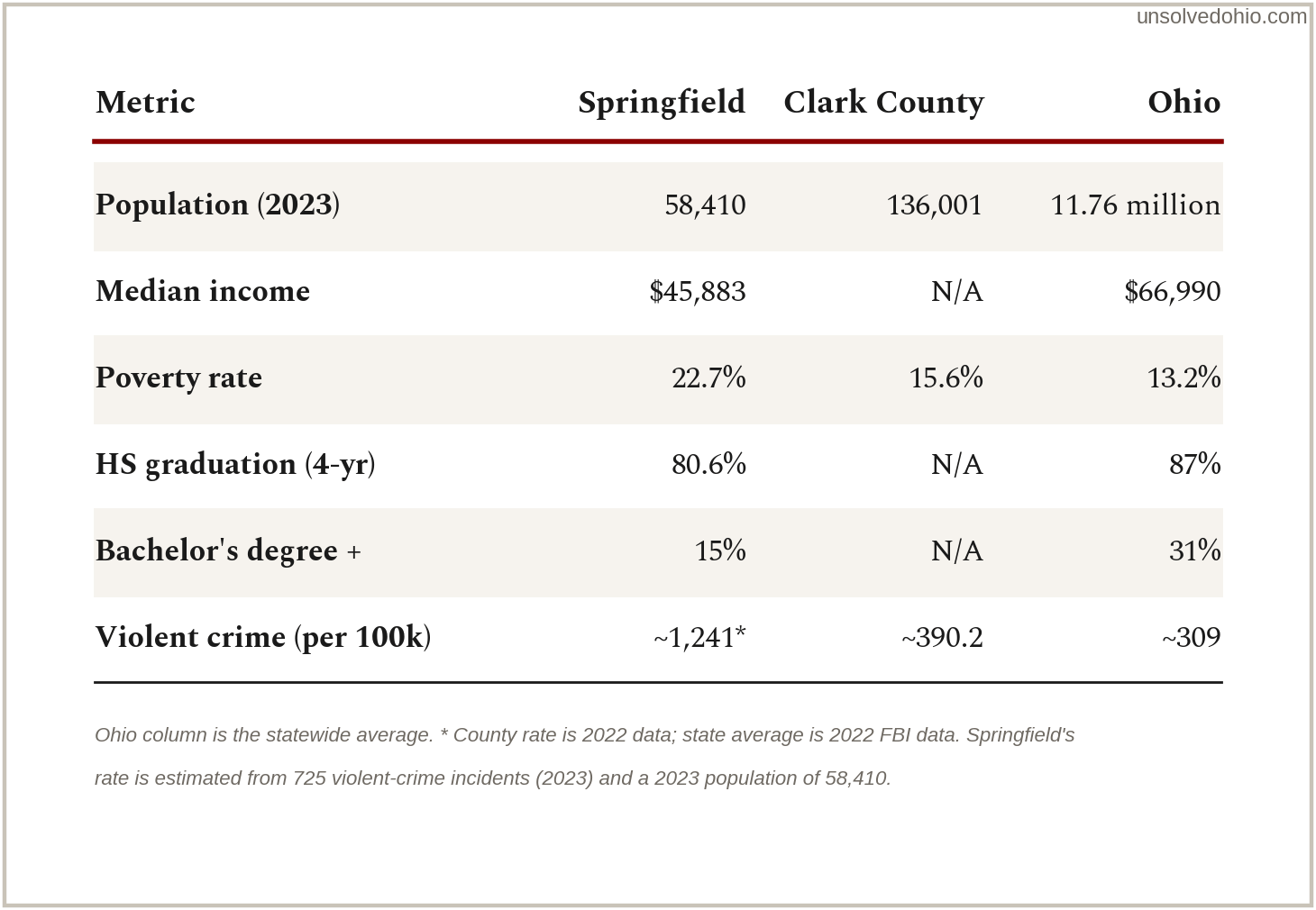
For a significant portion of Springfield’s residents, the day begins with the pervasive weight of economic precarity. The city’s poverty rate stands at a staggering 22.7%, a figure dramatically higher than both the Clark County average of 15.6% and the Ohio state average of 13.2%, with a median household income of just $45,883, compared to the state median of nearly $67,000, the daily struggle to afford housing, food, and healthcare is a constant reality for thousands of families.
This economic hardship is a direct legacy of the collapse of the high-wage manufacturing jobs that once formed the bedrock of the city’s middle class. The path to a better future through education is fraught with systemic challenges.
The Springfield City School District is officially rated by the state as needing support to meet standards in nearly every critical area, from academic achievement and student progress to closing educational gaps for at-risk student groups. The four-year high school graduation rate is just 80.6%, lagging behind the state average of 87%. This struggle continues into higher education. Among the city’s adult population, only 15% hold a bachelor’s degree or higher, less than half the statewide rate of 31%. This educational attainment gap, itself a product of the concentrated poverty and disinvestment in historically redlined neighborhoods, leaves a large segment of the workforce ill-equipped for the demands of a post-industrial economy, perpetuating a cycle of limited opportunity and economic distress.
This environment of economic and educational disadvantage contributes to a pervasive sense of insecurity. While politicians have debated the exact figures, the city’s own data reported to the FBI shows a clear upward trend in crime in recent years. Between 2021 and 2023, overall index crimes increased by roughly 15%. More alarmingly, the number of homicides in the city doubled during that same period, rising from five in 2021 to 11 in 2023.
In 2025, Springfield saw eight homicides before the end of July and 14 by year’s end. The violent crime rate is distressingly high, far exceeding state and even county averages. This statistical reality is reflected in the perceptions of residents; in one poll, a combined 55% of respondents reported feeling either “not safe” or only “somewhat safe” in their own community. For many, daily life in Springfield is lived with an undercurrent of caution and a heightened awareness of the potential for violence. The struggles they face are not isolated incidents but are deeply interwoven with the city’s history, a daily reminder of the long shadow cast by the ghosts of its past.
Springfield, Ohio — Socio-Economic Snapshot (2023 Data)
Some would say Springfield, Ohio, has been characterized as the “Killing Fields for Women” due to what is described as a disproportionately high number of violent crimes and unresolved cases involving female victims for a community of its size. Court records throughout Clark County document numerous instances of women being beaten, stabbed, and shot, in addition to a significant number of women who have been murdered, gone missing, or have died under mysterious circumstances. All this, from a city of fewer than 60,000 people.
From Stringboards to AI
In the collective imagination of famous TV series and characters, such as Detective “Joe Friday” of Dragnet in the 1960s, and Peter Falk as Lt. Columbo in the 1970s, the detective endures as a figure of relentless grit. This was the era of “gumshoe” police work, defined by worn-out shoe leather, overflowing ashtrays, and the clatter of typewriters. As depicted in shows like Barney Miller, police work was a grind of handwritten forms and analog processes. For complex cases, the primary analytical tool was the stringboard, a physical wall of photos, notes, and documents connected by a web of pins and twine. This manual form of link analysis was a painstaking effort to visualize connections between people, places, and evidence, drawing from disparate sources like court filings, arrest records, and witness interviews.
While the gritty realism of Barney Miller showed the paperwork, shows like Miami Vice in the 1980s introduced more sophisticated surveillance tools, hinting at the technological shift to come. The advent of the personal computer and the internet in the 1990s marked the single most significant change in criminal investigation since fingerprint analysis. The world of paper records, index cards, and physical stringboards began to give way to digital databases and electronic files.
This transition is mirrored in the police procedurals of the era, from the street-level investigations in TV shows like Homicide: Life on the Street and NYPD Blue, which gave way to the science-driven narratives of the 2000s in shows like CSI, Cold Case, and Dexter, where technology and forensics took center stage.
Two key developments defined this new era.
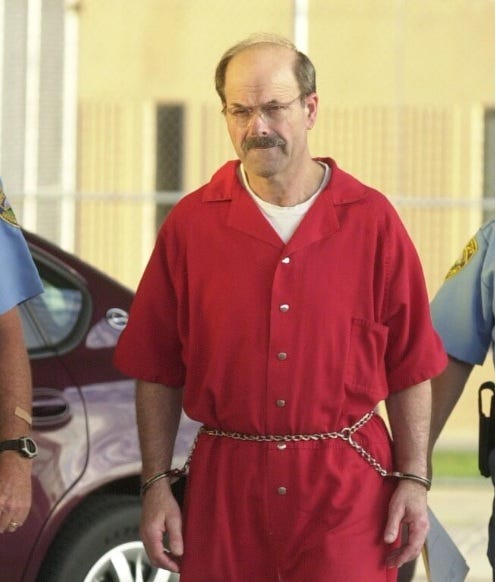
The analysis of digital evidence became a critical discipline. Criminals began leaving digital footprints, and investigators learned to follow them. The BTK serial killer case is the quintessential example of this transition. After a 30-year silence, Dennis Rader (BTK serial killer, “Bind, Torture, Kill”) resurfaced in 2004, taunting police. His critical mistake was sending a floppy disk to a news station, believing that deleting a file would erase his tracks. A forensic examiner recovered metadata from a deleted Word document that pointed directly to “Dennis” at “Christ Lutheran Church,” leading police straight to Rader and ending his reign of terror.
The creation of national databases revolutionized how law enforcement shared information. The Automated Fingerprint Identification System (AFIS) allowed agencies to search and match fingerprints against a massive digital repository in minutes, rather than weeks. Even more transformative was the Combined DNA Index System (CODIS), launched by the FBI in the 1990s. CODIS allows labs to compare crime scene DNA against a national database of convicted offenders and arrestees. This technology has been instrumental in solving thousands of cold cases, linking seemingly unrelated crimes, and exonerating the wrongly convicted.
OSINT and Social Networks
The rise of social media and the proliferation of publicly available information created another seismic shift. The stringboard, once a physical object, was reborn as a digital concept: link analysis.
Investigators could now use software to map vast, complex networks of relationships between people, organizations, and digital entities. This gave rise to Open-Source Intelligence (OSINT), the practice of collecting and analyzing data from public sources like social media (Twitter (X) and Facebook), news articles, court documents and government records to generate investigative leads.
Modern detective shows like Bosch depict investigators leveraging cell phone data, social media, and vast digital records to solve crimes. This reflects the reality of contemporary policing, where a digital trail can be as crucial as physical evidence. The Gilgo Beach serial murders cases went cold for decades, but were cracked by fusing multiple data streams: vehicle registration databases (OSINT), historical Google Maps imagery to place the suspect’s truck at his home, and analysis of burner phones and email accounts that linked the suspect’s real-world identity to his covert online activities.
Social Media’s Unprecedented Role in the Tragic Case of Gabby Petito
The disappearance and murder of Gabrielle “Gabby” Petito in 2021 became a case where the power of social media was on full display, playing a pivotal and unprecedented role in tracking her last known movements and ultimately leading to the discovery of her remains. While traditional law enforcement methods were crucial, the case was undeniably amplified and accelerated by a global community of “internet sleuths” who meticulously pieced together digital clues left behind by Petito and her fiancé, Brian Laundrie. Petito, a 22-year-old aspiring travel influencer, had been documenting her cross-country van trip with Laundrie on Instagram and YouTube. When she vanished in late August 2021, her active social media presence became a digital breadcrumb trail for a concerned public. As news of her disappearance spread, users across various platforms, including TikTok, Instagram, and YouTube, began to dissect her posts, analyzing captions, locations, and the couple’s on-screen dynamics for any sign of trouble. This collective effort proved to be a powerful investigative tool. The intense public scrutiny kept the case in the national spotlight, pressuring law enforcement to dedicate significant resources to the search.
A key breakthrough in the case came directly from social media. A family of YouTubers, the Bethunes, who had been documenting their own travels, realized they had footage of Petito’s distinctive white van parked on the side of a remote road in Grand Teton National Park in Wyoming. They reported their findings to the FBI, providing a crucial piece of evidence that narrowed down the search area. It was in this vicinity that Petito’s remains were later discovered. Law enforcement agencies also leveraged social media to their advantage, using their platforms to share official updates, request public assistance, and debunk false rumors. The bodycam footage from a police officer stop in Moab, Utah, which showed a visibly distressed Petito, was widely circulated online, offering a chilling glimpse into the couple’s troubled relationship and further fueling public interest.
AI Helps in Solving Murder Cases
Now, in 2025, another, perhaps even bigger, change is underway. Artificial intelligence is no longer a futuristic concept; it is an accessible tool that is fundamentally reshaping the landscape of criminal investigation for both law enforcement and the criminals they pursue. For investigators, AI is a powerful analytical partner capable of processing information at a scale and speed no human could ever achieve. AI excels at sifting through immense datasets — from financial records and communication logs to social media activity — to perform link analysis, automatically identifying hidden connections, criminal networks, and key influencers within those networks.
In genetic genealogy, AI helps analyze DNA to find familial links in public databases, a technique that has cracked decades-old cases. In a 2006 triple murder case in Kerala, India, police in 2023 used AI to digitally age old photographs of the suspects, leading to a match on Facebook and their eventual arrest in 2025.
AI can also analyze massive volumes of digital evidence from seized devices, flagging relevant images, videos, or text, saving investigators thousands of hours of manual review. In the landscape of modern criminal justice, particularly in the painstaking work of re-examining cold cases involving missing and murdered women, the primary obstacle is no longer a scarcity of information but an overwhelming surplus. The digital age has transformed the nature of evidence. What was once confined to physical case files — manila folders filled with typed reports, crime scene photographs, and witness statements — has exploded into a vast, nebulous digital universe. An investigation today must contend with a mountain of data scattered across countless formats and locations: court transcripts, arrest records, parole hearings, digitized cold case files from decades past, endless archives of news articles, and the sprawling, ephemeral world of social media.
This is the investigator’s dilemma: the crucial clue that could connect a murder is, in raw data, overwhelmingly “unstructured,” meaning it consists of human language — the narratives of police reports, the testimony of witnesses, and the prose of a news story — rather than the neat, organized rows and columns of a spreadsheet. A simple keyword search, the traditional tool of digital investigation, is profoundly inadequate for this task. It can find explicit mentions but is blind to context, nuance, and the subtle, implicit relationships that form the connective tissue of a complex case. An investigator might search for a suspect’s name and find dozens of documents.
Still, this method cannot reveal whether the suspect’s associate was mentioned in a separate case, or that his vehicle was described in a witness statement from an entirely different crime. The scale of the problem is akin to an investigator standing in a library containing millions of unsorted books, tasked with finding a single, unmarked sentence that links two people who have never been publicly associated. For a human, or even a team of humans, this task is not just daunting; it is a practical impossibility.
This shift from information scarcity to information overload represents a qualitative change in the very nature of investigative work. In the past, an investigator’s primary role was to find scarce clues. Today, the clues are often present but are so deeply buried in the digital noise that they are effectively invisible. Some police departments have reported significant successes after integrating these technologies into their workflows. For example, the Miami Police Department has claimed that the use of AI has dramatically increased their clearance rates for homicides and other violent crimes. According to Assistant Police Chief Armando Aguilar, after implementing AI in 2023, the department solved 68% of murders, up from 45% previously, and 58% of violent crimes, up from less than 38%. These successes are attributed to technology’s ability to help detectives find suspects and connect disparate pieces of evidence much faster than traditional methods would allow.
Cracking Cold Cases: When Time and Data Are the Enemy
Cold cases are a particularly compelling application for AI-driven analysis. By their nature, these investigations are burdened by two significant obstacles that AI is uniquely equipped to overcome: the sheer volume of accumulated data and the passage of time, which scatters evidence and erodes human memory. A case file that has been open for decades can contain a labyrinth of witness statements, forensic reports, old news clippings, and follow-up interviews, making a comprehensive manual review a monumental, if not impossible, task. AI excels at processing these large, historical datasets, identifying patterns, and cross-referencing details that may have been missed by generations of human investigators.
A landmark trial conducted by the Avon and Somerset Police in the United Kingdom vividly illustrates this capability. The force used an Australian-developed AI tool named “Söze” to analyze the complete evidential material from 27 complex cold cases. The AI platform was able to process and structure all of the data — including witness statements, forensic evidence, and surveillance footage — in just 30 hours. The police estimated that for a human analyst to perform the same review would take approximately 81 years of continuous work. Perhaps the most iconic example of technology cracking a decades-old case is that of the Golden State Killer. While the final breakthrough came from the novel application of genetic genealogy, the underlying principle is the same: using computational power to find a single, critical signal within a massive dataset.
Investigators uploaded crime scene DNA to a public genealogy database, GEDmatch, and searched for familial matches among hundreds of thousands of profiles. This allowed them to meticulously construct a vast family tree, a data analysis task of enormous scale, which ultimately led them to Joseph James DeAngelo.
This case serves as a powerful parallel to text-based AI analysis, demonstrating how large-scale data correlation, whether genetic or linguistic, can illuminate pathways to justice that have been dark for decades. It reinforces the idea that many cases are not “unsolvable” due to a lack of clues, but rather “un-processable” by conventional human means. To sum things up, you are about to dive deep into the stories of missing and murdered Springfield women and their connections with people, locations, and time and space with the help of AI.
Connecting the Dots: From Data Points to Relationships — Link Analysis
The phrase “birds of a feather flock together” is a well-known proverb. The phrase is often used when a person’s past experiences and observations hold true in their present observation. In the world of crime and drugs, it’s usually said that “birds of a feather flock together.” This simply means that people involved in criminal activity tend to associate with others who are also engaged in similar activities.
The same holds true for people who watch NFL football. Green Bay Packer fans and Chicago Bears fans are worldwide; location is not a boundary issue that prevents people from being a part of these groups. However, there are boundaries. It would be doubtful if a Green Bay Packer fan would frequent an establishment full of Chicago Bears fans. This type of social behavior (Packer fans intermingling with Bears fans) has restricted societal and social boundaries; to put it bluntly, you would not see many Green Bay Packers fans in the social circles of Chicago Bear fans.
So, it wouldn’t be a stretch to assume that people in Springfield naturally seek out others who are in the same societal, social and locational circle to share similar interests, even if those interests are dangerous or illegal. Commonly, people learn from their social circles. If someone’s friends are involved in crime or using drugs, they are far more likely to adopt those behaviors themselves through observation and peer pressure. This tendency for criminals and drug users to form their own social groups has serious consequences. Being in such a group makes illegal activities seem normal and acceptable, which increases the chance that a person will get involved or go deeper. The group reinforces these dangerous behaviors, and being part of the network provides more opportunities to commit crimes and get access to drugs. Understanding these social connections is critical in missing person cases, as an individual’s circle of friends often holds the key to figuring out what happened to them. As you will read throughout this Substack, the use of AI and Social Network Analysis (SNA) will be used to understand the time and space of relationships. Social Network Analysis (SNA) is built on a simple idea: people’s actions are heavily influenced by the company they keep. This is especially true in the criminal world, where offenders are often part of a larger network of associates who also break the law.
Instead of focusing solely on individuals, Social Network Analysis prioritizes the relationships between people as the most important clue. It gives researchers a powerful tool to identify, map out, and measure the patterns of these connections. By charting who knows whom, who talks to whom, and who was seen with whom, one can turn a confusing web of individuals into a clear map of the entire group.

In this Substack of 50+ unsolved murders and missing women, we will demonstrate the clear path as to who the key players are and understand how a criminal network, from a small, organized shoplifting ring and drug users, ties into prostitution as well as drug trafficking.
It’s important to note that there are years of research behind these methods. The principle of homophily explains that individuals tend to form connections with others who are similar to themselves, whether in age, gender, race, or, in this context, deviant behaviors like drug use or criminal activity. Additionally, Social Learning Theory suggests that people learn behaviors through observing, imitating, and modeling others, especially within their social networks. In the context of drugs and crime, associating with delinquent peers who use drugs and engage in criminal activities can increase an individual’s likelihood of adopting these behaviors. The social network charts detailed in this book will show individuals with an increased risk of involvement leading to violent harm and sometimes death. Surrounding oneself with individuals who use drugs or engage in criminal acts can normalize these behaviors, making them seem more acceptable or even expected, leading to a greater likelihood of participation in criminal activities. Within such social circles, drug use and criminal behavior can be reinforced through shared experiences and group identity, potentially escalating an individual’s involvement in crime.
Based on the research, these criminal networks and peer groups were involved in drug use and had access to illicit substances as well as opportunities to engage in related criminal activities. Real-world cases demonstrate how Social Network techniques move beyond academic exercises to become indispensable tools for solving the most challenging homicides and missing person investigations.
Case Study: The Brittney Gargol Murder (SOCMINT as the Smoking Gun)
In March 2015, 18-year-old Brittney Gargol was found murdered on the side of a road in Saskatchewan, Canada. The investigation quickly focused on her friend, Cheyenne Antoine, who was with her on the night she disappeared. The pivotal piece of evidence came not from a traditional crime scene but from Facebook. Investigators discovered a selfie that the two women had posted just hours before the murder. In the photo, Antoine was wearing a distinctive black belt. This belt was a visual match for the ligature marks found on Gargol’s body and was ultimately determined to be the murder weapon. Confronted with this undeniable digital link between herself, the victim, and the weapon at the time of the crime, Antoine confessed. She was later convicted of manslaughter. This case is a stark illustration of how a single piece of social media intelligence can provide the direct, irrefutable link needed to solve a homicide.
Case Study: FBI Convenience Store Robberies (SNA Revealing Hidden Conspirators)
This case, detailed by the FBI as an early success of its Social Network Analysis program, highlights the method’s power to uncover larger conspiracies. Investigators in one precinct were looking into a series of convenience store robberies and had a person of interest. A crime analyst used SNA software to map this individual’s known criminal network. The resulting sociogram revealed a previously unknown connection to a member of a separate criminal network being investigated by another precinct. Using these two individuals as new “seed” nodes, the analyst generated a combined network map. This new visualization exposed a hidden group of associates, identified a new primary suspect who was linked to both sets of robberies, and demonstrated that what were thought to be disconnected crimes were, in fact, part of a coordinated series. This exemplifies the core value of SNA: to discover the non-obvious relationships that connect seemingly disparate criminal acts.
Case Study: The Green River Killer (SNA for Re-evaluating Cold Cases)
The investigation into the Green River serial murders, which spanned decades, serves as a powerful academic case study for the tactical application of SNA in cold cases. Researchers have constructed an “affiliation network,” a type of sociogram that links people not to each other directly but to the locations they frequent (e.g., bars, parks, workplaces). By mapping the known victims and suspects to the places they were associated with, the analysis revealed intersecting behavioral patterns. When the network was analyzed at different points in time, the centrality of various suspects shifted dramatically. The study suggested that the investigators’ initial working hypothesis had led them to focus on the wrong individuals. At the same time, another suspect, Gary Ridgway, showed increasing centrality in the network over time. This demonstrates the use of SNA not merely to confirm existing leads but to critically challenge investigative assumptions and redirect resources, a function that is invaluable when a complex case has gone cold.
So, what information was accessed to build SNA case studies in Springfield, and how was it used? The deep dive began with arrest records, traffic and criminal court records, news media reports, and internet searches (i.e., obituaries, marriage and divorce files, child custody, tax liens, property ownership, and civil cases). The study collected social media from Facebook and Twitter (now X) account information. The social media accounts were the most time-consuming due to the very nature that most of the subjects have a “ton” of friends and followers due to the business of drug and criminal activity. For every woman who vanished in Springfield and for every murder that remains a cold case, a complex web of human connections was left behind, a silent, invisible architecture of relationships.
In this Substack, it is essential to recognize that traditional investigative methods, which follow a linear path and pursue individual leads one by one, have not been effective. This Substack introduces a new lens through which to view these tragedies: Social Network Analysis (SNA) and Artificial Intelligence (AI). By shifting the focus from isolated individuals to the intricate network of relationships that surround them, the Substack begins to map the social ecosystems where clues and culprits lie hidden. The fundamental question we sought to answer was how and why these people are connected and what, if any, role they played in our subjects being murdered or missing.
Most importantly, who were the people involved in these dangerous, social worlds these women navigated, and are they still lurking in Springfield?
Case File 2.2 turns from the city to the system — and to the year that passed before anyone with a badge wrote Amber Whitmer’s name on a missing-person report.
Disclaimer
Unsolved Ohio reports from public court records, official registries, documented media reports, on-record interviews, and open-source analysis using Artificial Intelligence and Social Network Analysis. A documented association between two people is a starting point for investigation — never proof of a crime — and naming anyone as a subject of investigative interest is not an accusation of guilt; any person not convicted of a specific crime is presumed innocent. This is an educational publication and not legal advice; read our full sourcing standard, presumption-of-innocence framing, and corrections policy in our Disclaimer.