



This installment introduces the investigative framework for Amanda Ward-Romine’s case. It names Daniel M. “Danny” Romine, who is deceased and was designated a suspect by the Springfield Police Division; no living person is accused of a crime here. The eight theories, the references to Amanda’s family, and the systemic questions raised about local law enforcement are investigative hypotheses and avenues drawn from public records and documented research — not findings, and not accusations against any named individual. Anyone named in a theoretical or statistical context, including Amanda’s family, is presumed innocent; a documented association or a statistical pattern is never proof of a crime.
Unsolved Ohio reports from public court records, official registries, documented media reports, and open-source analysis using Artificial Intelligence and Social Network Analysis. This is an educational publication and not legal advice — read our full sourcing standard, presumption-of-innocence framing, and corrections policy in our Disclaimer.
The Suspect
In the ongoing investigation into the disappearance and death of Amanda Ward-Romine, the status of her husband, Daniel M. “Danny” Romine, is distinctly classified by law enforcement and separates him from other individuals in the case periphery.

Daniel M. Romine is officially considered by the Springfield Police Division a suspect in the disappearance and homicide of his wife, Amanda Ward-Romine.
Unlike peripheral figures whose documented criminal histories merely place them in the ambient geographic or social network of the victim, Daniel Romine’s connection to the case is direct, central, and formally recognized by investigating authorities. Based on his intimate proximity to the victim, their established domestic history, and the timeline surrounding her vanishing, investigators have actively designated Daniel Romine as a suspect.
As her husband, his actions, movements, financial motives, and known associations during the critical window of Amanda’s disappearance remain a foundational focal point of the homicide investigation. While Daniel Romine’s subsequent death precludes formal prosecution, his official classification as a suspect remains a critical element of the open case file and the ongoing pursuit of definitive answers regarding the fate of Amanda Ward-Romine.
Eight Theories
As we begin our next case, we again build a comprehensive investigative framework for Amanda Ward-Romine. Every serious investigation begins by identifying every reasonable explanation for a person’s disappearance before the evidence begins eliminating them one by one. These eight theories need to be organized by their proximity to the victim, categorized by network proximity and the specific investigative focus required for each.
The Inner Circle (Highest Statistical Probability)
Historically, violence and concealment are perpetrated by those who share the tightest physical and emotional spaces with the victim.
The Husband / Intimate Partner: Statistically, this is always the primary vector of investigation. Intimate partner violence rarely results in spontaneous disappearance; it follows a predictable escalation. The focus here is identifying the precipitating event — was there a recent separation, an escalation in control tactics, or a financial rupture just prior to her disappearance?
Sororicide: While statistically the rarest form of intrafamilial homicide, it becomes highly relevant if the sisters were operating in a “closed psychological system.” The investigation must look for a failed separation, a toxic “parasite and host” caretaking dynamic, or a sudden, explosive dispute over scarce resources or weaponized family secrets.
The Underworld and Systemic Vectors (High Network Exposure)
If Amanda’s lifestyle included substance abuse, her risk profile expands significantly into networks that operate outside standard legal protections.
Concealed Drug Overdose: In communities heavily impacted by heroin and fentanyl, fatal overdoses are common. However, if she overdosed in the presence of others, particularly in a trap house or alongside individuals with active warrants, panic often dictates the next move. Co-users will frequently move and conceal the body to avoid drawing law enforcement to their location.
Drug Debt or Witness Elimination: Using link analysis, the objective is to map Amanda’s narcotic network. Was she a low-level user, or did she hold debt with apex nodes in the local drug trade? Alternatively, in the highly paranoid environment of illicit drugs, being perceived as a “snitch” — or simply witnessing a transaction or violent act she shouldn’t have — can instantly make someone a target for elimination.
Law Enforcement Involvement: Given the documented history of Springfield PD and Clark County Deputies abusing vulnerable women, this systemic threat cannot be ignored. Marginalized women are frequently targeted by predatory authority figures because their lifestyle makes them “less dead” in the eyes of the system. This requires a forensic audit of dispatch records, GPS cruiser logs, and identifying officers with a history of sexual misconduct or excessive force complaints.
The Periphery and the Unknown (Lower Probability)
These theories involve external actors or completely independent actions, making them harder to track but vital to keep on the board.
Serial Killer / Target of Opportunity: If Amanda was walking alone, soliciting, or hitchhiking, she became a highly vulnerable target of opportunity. This requires geographic profiling — cross-referencing the location she was last seen against the registered addresses of violent sex offenders and looking for clustering with other missing women in the immediate region.
Random Homicide: A purely random act of fatal violence by a stranger with no prior stalking or sexual motive. This is exceedingly rare unless the victim inadvertently stepped into a volatile situation — for example, walking into a robbery in progress.
Voluntary Disappearance: The “fresh start.” While common in the 1970s, establishing a new life completely off the grid today is incredibly difficult without a well-funded support network. Proving this requires auditing her digital footprint: looking for untouched bank accounts, abandoned social media, and a complete cessation of her Social Security number activity.
“Experience is simply the name we give our mistakes.” — Oscar Wilde
The peddlers of modern tragedy — the voices humming through car stereos on morning commutes, the slickly produced documentaries flickering in darkened living rooms — prefer their horrors drawn with a ruler. They chart a life with the comforting, unyielding geometry of a straight line. Here is the birth; here is the childhood; here is the first stumble, the long fall, and the final, bloody punctuation mark. As the line stretches across the screen, it gathers little points of light: an eviction, a bruised cheek, a police siren in the dead of night.
It is a tidy narrative, relying on a fundamental, if unspoken, assumption: that the subject was ever traveling the same road as the rest of us. It assumes a progression mapped by Erik Erikson — a normal staircase of human development, where psychosocial crises are met and resolved, where trust is built, and identity is forged in the warm fires of community.
But deviance does not walk a solitary, straight path. There is an architecture to ruin, and it is rarely built alone.
When Jimmy looks at the evidence board, eyes narrowed by 35 years of pulling the truth from the shadowed, violent corners of the world, he doesn’t see a single line. And when Beth, carrying the weight of a city’s broken families and generations of trauma, lays out the sociograms, the fallacy of the singular timeline dissolves entirely. What they see in the case of Amanda Ward-Romine, and the forty ghosts that follow her, is a sprawling, interwoven tapestry of parallel lines.
Amanda did not exist in a vacuum. To tell her true story is to align her timeline with those who walked beside her — the accomplices, the lovers, the transient friends who shared her orbit. If you lay these lives side-by-side, ignoring the dates on the calendar and instead aligning the dark milestones, a terrifying synchronization emerges. Point for point, they match. The exact hour the subjects leave home for the first time; the first sting of a needle; the first metallic click of handcuffs for soliciting; the first desperate shoplift. Through time and space, these points of interest line up with a cold, mathematical precision.

To understand Amanda, one must abandon the comforting milestones of a “normal” life and adopt a new cartography — a map of how antisocial, violent, and criminal behavior begins, metastasizes, and sometimes, tragically, ends.
It begins, as Lonnie Athens observed, in the crucible of Brutalization. Amanda’s timeline, and the timelines of those who drifted into her gravity, were stained early. They were not children navigating Erikson’s crisis of industry versus inferiority; they were subjects of severe trauma, witnessing violence at the hands of those meant to protect them. This is the first parallel point. It breeds Belligerency, a dark epiphany where the child realizes that to survive the wolves, one must bare their own teeth. When Amanda and her cohort engaged in their Violent Performances, testing their aggression against a world that had only ever offered them the back of its hand, they were stepping into Virulency — embracing a fearsome, offensive identity just to maintain control over their chaotic lives.
Yet, as the parallel lines stretch forward, they begin to fray and separate, revealing the dual pathways Terrie Moffitt so clearly defined. In the accomplices that faded away, we see the Adolescence-Limited offenders — the teenagers caught in the maturity gap, stealing and fighting to mimic adulthood, only to eventually age out, anchored by the responsibilities of jobs and quiet lives. But Amanda’s line, and the lines of those she remained tethered to, were Life-Course-Persistent. Their deviance was sown deep in the soil of early childhood, an inescapable trajectory that only accelerated as the years compounded.
You can trace the escalation of their survival tactics through Rolf Loeber’s pathways. You see the Authority Conflict in their early truancy records, the Covert pathway in the shoplifting and the quiet, desperate thefts, and finally, the Overt pathway, where the quiet sins erupt into public, physical violence.
The tragedy of Amanda Ward-Romine is not just in the crimes committed or the final, inevitable point of her line. The tragedy lies in the spaces in between, in the missed exits mapped by Robert Sampson and John Laub. Their theory of informal social control searches for Turning Points — a stable marriage, a tour of military service, a steady paycheck — that might sever a criminal trajectory and build a bridge back to the sunlit world.
For Amanda, and the parallel lives bound to hers, those turning points were mirages. As we trace her life, we will not look at a single string pulled taut. We will examine the entire, tangled knot. We will align the first arrests, the first betrayals, and the final sightings of her accomplices and lovers next to her own, reading the synchronized heartbeats of the damned. Only then, in the reflection of the lives that burned alongside hers, can the true story of Amanda Ward-Romine be told.
The Family She Came From
Before testing any investigative theory, we must first understand the social network from which Amanda emerged: the marriages and divorces of Amanda’s biological mother, her biological father, her two sisters Aliya and Karla, and her brother Bruce.
Harvard researchers Sheldon and Eleanor Glueck conducted the foundational studies on life-course criminology in the 1930s and 1950s. In their landmark work Unraveling Juvenile Delinquency, the Gluecks argued that family environment is the single most important predictor of criminal behavior. Criminologist Travis Hirschi did not ask why people commit crimes; he asked why they don’t — and answered that strong bonds to society keep people in line. Sociologist and criminologist Robert Agnew, in General Strain Theory, provided the psychological “why” behind the bad behavior that follows a family split. Agnew categorized the “loss of positively valued stimuli” (a parent leaving the home) and the “presentation of negative stimuli” (parental conflict, custody battles, financial stress) as major strains. When a child lacks healthy coping mechanisms to deal with the anger generated by the divorce, they turn to externalizing behaviors — substance abuse, fighting, or delinquency — to manage the emotional pain or lash out at the source of their strain.
Could a Family Member Have Killed Amanda?
In the next installment we ask the reader a hard question: is it possible a family member killed Amanda? Charles Patrick Ewing, a forensic psychologist who authored the 1997 book Fatal Families: The Dynamics of Intrafamilial Homicide, dedicates a chapter to fratricide and sororicide — the killing of a brother or sister. Siblicide is consistently identified as one of the rarest forms of family homicide, accounting for roughly 2% of all intrafamilial murders. Within that small margin, a sister killing a sister is the absolute rarest combination. Ewing and other forensic researchers note that when sororicide occurs, the perpetrator is predominantly male (a brother killing his sister).
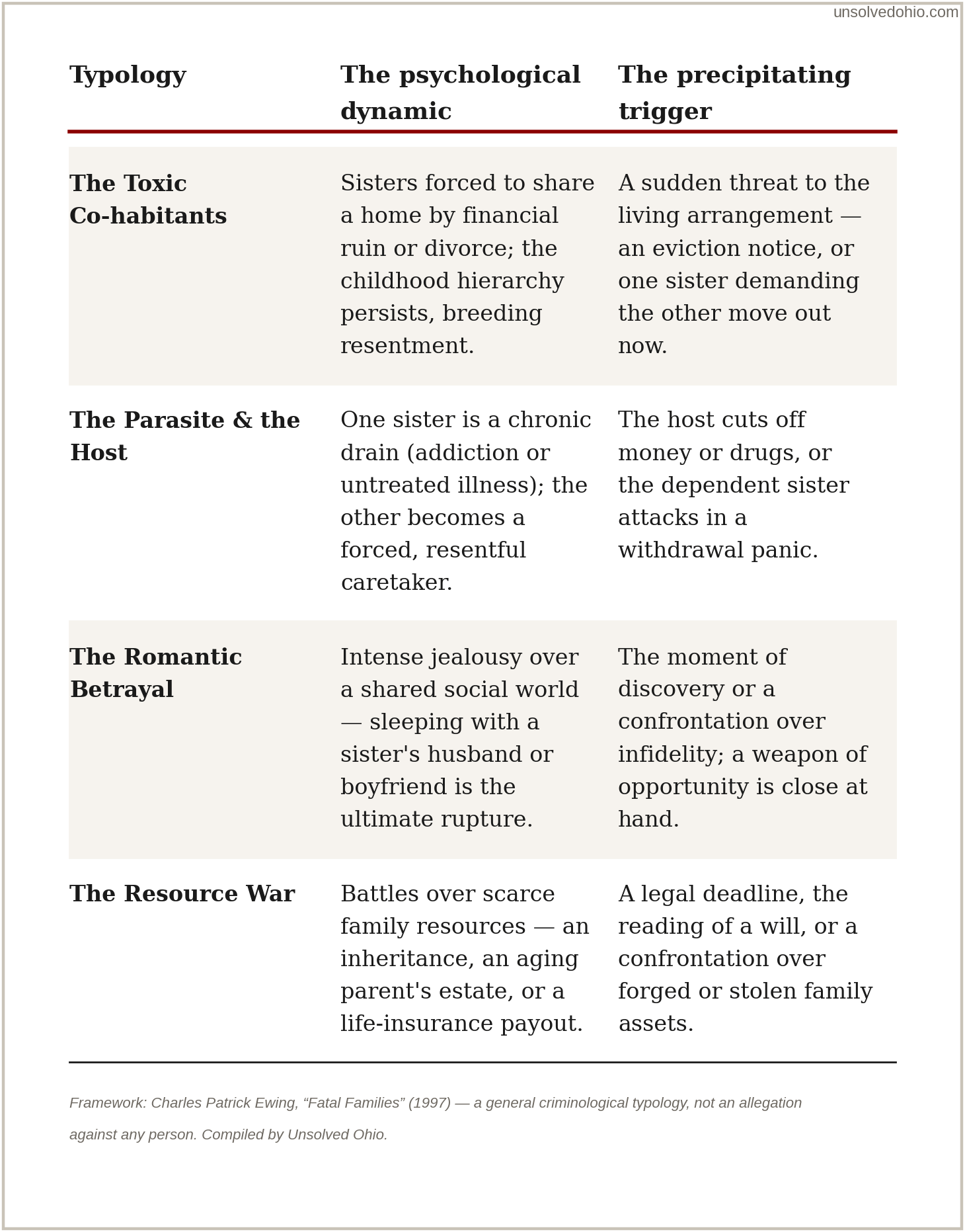
When a female does kill her sister, Ewing’s case studies reveal that it is almost never a random or spontaneous event. Instead, it is the culmination of deep-rooted, long-standing pathology within the home. When examining sororicide specifically between women aged 25 and 40, the criminological profile shifts dramatically from juvenile cases. Because adult women rarely commit premeditated murder for thrill or stranger-violence, adult sororicide in this age bracket is typically the volcanic eruption of a long-simmering, highly toxic enmeshment.
This is where the case begins. The next installment turns to the family Amanda came from, and the question the statistics force us to ask. Subscribe now to follow the Amanda Ward-Romine investigation from the beginning — and read the full, continually updated case file at unsolvedohio.com.