



This is part of the Amber Whitmer case file — start at the hub: Amber Marie Whitmer. This installment tests one of the six questions from The Black Hole.
This installment presents a theory built from the public record and the authors’ analysis. It names no person as responsible for Amber Whitmer’s disappearance. Everyone mentioned is presumed innocent of anything not adjudicated, and any individual named as deceased is noted as such. See our full Disclaimer.
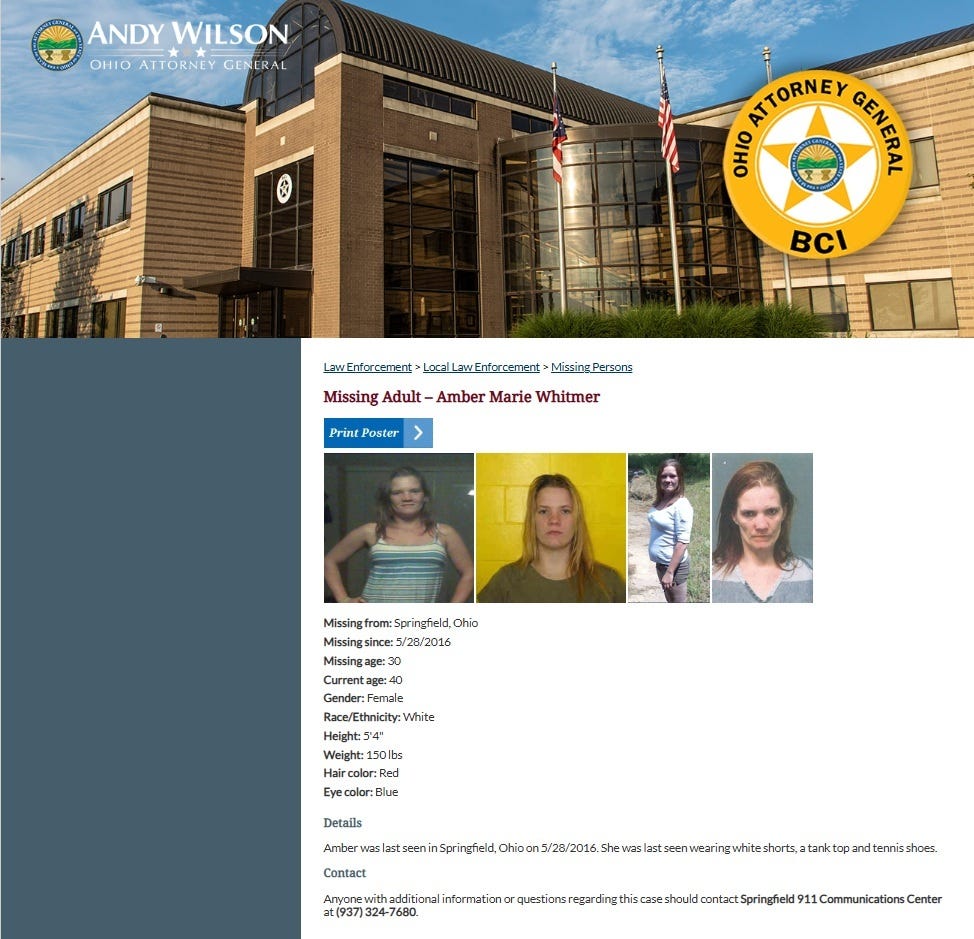
Theory 4: Voluntarily Left the Area
Investigative probability (the authors’ assessment): Low to Moderate.
Springfield, like many places where the industrial promise long ago rusted away, can feel less like a home than a trap. When someone vanishes from its gray geography, the mind drifts to the violent and the predatory — foul play, an overdose in a shadowed room, the quiet horrors of trafficking. Those are the expected endings here.
But there is another corner worth exploring — one that asks not what might have been done to Amber Whitmer, but what Amber might have chosen to do for herself. What if she simply walked away? Not out of malice, but because the weight of her reality had become too heavy to carry.
An inheritance of chaos
Amber was a child of a particular midwestern despair — a lineage touched by generations of chemical dependency, the names Boysel and Crosby recurring like mile-markers along a well-worn road of addiction, and a childhood spent in houses where, as the authors put it, children are not raised so much as seasoned: taught early that relationships are fragile, that security is a myth, that tomorrow is just another version of today’s emergency. (That family map is drawn in Before Springfield and The Family of Risk.)
By 2016, Amber was thirty — her documented life on Springfield’s streets already a decade deep — entangled in a subculture of crime, hard habits, and dangerous men, living on the absolute periphery of a respectable life. Every addict eventually reaches an intersection where the road splits sharply; some call it rock bottom. For most that cliff is terminal, but for a few it brings a strange, desperate clarity. In Clark County, places like McKinley Hall offered a ladder out — and any counselor there will tell you the first commandment of recovery: change your playground and change your playmates. To stay sober in the same alleys where you got high is nearly impossible.
Perhaps, at her mother’s birthday gathering just before she vanished, Amber looked around and understood that the air in Springfield had turned toxic. A woman with her history has a finely tuned radar for incoming disaster — and the disaster was coming. Prentiss Hare had already begun the violence that would shock the community; not long after Amber disappeared, a woman named Lacie Henry — tied to the same unstable world — was shot and killed in December 2016. It is plausible Amber saw the storm and ran before the rain.
The case against a planned escape
The physical facts push back hard. Amber owned no car. The courts had stripped her license. To leave Springfield she would have needed a confederate, a bus ticket, or a thumb on the interstate. Yet the geography of her family offered distant doors: her grandmother’s sprawling clan reached to California and Arizona (the same California-to-Ohio line traced in Before Springfield). Did Amber quietly call a distant relative and beg for a lifeline?
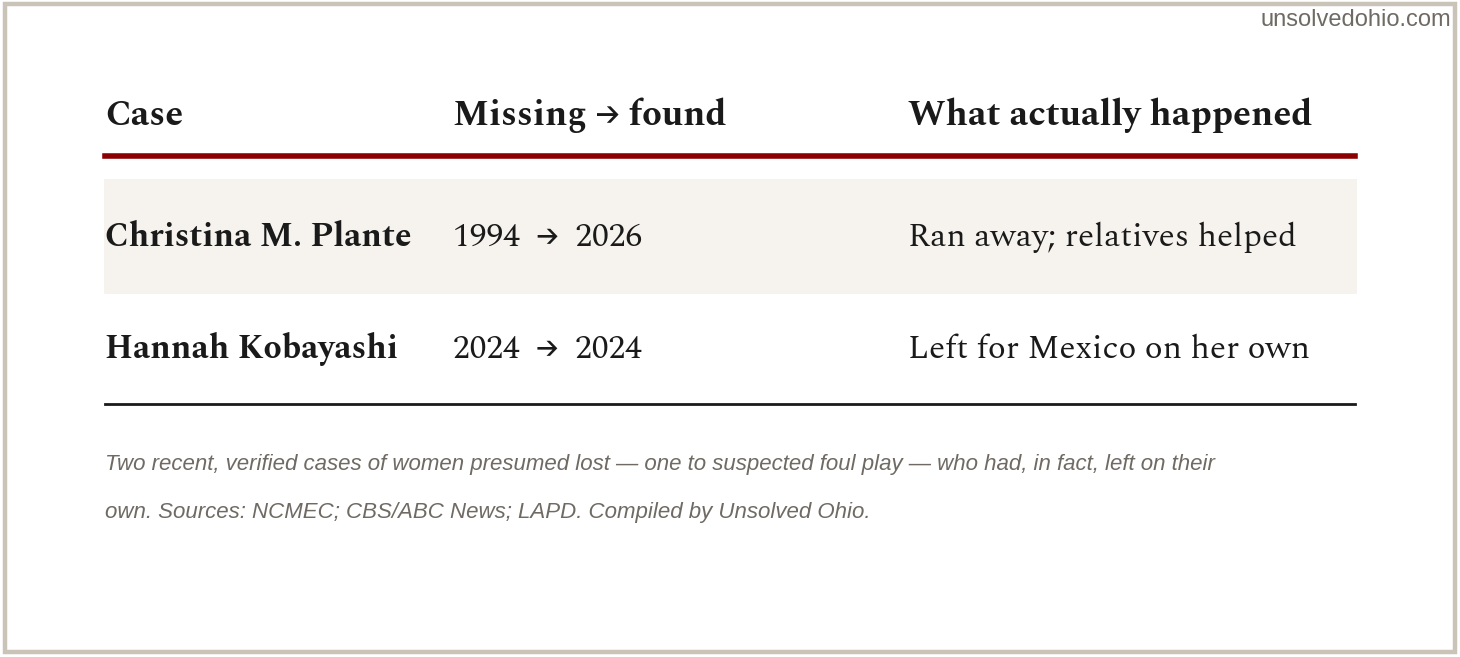
History is full of ghosts who chose to reappear elsewhere. In 2026, an Arizona woman named Christina Marie Plante — who had vanished at thirteen in 1994, her disappearance treated as suspicious and possibly foul play — was found alive at forty-four; investigators concluded she had run away, with the help of relatives she’d quietly stayed in contact with. In 2024, after a massive search, the Los Angeles police determined that Hannah Kobayashi had simply walked across the border into Mexico and set down her old life; she resurfaced, safe, weeks later. And beyond the individual cases there are the deliberate machineries — domestic-violence shelters and underground survivor networks built to make hunted women invisible to the people looking for them.
The great stumbling block
Here the theory nearly collapses. Nearly ten years have passed. In 2026 — the AI-and-database age — people who flee almost always leave a footprint: a job application, a clinic visit, a routine traffic stop, a fresh profile under a pseudonym. Something usually slips through. For Amber, there is nothing. Only a vast, echoing void.
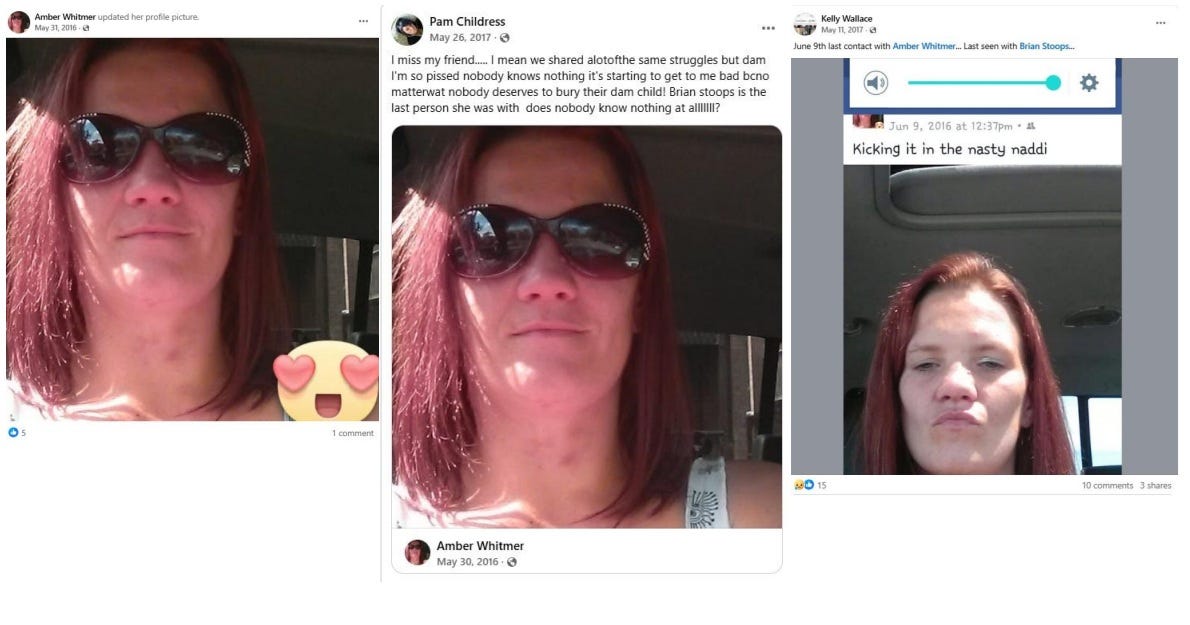
“If I were forced to wager on the fate of Amber Whitmer,” one of the authors writes, “I would set the odds of a voluntary escape at fifty-to-one.” It is a long shot — a romantic notion born of our preference for a living runaway over a hidden grave. It is highly improbable. But in the strange, dark catalog of human disappearances, it remains a door we cannot completely lock.
If you have information about Amber Whitmer’s disappearance, submit it at unsolvedohio.com. Your name will never be published without your explicit written permission.
Amber Whitmer was last seen May 28, 2016. She has not been found.