



This is part of the Amber Whitmer case file — start at the hub: Amber Marie Whitmer. This installment tests one of the six questions from The Black Hole.
This installment names individuals whose public records, documented histories, and proximity to Amber Whitmer’s world place them within the investigative scope of this case. No one named here has been charged in connection with Amber’s disappearance, and everyone is presumed innocent unless and until proven guilty. Convictions are stated as such, with citation; charges that did not end in conviction are identified as charges. Every fact is drawn from public court records, official investigations, or documented reporting. The purpose is to generate investigative leads, not verdicts. See our full Disclaimer.
Theory 3: Kidnapped for Trafficking
Investigative probability (the authors’ assessment): High.
There is a geometry to human ruin. Looked at closely, the scattering of lost women across the Rust Belt reveals itself not as chaos but as a design. In the spaces between Springfield and Portsmouth, Ohio, the disappearance of Amber Whitmer in May 2016 stops being a solitary mystery and becomes a predictable node in a pattern — a tragedy an ecosystem built for predators was primed to produce.
To understand Amber’s fate, set aside the image of the random, solitary stranger. The darker possibility is a story of supply chains, spatial overlaps, and the commerce of human beings. The questions hang in the air: Was Amber recruited? Was Amber sold? Or did she simply know too much about the pipeline that ran between Circleville, Portsmouth, and Springfield?
The spider in the courthouse
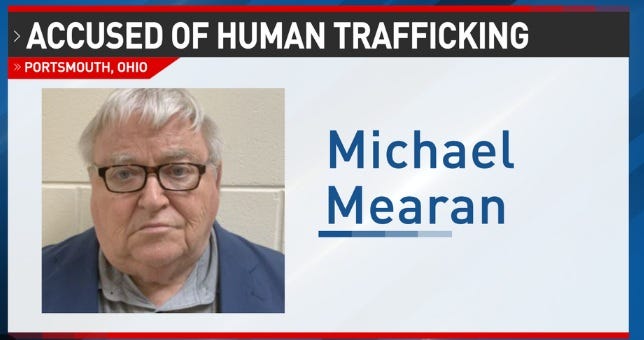
Every web has a center. In this regional narcotics-and-prostitution enterprise, the authors place that center at an attorney named Michael Mearan — a former Portsmouth city councilman who, according to FBI affidavits and investigative reporting, operated behind the veneer of the law. The documented allegation is that he used legal representation, housing, and money to recruit vulnerable women — women drowning in the opioid epidemic, with legal trouble and dependency — and, with an associate, scheduled them for sex with regional clients said to include businessmen, correctional staff, and a local judge, sometimes moving them interstate.
The fuel for a machine like that is narcotics. The authors identify the supplier as Mark Eubanks (”Flex”), operating out of Columbus, who distributed heroin, oxycodone, and steroids to regional dealers. In October 2016, the U.S. Attorney’s Office for the Southern District of Ohio dismantled Eubanks’s network: Eubanks pleaded guilty to conspiracy to distribute heroin and was sentenced to 150 months in federal prison — a matter of public record, stated as fact.
Mearan’s reckoning took longer. In October 2020, Ohio Attorney General Dave Yost and Scioto County Prosecutor Shane Tieman announced an 18-count felony indictment against the then-74-year-old attorney — charges spanning 2003–2018 and six alleged victims, including engaging in a pattern of corrupt activity, trafficking in persons, and compelling prostitution. He maintained his innocence, posted bond — and died in November 2021, before he could stand trial (which had been set for January). He was never convicted. As Yost noted at the time, he at least died publicly charged, which afforded his alleged victims the dignity of being believed.
The women who walked the path first
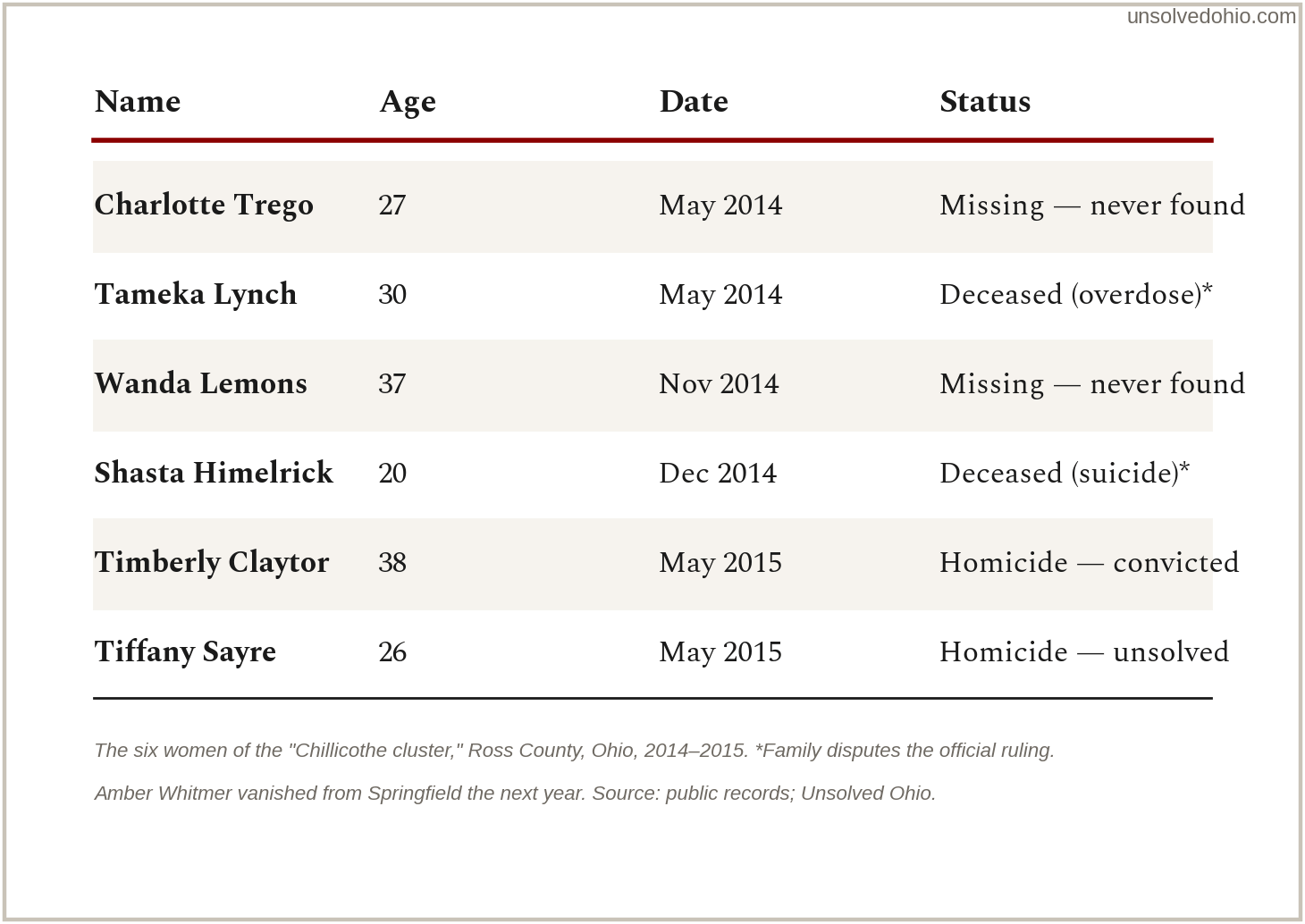
Before the web unraveled, the authors argue, it consumed. To gauge the danger facing Amber in May 2016, look at the women who came just before her — all sharing her demographic vulnerabilities.
Megan Lancaster (25) — a mother, disappeared from Portsmouth in April 2013; her car was found abandoned at a fast-food restaurant. Never located.
An unnamed woman — found deceased in Scioto County on July 17, 2013; cause of death, multiple traumas.
Charlotte Trego (27) — vanished May 2014; whereabouts unknown.
Tameka Lynch (30) — disappeared and found deceased in May 2014 on a Paint Creek sandbar; ruled a multiple-drug overdose, a finding her family disputes.
Wanda Lemons (37) — a mother of five, missing since November 2014; never located.
Shasta Himelrick (20) — pregnant, disappeared December 2014; recovered from the Scioto River in January 2015; ruled a suicide by drowning, which her family contested.
Timberly Claytor (38) — found deceased in Massieville in May 2015; homicide by gunshot. A man, Jason McCrary, was convicted of her murder (stated as fact).
Tiffany Sayre (26) — a mother of two, vanished May 2015, found in June 2015 in a Highland County creek; ruled a homicide.
This was the machinery already running in southern Ohio when Amber vanished from Springfield in May 2016. She was, in the authors’ phrase, walking onto a stage already soaked in blood.
The geometry of Kinnane Avenue
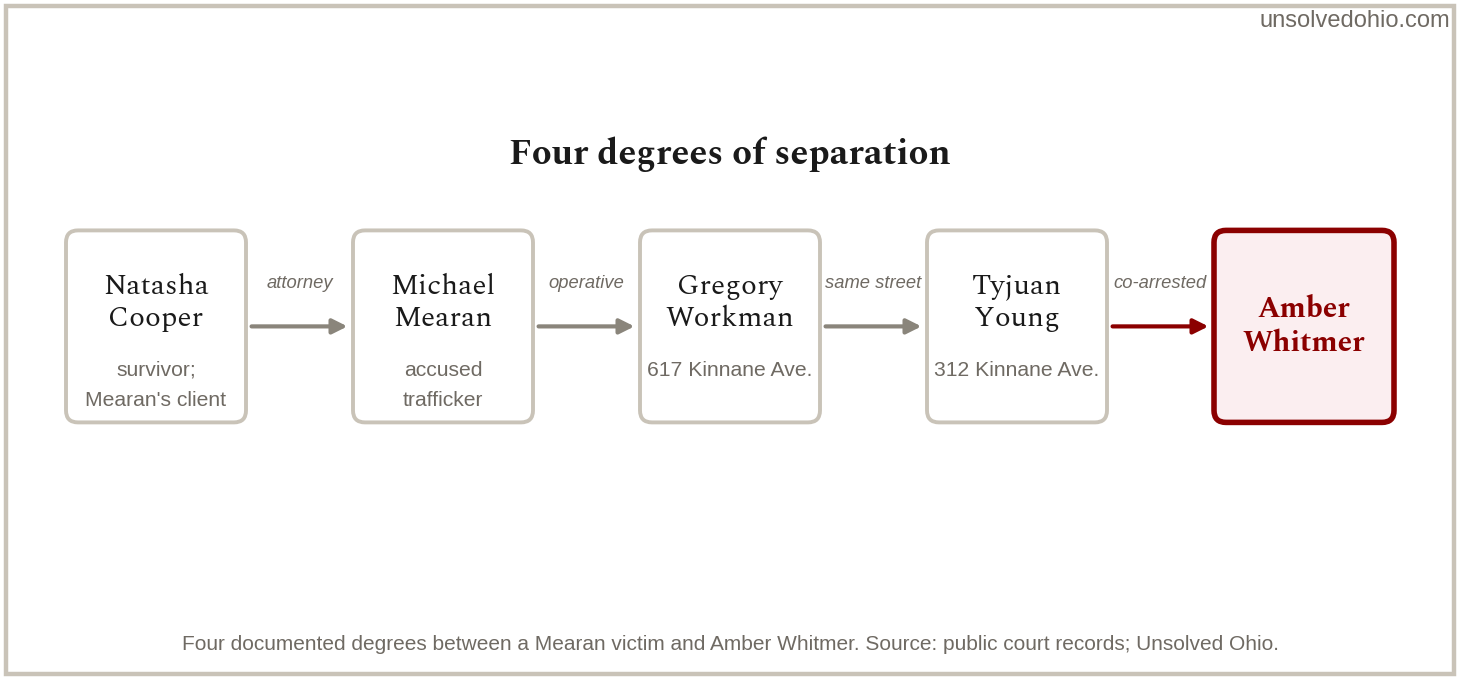
How does a Springfield woman fall into the orbit of a Portsmouth attorney’s ring? In network terms, distance is measured not in miles but in degrees of separation — and the authors map the connection to a single Springfield street.
At 617 Kinnane Avenue, records tie an address to Gregory Workman, described as a convicted heroin dealer said to have operated as a Springfield extension of the Mearan network. A few doors down, at 312 Kinnane Avenue, lived Tyjuan Young — a violent figure in Amber’s immediate circle and her co-defendant in her final arrest.
A figure from the Mearan-linked investigation and a figure from Amber’s personal network, operating on the same short street — that overlap is the bridge the authors read as a direct vector between Amber and the enterprise.
The same street pulls in Natasha Cooper (also recorded as Natasha Ward), a Portsmouth woman whose court records identify her as a Michael Mearan victim — even as Mearan repeatedly served as her defense attorney, once driving from Chillicothe to represent her on a misdemeanor. Cooper survived. In 2024 she testified before the Ohio Senate in support of Senate Bill 214, which lets trafficking survivors seek to expunge records they acquired while being exploited: “I have multiple felonies that I received during my exploitation… How could the state that asked for my testimony to convict my trafficker withhold an expungement from me?”
A convergence of playbooks
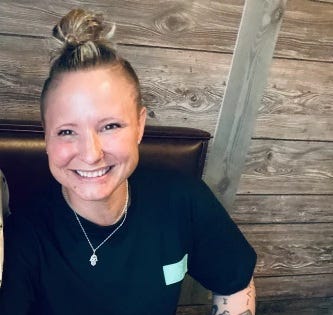
The theory is not that a stranger took Amber in the night, but that she stood at the convergence of several predatory systems at once. Her life in survival sex work made her a target for exploitation — the authors point to documented associates like Robert Cobb Sr. (a long Clark County arrest record) and Key’audi Wilcoxson. Her place in the drug economy put her within one degree of violent figures like Tyjuan Young — and, through him, of the man the authors call the “witness eliminator,” Prentiss Hare (convicted of two Springfield murders). And the Portsmouth pipeline had both the reach and the motive to move — or silence — a woman like her, especially one who might be a witness. Twenty miles north of Chillicothe sits Circleville, where Amber’s own family tree begins — and where, the state would later prove, some of her own relatives ran a drug-trafficking ring of their own.
In an ecosystem defined by trafficking and federal narcotics cases, a marginalized, addicted woman is a liability — a potential witness whose permanent silence protects the enterprise. Amber’s vulnerability made her the perfect target, and the lost year proved the chilling corollary: she could vanish and go uninvestigated by the very system meant to protect her.
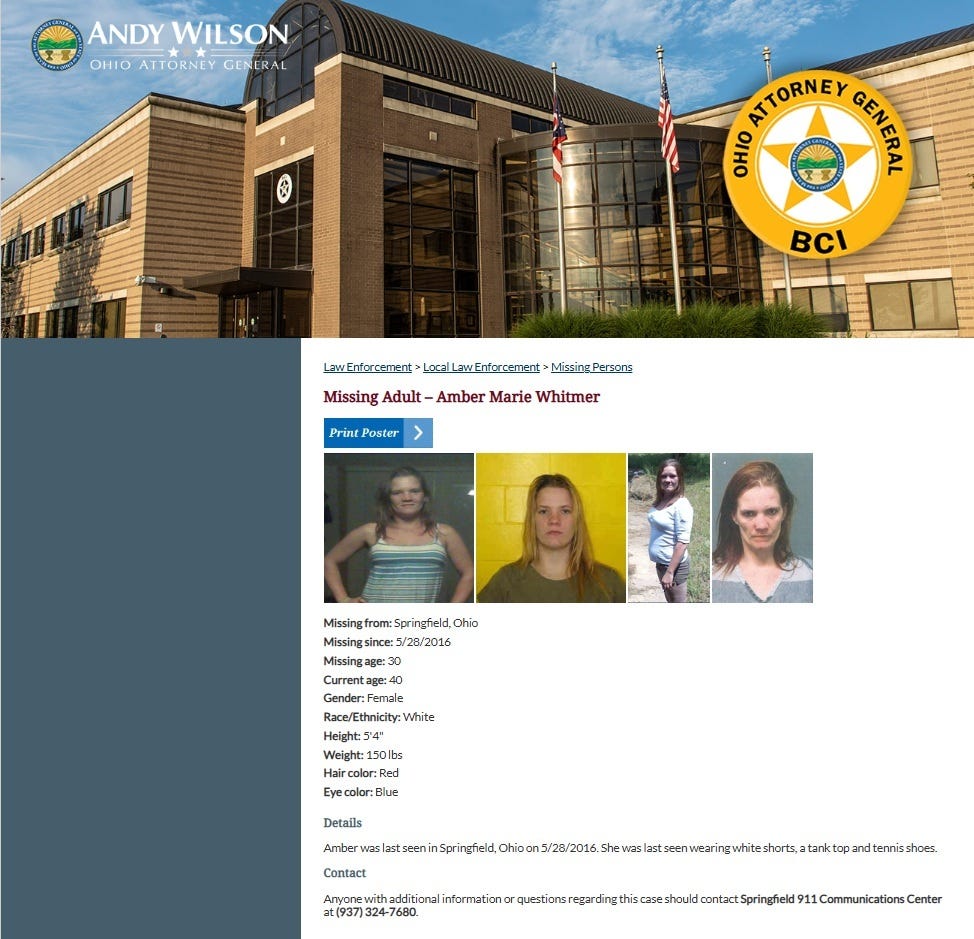
What remains open
This theory rests on documented proximity, overlapping networks, and pattern — not on any charge, confession, or physical evidence tying a specific person to Amber’s disappearance. What would move it toward fact: the lost cell-phone and location data; testimony from any surviving figure in the network; or a body. Until then, it is exactly what it is labeled here — a theory, and one of six the case must weigh.


If you have information about Amber Whitmer’s disappearance — or about any of the women named here — submit it at unsolvedohio.com. Your name will never be published without your explicit written permission.
Amber Whitmer was last seen in May 2016. She has not been found.